
 Local elections in France have been a disaster for the presidential party
Oksana Mitrofanova, Julien Plouchart
The local elections in France were special. In early 2020, politicians and journalists believed that this event would be a kind of election test for President Emmanuel Macron’s party “La République En Marche!” (“The Republic, Forward!”), and that this party would be able to control both the capital Paris and some regional cities such as Lyon. However, both rounds of elections in France were affected by the coronavirus epidemic. Frightened voters were in no hurry to vote, with electoral abstention reaching 54 % on 15 March (first round) and 58 % on 28 June (second round).
The Battle of Paris
And although it was assumed that the candidate from the party “The Republic, Forward!” would win the 2020 Paris municipal election, the result itself was a real defeat for the presidential camp.
Recall that in 2017, both in the presidential and parliamentary elections and in the European elections in 2019, E. Macron’s camp got the most votes in the capital. In the middle of the past year 2019, it seemed very likely that the candidate from the presidential party would win the capital elections in 2020, which would be considered a symbolic victory for E. Macron’s supporters. But in fact the election campaign of the party “The Republic, Forward!” had to go a long way.
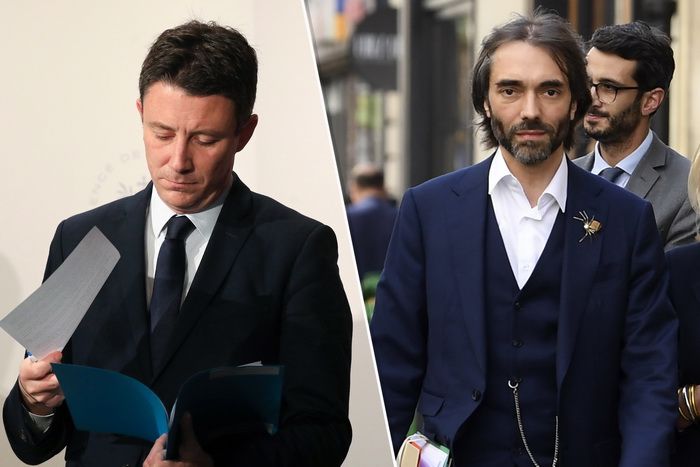 |
| Benjamin Griveaux and Cédric Villani |
Benjamin Griveaux had just been nominated as a candidate for the party, when another candidate suddenly was registered — his fellow party member, the famous mathematician Cédric Villani. During his campaign, B. Griveaux was unable to offer an interesting and original program: he distinguished himself only by the proposal to create a central park in the northern part of Paris, which was perceived as an unrealistic idea. Due to this unsuccessful campaign, B. Griveaux lost the status of the favorite. The so-called tragicomedy took place already in February 2020, and caused both the political fall of B. Griveaux and the end of the E. Macron camp’s hopes for “taking Paris”. This refers to a sexual video about B. Griveaux posted on the Internet. Russian Peter Pavlensky claimed responsibility for its spread. As a result, B. Griveaux had to withdraw his candidacy. Minister of Health Agnes Buzyn was proposed to be the candidate from the party “The Republic, Forward!” in Paris.
After the first round of elections in March 2020, Anne Hidalgo, mayor of Paris, a representative of Socialists, came out on top with 29 % of the vote. Member of the French right-wing party “Les Républicains” (“The Republicans”) Rachida Dati got 23 % of the vote, while the above-mentioned Agnes Buzyn — 17 %. In the second round of elections, which took place in June 2020, Anne Hidalgo, with the support of the “green” candidate David Belliard managed to get 49 % of the vote, Rachida Dati got 34 % of the vote, Agnes Buzyn — 13 %. Thus, Anne Hidalgo was re-elected mayor of Paris after she managed to enlist the support of both the Socialists and the Greens. By the way, she may become a candidate from the left in the 2022 presidential election.
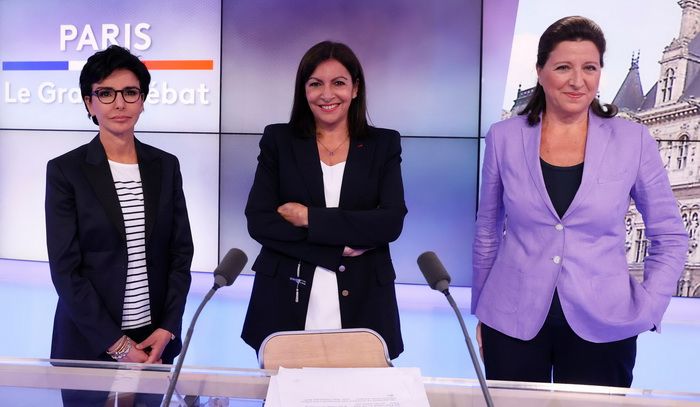 |
| Candidates of the 2020 Paris mayoral elections Rachida Dati, Anne Hidalgo (won) and Agnes Buzyn |
The Greens’ and Socialists’ victory in many cities
In the second round of local elections, the candidates from the Greens won in many cities: Jeanne Barseghian was elected mayor of Strasbourg, Grégory Doucet — of Lyon, and Pierre Hurmic — of Bordeaux. These three “green” victories have a symbolic meaning. After all, although Strasbourg was the only city that could get a candidate from the party “The Republic, Forward!”, the victory was won by the “green” candidate.
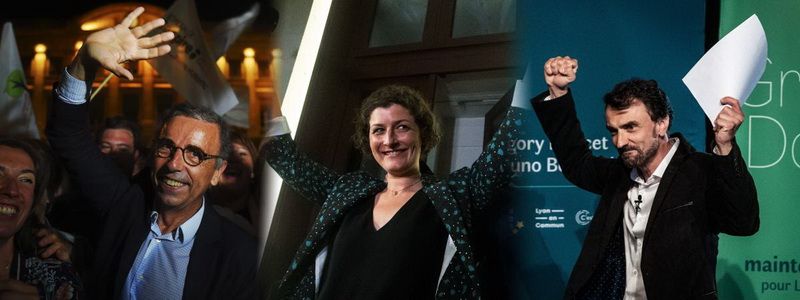 |
| Pierre Hurmic, Jeanne Barseghian and Gregory Doucet, “green” candidates victorious in elections in Bordeaux, Strasbourg and Lyon |
The Greens’ victories in Lyon and Bordeaux marked the failure of the local candidates’ strategy for an alliance between “The Republicans” and “The Republic, Forward!”. This victory of the “greens” can be associated both with the desire of a large part of the population to improve the quality of life in large cities, and with the wish to change traditional political elites. It is also worth noting that the “green” candidate David Belliard, who won only 10 % of the vote in the first round of local elections in Paris, supported the Socialist candidate Anne Hidalgo, who was elected mayor of Paris in the second round of local elections. Socialist Martine Aubry won the local election in Lille with 40 % of the vote against the “green” candidate Stéphane Baly with 39 % of the vote. Significantly, with the exception of Nice and Toulouse, where Republican mayors Christian Estrosi and Jean-Luc Moudenc were elected, it was the left-wing candidates, the Socialists or the Greens, who won in all major French cities.
The local elections caused changes in two major cities: in Bordeaux, the victory of the “green” candidate, Pierre Hurmic, put an end to the leadership of the right-wing mayors who had ruled there since 1947; in Marseilles, the victory of the socialist Michèle Rubirola interrupted the rule of the city by the right, which they had been exercising since 1995.
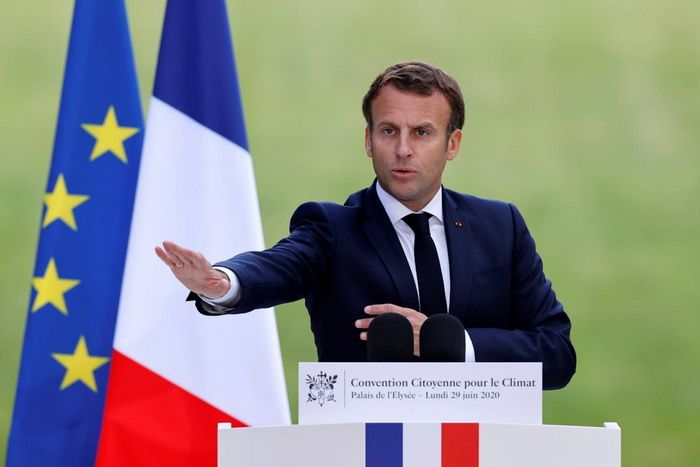 |
| French President E. Macron during a meeting with members of the Citizens’ Convention for Climate |
The local elections, which were limited due to the coronavirus pandemic, were a disaster for the presidential party, which failed to conquer any major city, as well as a great victory for the Socialists and the Greens. The elections were followed by a presentation of the results of the Citizens’ Convention for Climate, President E. Macron’s response to these proposals, as well as changes in government and the replacement of the country’s Prime Minister by E. Macron in preparation for the 2022 presidential race. It is clear that this is his reaction to the lost local elections this year.
About the authors:
Oksana Mitrofanova — Ph.D. in Political Science, Senior Researcher
at the Institute of World History of the National Academy of Sciences of Ukraine
Julien Plouchart — Ph.D. student at the Cergy Paris University


