
 Ivan Sichen
The main political event in Russia in this year was the September 2021 parliamentary elections. As expected, despite the opposition’s attempts to influence their results, they did not lead to significant changes in the balance of political forces in the Russian State Duma and allowed V. Putin to retain sole power in the country.
According to independent opinion polls, the election results were clearly falsified. In fact, the same was shown by their holding, which was accompanied by numerous violations. The involvement of the population of the annexed and occupied territories of Ukraine in the Russian elections was also illegal.
In general, these circumstances are well known and widely covered in the media. However, publications on this issue mostly provide only some data related to the elections in Russia without their in-depth analysis. In view of this, I would like to draw some conclusions from the situation with parliamentary elections in Russia, which concern the interests of our state.
As you know, according to the results of the parliamentary elections in Russia, the ruling United Russia party won, gaining 49.82 % of the vote. Apart from it, Duma now includes four other parties: the Communist Party — 18.93 % of the vote; LDPR — 7.55 %; “Fair Russia — For the Truth” — 7.46 %; “New People” — 5.32 % (is a new political force that entered parliament for the first time; was created in March 2020 by Russian businessman A. Davankov; declares center-right views; most likely is a “technical project” of the Kremlin).
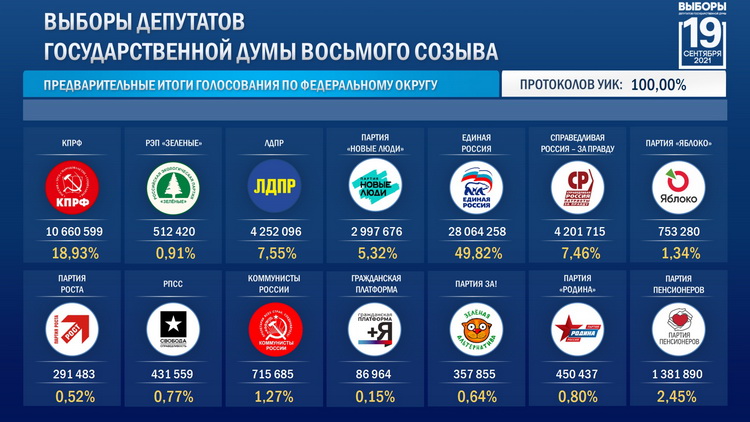 |
| Official results of the 2021 parliamentary elections in Russia |
In the introduction to the article it was already mentioned how such results were achieved. The methods of action of the Putin regime to remain in power in the country have been known since the early 2000s and do not require additional details. Especially as this theme may be the subject not only of a separate article, but of an entire book or textbook for the actions of special services.
Let me remind, that in 2000, V. Putin was elected President of Russia as the ”winner” of the Second Chechen War, which was provoked by the Kremlin precisely to ensure a controlled transfer of power in the country. Moscow’s attack on Ukraine, which was carried out in the interests of raising Putin’s rating after his catastrophic fall due to rigged presidential elections and mass anti-Putin demonstrations in Russia in 2012, had the same goal.
However, let’s leave history alone and return to the present. So, what conclusions can we draw from the situation with parliamentary elections in Russia?
First, the Russian propaganda’s allegations about “mass support by the population of the current government of the country” are not true. Evidence of this is the steady downward trend in the ratings of both V. Putin himself and the ruling United Russia party. For example, even according to official data, since the previous parliamentary elections in 2016, United Russia has lost about 5 % of the vote. At this, according to independent polls, in reality United Russia received only 8–16 % of the vote.
 |
| The Russian propaganda’s allegations about “mass support by the population of the current government of the country” are not true |
Second, the complication of socio-economic problems in Russia as a result of Western sanctions and a number of other factors leads to a gradual loss of the positive effect of the “Russian Spring” for the Putin regime. Moreover, this also applies to Crimea, where, again according to official data, United Russia lost more than 9 % of the vote. And the turnout of Crimeans was less than 50 % (even taking into account all sorts of falsifications such as “carousels” and stuffing the ballot boxes). This once again confirmed the fact that the majority of the Crimean population does not identify itself with Russia and is indifferent to it.
Third, the changes in the mood of the Russian population are mainly related to the return to communist ideology, which is considered an alternative to Putin’s national-oligarchic system. Thus, since the previous parliamentary elections, the electoral rating of the Communist Party of the Russian Federation has increased by 5.6 % — from 13.34 % to 18.93 %. But then, according to independent polls, 61 % of Russian citizens voted for the Communist Party. It is quite significant that the Communist Party is also taking over part of the electorate of the Liberal Democratic Party of Russia (LDPR) — the party of openly chauvinistic and Nazi nature. In particular, while in 2016 the Liberal Democratic Party won 13.14 % of the vote, in this year’s elections it got almost twice less.
 |
| Communist ideology is considered in Russia an alternative to Putin’s national-oligarchic system |
|
…Russian democratic forces are in no way democratic in the Western sense of the term… |
Fourth, the democratic opposition to the Putin regime is also growing. In particular, since 2016, the rating of the party “Fair Russia” has increased from 6.22 % to 7.46 % of the vote. However, according to independent observers, in fact, 22–28 % of voters voted for this party in this year’s elections. At this, its main electorate was supporters of A. Navalny, who formally has no party of his own and, in general, was not admitted to the elections because he is in prison. But Russian democratic forces are in no way democratic in the Western, including Ukrainian, sense of the term. For example, the Russian democrats are in favor of restoring democratic freedoms in Russia and ending its confrontation with the West. However, they do not support Ukraine’s independence in any way and are not going to return Crimea to it and end the conflict in the Donbas.
|
…The negative reaction of the West to the elections in Russia was limited to ordinary declarations… |
Fifth, in the case of the Russian elections, Western countries and international organizations have once again shown a rather dual attitude to Russia and Ukraine. Despite the apparent falsification of the parliamentary elections in Russia, leading Western countries have recognized them, except for the results of voting in Crimea and the occupied territories of the Donbas. However, no additional sanctions against Russia have been introduced. In fact, the negative reaction of the West to the elections in Russia was limited to ordinary declarations, as well as a resolution of the European Parliament of September 16 2021, which called on EU member states not to recognize the future composition of the State Duma.
Sixth, despite the fall in the rating of his power, V. Putin is not going to give it up and is doing his best to keep it in his hands. A wide range of methods is used for this, including: conducting a massive information campaign in support of the current leadership of the country and its policy; severe harassment of the opposition and suppression of protests; election fraud. And now there is the involvement of the population of the annexed and occupied territories of Ukraine in the elections, which the Kremlin believes should be grateful to V. Putin for “protection from Ukrainian nationalists”, “return to Russia” (in the case of Crimea) and granting them Russian passports.
 |
| V. Putin is not going to give up his power and is doing his best to keep it in his hands |
However, due to the steady decline in the rating of the leadership of the Russian Federation, with each year coming, the problem of retaining power is becoming more acute. As a result, the Kremlin’s above-mentioned methods of action are becoming tougher and more daring. This is exactly what the preparation and holding of parliamentary elections in Russia this year showed. According to Western experts, voting in Russia has long had nothing to do with the true will of the population.
|
…These circumstances indicate the impossibility of positive changes for Ukraine in Russia’s policy, at least in the years to come… |
In general, these circumstances indicate the impossibility of positive changes for Ukraine in Russia’s policy, at least in the years to come. On the contrary, Moscow’s policy towards Ukraine will become even tougher and more aggressive.
For example, Putin’s regime will try to stop the trend of falling of its rating by intensifying efforts to divert the attention of the Russian population from the country’s internal problems to the revival of Russia as a great world power, its protection from external enemies, support of “compatriots” abroad and building the “Russian world”.
Within the framework of such efforts, one of the main directions of Moscow’s actions will remain Ukraine, which is of special, and, so to speak, “sacred” importance for Russia. An example of this was the Kremlin’s resumption of armed provocations in the Donbas and the escalation of military tensions around Ukraine in the first half of 2021, which, in particular, aimed at leveling the consequences of Navalny’s arrest and their negative resonance for the Russian leadership.
Moscow’s deliberate escalation of the confrontation with the West has the same goals, forming the Russian population’s vision of Russia as a “besieged fortress”. To date, this has led to the de facto resumption of the Cold War between Russia and the West, which is again centered on Ukraine. At this, the confrontation between Moscow and the United States/NATO is accompanied by an increase in the number of their troops in the European theater, including around our country.
|
…In case of a real threat to Putin’s power, he may decide to carry out a full-scale armed aggression against Ukraine… |
Given these circumstances, in case of a real threat to Putin’s power, he may decide to carry out a full-scale armed aggression against Ukraine to consolidate Russian society around him.
Besides, the real threat to Ukraine is Moscow’s actions to involve the population of Crimea and the “DPR” and “LPR” in the elections in Russia. This creates preconditions for legalization of the annexation and occupation of Ukrainian territories by Russia.


