
Vadym Volokhov
November 19, 2017, the troops of the Islamic State (ISIS) were thrown out of the city of Abu Kamal. This fact is already seen in the world as the end of the self-proclaimed in 2014 Islamic Caliphate.
Against this background, on 22 November 2017, the presidents of the Islamic Republic of Iran (IRI) H. Rouhani, of Russia — V. Putin and of Turkey — R. Erdogan met in Sochi. The main theme of the talks was the current situation in Syria and its future. On this issue, V. Putin proposed R. Erdogan and H. Rouhani to consider the implementation of a joint comprehensive program for the restoration of Syria worth a total of about 300 billion US dollars.
The meeting adopted a joint statement on the settlement of the situation in Syria. In particular, it emphasizes that “the establishment of de-escalation zones and political initiatives to solve the Syrian crisis under no circumstances should undermine the sovereignty, independence, unity and territorial integrity of the Syrian Arab Republic”.
|
1. “Northern” or “Idlib” — the largest zone on the border with Turkey. The territory of the zone is controlled by the organization “al-Nusra” and the Kurds. 2. “Rastan” is the territory between Hama and Homs. The situation in this area is relatively calm, one of the main Syria’s roads goes through it. 3. “Eastern Ghouta” — a suburb of Damascus, the city of Douma. In this zone, the situation is tense, there are constant clashes of militants with government troops. 4. “Daraa” — the southern, border region of Syria with Jordan and the Golan Heights.
|
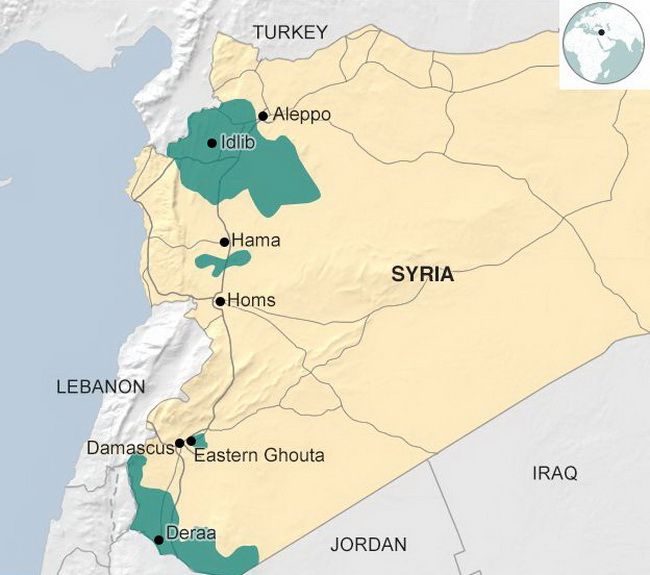
It was also stated that Russia, Iran and Turkey intend to work together to prepare for the Syrian National Dialogue Congress, which is scheduled to be held in Sochi this December.
So is the war over? Are the Kremlin and Damascus celebrating victory? Let’s not jump with conclusions, it’s not all that simple.
The meeting of the three presidents in Sochi once again confirmed the fundamental differences in approaches to resolving the Syrian problem between the two coalition or external players’ groups. On the one hand, it is the United States, Saudi Arabia and Israel with numerous allies. On the other hand — Russia, Iran and Turkey with a much smaller “support group” and a significantly greater burden of all sorts of problems.
First of all, the list of such problems that will not allow Russia and its satellites to become a “guarantor of peace and stability in Syria” includes the Kurds’ active actions aimed at building an independent Kurdish state, as well as international disagreements over the issue of establishing a transport and energy transit corridor to the coast of the Mediterranean and prospects for preserving B. Assad’s regime in Damascus. By the way, Russia, Iran and Turkey have their own points of view on the ways and principles of these disagreements settlement.
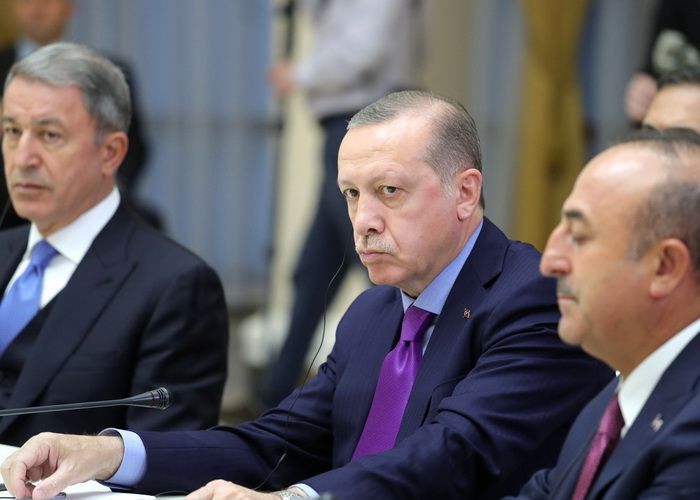 |
| President of the Republic of Turkey Recep Tayyip Erdogan |
Thus, the most important thing for R. Erdogan is to ensure a balance of interests in the region and to preserve Turkey’s place in NATO. With this in mind, Ankara can sign a declaration on the “unity of Syria”, which does not impose any obligations on it.
At this, if Turkey gets at least a minimum chance to seize Afrin (the “Northern” zone of de-escalation) then it will use it. The success of such a move will enable Ankara to unite the controlled areas in the northwest of Syria from the Euphrates to Idlib.
At the same time, Turkey would be happy with the division of Syria, provided that Ankara would control the northern areas of the Syrian state with their further Turkization. In turn, this would open up prospects for creating a new Sunni country under the auspices of Ankara as part of the territories of Syria and the north-western regions of Iraq.
Let me remind that Afrin is only 33 km off the Mediterranean coast, and its submission to Ankara would finally bury the Kurdish dreams of independence. In this case, Turkey itself would surround Kurdish territories from the north, west and south with its military bases, which would be deployed on the territory of the future Sunni state. Finally, Turkey itself would create a “Sunni belt” and get access to the monarchies of the Gulf. Two belts: the “Shiite” and the “Sunni” is too much for the Middle East! Therefore, the interests of Turkey and Iran are mutually unacceptable.
While the commonness of Turkey and the United States’ interests is obvious. Washington also seeks to break the “Shiite belt”, and it was for this that the Syrian Democratic Forces (SDF) (an alliance of armed formations of different groups of the Syrian opposition, which engages between Syria and Iraq and promotes the formation of the Kurdish-Arab alliance) were created.
Under these circumstances, V. Putin’s main goals are to maintain his image of a “fighter against terrorism”, preserving Russia’s influence on Syria and developing relations with Tehran, but without excessive exacerbation of relations between Russia and the West.
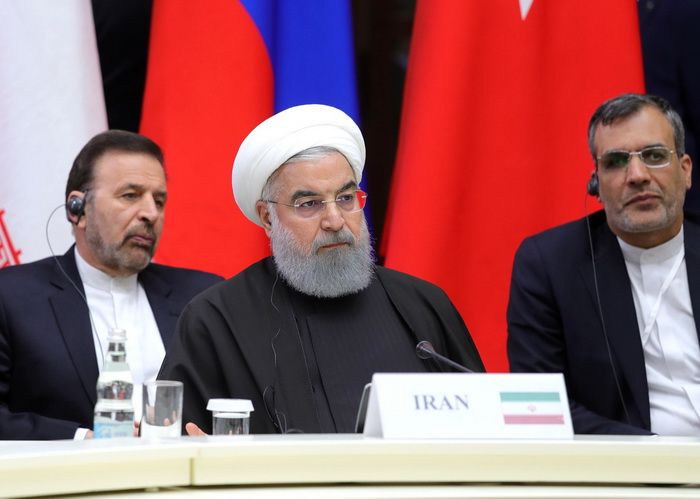 |
| President of the Islamic Republic of Iran Hassan Rouhani |
Iran has its own interests and seeks to prevent the division of Iraq and Syria, and to maintain its position not only in the Syrian territory but also in the Gulf region as a whole. In addition, during the meeting in Sochi, Iranian President H. Rouhani expressed concern over the transformation of the US-led international counter-terrorism operation in Syria into a coalition against the Shia community in the region and directly against IRI.
Such anxiety for Tehran has enough grounds. So, at the end of November of this year, Israeli Defense Minister A. Lieberman called on the members of the international coalition in Syria to create a new coalition against Iran and Hezbollah, which the League of Arab States has recognized as a terrorist organization. It is clear that the emergence of such a coalition will lead to a significant exacerbation of the situation in the Middle East and the actual rupture of the “Shiite belt” (Iran-Iraq-Syria-Lebanon). And even more so, it could provoke new religious-civil wars between Sunnis and Shiites in Syria and Iraq.
Thus, the Russia-Iran-Turkey coalition is rather fragile, which greatly complicates the ability to quickly achieve its goals. We all understand that quickly done is never good.
As for the United States, “The Washington Post”, referring to its sources, points out that Washington plans to leave part of its troops in northern Syria and create a new government separate from Damascus. The White House knows very well that the withdrawal of US troops from Syria would give B. Assad an opportunity to complete the capture of the entire territory of the country and maintain his power, which would mean the victory of Russia and Iran. At the same time, continued pressure by the USA in the alliance with the SDF on B. Assad’s regime would force him to make concessions during the Geneva talks under the auspices of the United Nations.
Obviously, the USA’s plans are contrary to those of Russia, Turkey and Iraq and create preconditions for dividing Syria into the zones of influence by the above-mentioned countries. At this, the zone of the USA’s influence is more attractive than that of its opponents in Syria. For example, it was less affected by the war, the bulk of Syrian resources and the country’s key infrastructure are in its territory. Besides, the United States and Saudi Arabia have far more resources to rebuild their zone of influence than Russia, Turkey and Iran to revive the territories under their control.
According to available data, Washington is ready to cooperate with Ankara and Moscow, but certainly not with Tehran. On the one hand, the reason for this is the opportunity to combine the efforts of the parties in solving the problems of Syria, and on the other — the advantage of the United States, which allows it to effectively counteract its opponents. It should also be noted that the so-called “Shiite belt of Iran” is under almost full control of the United States and the SDF, as well as guaranteed prospects for a conflict between a moderate opposition in Syria and any pro-Russian government in Damascus.
This situation did not create itself, but was partly created by Washington, which knows exactly what it seeks to achieve in Syria, and therefore, without unnecessary movements, is consistently working to achieve its goal.
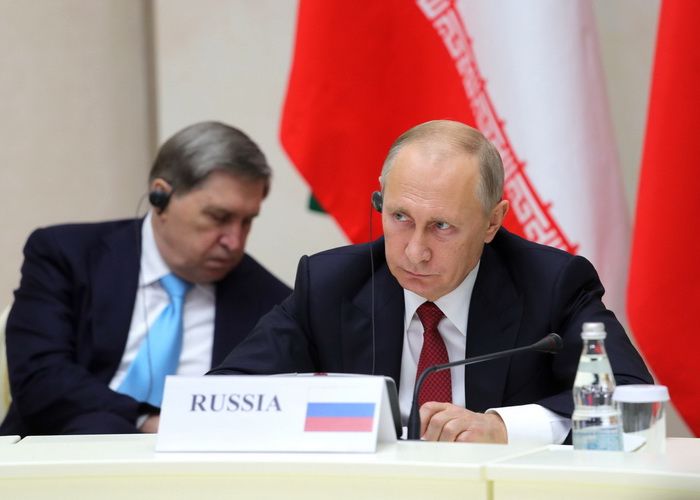 |
| Russian President V. Putin |
Part of the problems was created by Russia which with great delay decided to intervene in Syrian conflict and now cannot hope for any significant result. Military assistance to B. Assad was provided when the situation was already established and was recorded by all parties of the conflict. Moscow needs a puppet, not an independent and strong partner, and therefore B. Assad was not invited to the meeting in Sochi, because he would have been one too many there.
Russia has got “an infinitely grateful and obedient doll”, but at a cost of catastrophic being late. Nowadays, Russian propaganda presents all the events as Moscow’s undisputed victory, but the situation is extremely complicated. Russia has not achieved any meaningful results, it is also unable to continue the war, because it requires significant financial expenditures. In this situation, all Russia can do is — “put a brave face on a sorry business” and count on support from Turkey and Iran which are running their own high-stakes game.
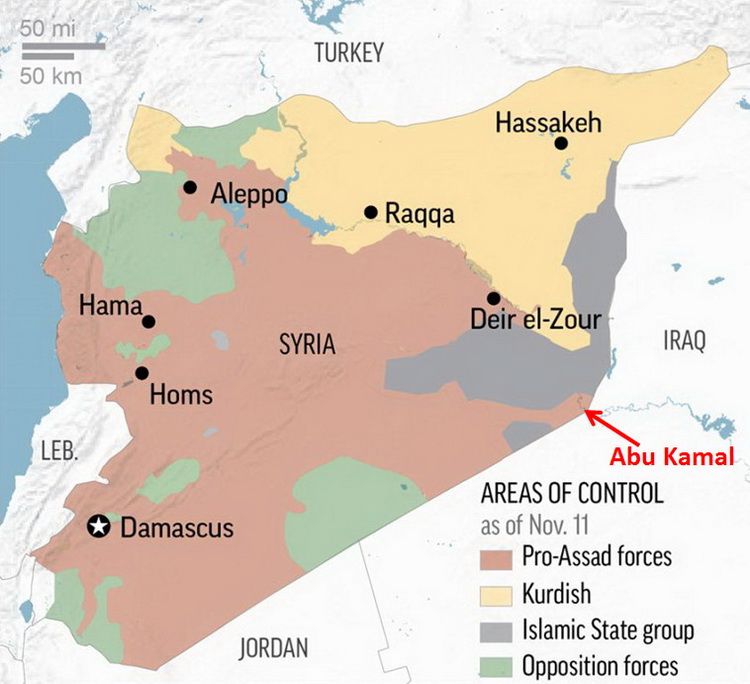 |
| The situation in Syria, November 2017 |
So, the situation today is as follows:
— the oil has remained in the Kurds’ hands (via SDF);
— the Syrian opposition can count on the full support by Sunni, Kurds and Druze;
— The United States has begun to create military bases in northern Syria. Besides, it is going to preserve 12–15 military bases in Iraq;
— Moscow will have to withdraw its troops from Syria until the new 2018 year, but it wants to leave two bases: the airbase in Khmeimim and the naval base in Tartus;
— B. Assad should either give away power, or fight to the end, if Tehran maintains its military presence in Syria. However, if the “Shiite militia” becomes part of the Syrian army, Christians and Druze will leave B. Assad and he will be able to rely only on the Alawites and Shiites.
It is clear that Moscow will not be able to convince participants in the Syrian conflict that it is necessary to preserve B. Assad in power. That is why V. Putin has started talking about the new constitution of Syria and the need for elections under the auspices of the UN. It is not superfluous to recall that it was the West and the moderate Syrian opposition that proposed it in 2012–2013, but Moscow and Tehran were against it.
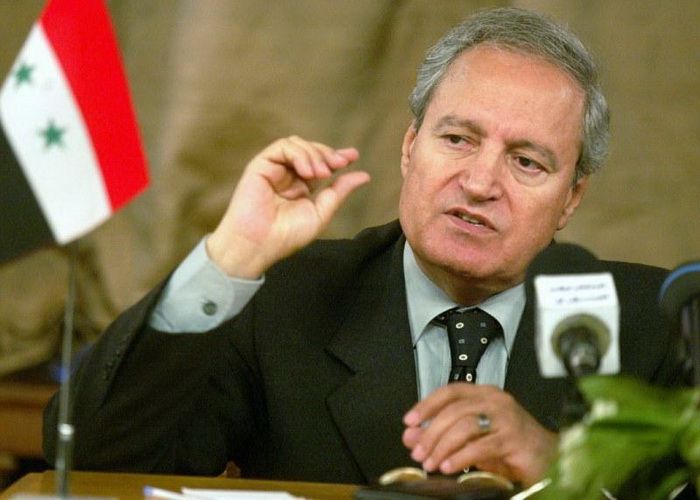 |
| Former Vice President of Syria Farouk al-Sharaa |
Today, it seems that Moscow has raised the issue not accidentally, because it has found someone to replace B. Assad and will try to bring its protégé to power. The Kremlin stressed that in the post-transition period after the National Dialogue Congress, instead of B. Assad, former vice president Farouk al-Sharaa (a Sunni and diplomat who was Syria’s Ambassador to Italy, then was appointed Deputy Foreign Minister; was responsible for cooperation with Western countries) could be President of the country.
This is evidenced by the fact that the Syrian president’s brother, Maher al-Assad, has been suspended from the commanding the Republican Guard. Arrests have been arranged among commanders of the Syrian Air Force, which have traditionally been focused on Iran.
Ankara has already agreed to this, but without the participation of the Kurds. Everyone understands that this is again a dead end situation;
— Syria will be restored by the West, together with the Gulf Cooperation Council, which will mean that the Syrian Government will be appropriate.
As for the Islamic State (ISIS), the following should be noted:
Firstly, the structure of the Caliphate cannot be destroyed in a military way, it has transformed into a network form and continues the struggle.
Secondly, the ISIS occupied not the most important strategic territory. The United States, Kurds and SDF did not allow the Caliphate to take control of the main economic areas of Syria.
Thirdly, the ISIS is turning to the strategy of survival. According to different estimates, up to 80 % of all ISIS fighters have left the combat zone. In the territories liberated from the ISIS, local terrorist groups create “sleeper cells”, “dissolving” among their families and tribes, and foreign fighters are returning to their countries or to countries where they have ties and hideouts.
The main forces, (al-Osra, Jaysh al-Jihad and Jund al-Khilafah elite units) are believed to have been relocated to Afghanistan, Libya, Nigeria, Somalia and Yemen. The mobilization structures of the ISIS that operate at each mosque are not aimed at recruiting militants, but at intensifying propaganda and training of new personnel.
So, after Sochi there are more questions than answers. One thing is clear, it is still a long way to the end of the war in the Middle East. The West blames Iran, Hezbollah and all Shiites for regional expansion, to which Israel, the United States and the Persian Gulf monarchies are ready to put an end.
A great war in this region can still happen, it’s just a matter of time.


