
S. Dyachenko
The beginning of the construction of the “South Stream” gas pipeline shows that Ukraine has little time for reforms in the energy sphere and finding its place in the European energy sector.
The driving force of the project – the Russian Federation, which considers it strategic and secured it in appropriate documents, continues to advance it persistently, despite all the arguments of its quite doubtful importance for the European community, which has its own project – “Nabucco West” and, together with Azerbaijan and Turkey supports the TANAR project.
While working out its own position, Ukraine should pay attention to the following:
1. The project does not answer the declared goal – diversification of the routes of the delivery of the Russian gas to European countries. Diversification in fact means more abilities for a choice. But after the realization of the “South Stream” and “North Stream” projects, the Ukrainian GTS will be not needed, so there will not be more possible routes of delivery, but replacing one of the directions of transmission by another one, which is quite risky, if we take into consideration the lack of proper volumes of the gas in both the streams. All links to the prospects of increasing of the Russian gas volumes look doubtful as the situation testifies to quite contrary.
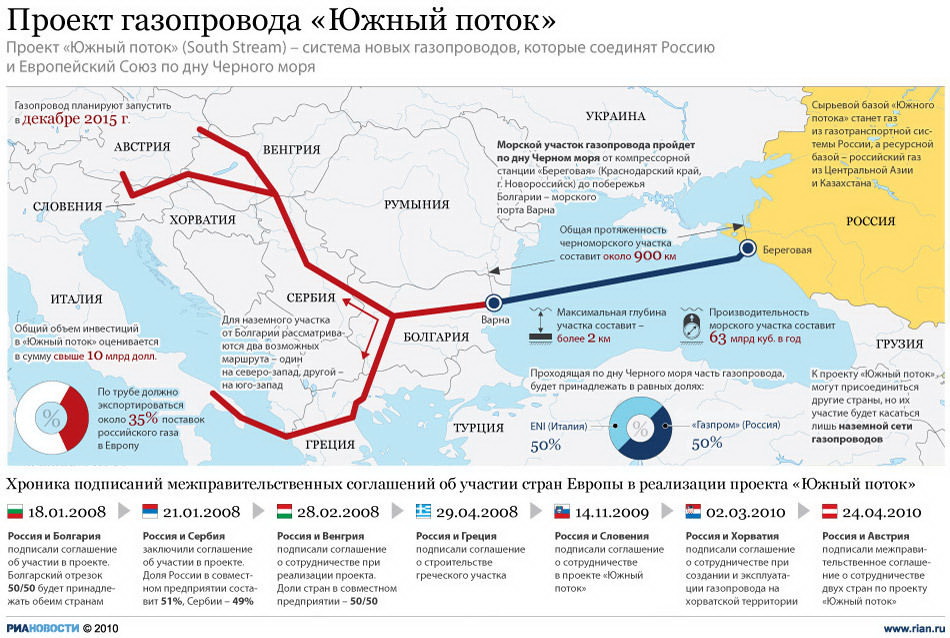 2. The “South Stream” project is answering the interests of the RF and companies -participators in the countries through whose territories it goes and who supported it. At the same time, the project contradicts the interests of the European community in the whole because:
- the realization of the project will need great money as it will be necessary to build not only the gas pipe through the Black Sea and all the way across the Balkans, but a few main pipelines at the territory of Russia itself, which in the long run will cost more than 35 billion Euro, while getting a similar increase of the transmission capability via Ukraine would cost much cheaper;
- the operation expanses of the “South Stream’s” exploitation will be higher than those of the Ukrainian GTS. At this in order to cover the expanses, the members of the project will be interested in keeping the transmission services prices high, which will be shifted on to the European consumers;
- the Ukrainian GTS is more reliable from the technological point of view. Over the years of its exploitation, there has not been a serious breakdown, which would have led to stoppage of gas delivery to the European consumers. Besides, its diversification will allow even in case of a serious breakdown to compensate the temporary loss of the carrying capability at a part of the gas pipeline. While a breakdown of the underwater part of the “South Stream” (900 km at the depth up to 2000 m) or of the “North Stream” (1220 km at the depth up to 200 m) will lead to stoppage of gas transmission for a long period of time (perhaps, a new underwater part will be needed to be constructed);
- due to the large capacity of the gas storage, Ukrainian GTS is much more reliable for South Stream in terms of demand fluctuation in abnormal weather conditions.
3. At the present transit rate, the profitable work of the Ukrainian GTS is ensured by the volumes of gas transmission up to 62 billion cubic meters of gas. Further decrease of the volumes will demand either increasing the transit rate or will make Ukraine stop the gas transmission system exploitation.
 Thus, the “South Stream” project is in fact a political project, aiming at depriving Ukraine of the transit status and creating a competition for the “Nabucco West” project. At this, by its finance- economic characteristics and importance for the creation of the new European architecture, the “South Stream” inferior to its rivals and satisfies only the interests of a separate group of managing subjects and countries.
Under such circumstances Ukraine has objective grounds for the support of its position concerning the “South Stream” and the prospects of the Ukrainian GTS from the European Commission and Energy Community, of which it has been a full member since 2010. Sadly, this never happened.
Most likely, the reason is the absence of a dialogue at a proper level. After having become a proper member of the energy association, Ukraine faced certain rights and duties. The country has to carry out market reforms of the energy sector, and after that it will be able to integrate it into the European energy space. In the strategic aspect the Ukrainian GTS and electric energy system can play an important role in supplying Europe with energy, helping to increase the reliability and effectiveness of the energy delivery.
But, to a great regret, the pace of the energy reforms in Ukraine is far from the desired. A great share of guilt lies on the state bodies, which cannot find effective ways of reforming quickly enough. But there are also objective obstacles. For example, it is already clear that Ukraine by 2018 won’t be able to bring greenhouse gas emissions of thermal electric power stations to the European level, as it is demanded by the implementation law of the EU. According to experts’ estimations, this will demand 12-17 billion US dollars, which within these time limits the country can neither find nor develop. It will also be difficult to create a really liberal gas market without the diversification of the sources of gas supply into the country, and to modernize the energy system for its transfer to the parallel with ENTSO-E work at the current level of the wearing out of the capital assets.
The mentioned above testifies to Ukraine’s need of help. This concerns both, the individual approach to fulfilling some tasks, and finding money for the modernization, and most important, the support of the projects which are strategic for its energy system. It is obvious, that the modernization of the Ukrainian GTS and its further integration into the European Energy Transmission System is such a project. Hopefully, Ukraine will get such a support.

