
 The Situation On the Front in November-December 2022
Ivan Sichen
As in most other protracted wars, the situation on the Russian-Ukrainian front is cyclical and is marked by a periodic intensification of battles with active movements of troops, after which the armed confrontation again becomes positional. And after the recent liberation from the occupiers of the right-bank part of Kherson region, the situation is exactly like that. Of course, this does not mean a standstill on the front. The enemy continues its offensive in certain directions in Donetsk and Luhansk regions. We also conduct individual offensive operations. However, most of them are local and, in fact, are part of the parties’ preparation for the implementation of larger intentions and plans. This will determine the course of the war in the near and medium term. This should be analyzed in more detail, and some conclusions and forecasts should be made.
Let’s start with an overall assessment of the situation on the front line. Despite being supposedly known, there are several rather contradictory points that should be adequately understood.
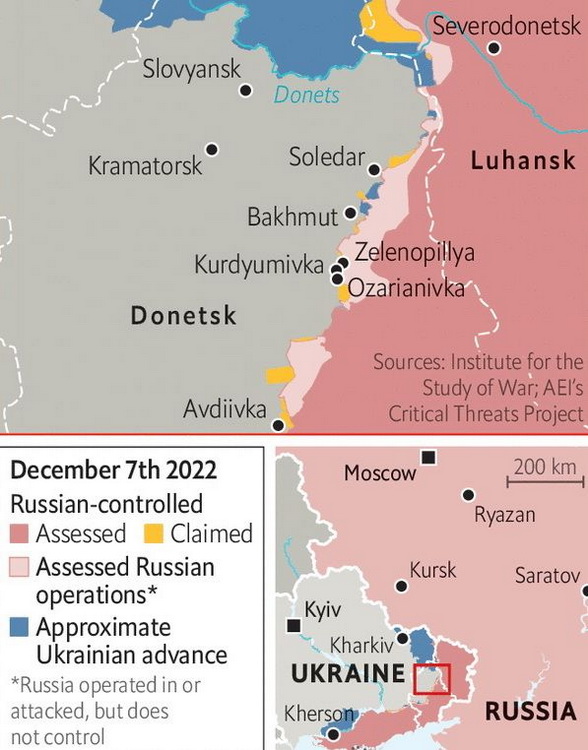 |
| The most difficult situation arose in the Donbas, where Russia and Ukraine simultaneously conduct active offensive and defensive operations |
For one, the most difficult situation arose in the Donbas, where Russia and Ukraine simultaneously conduct active offensive and defensive operations. Currently, Russia’s main goal here remains to take full control of the territory of Donetsk region. Therefore, Russian troops are inflicting two main strikes in the direction of the cities of Bakhmut and Avdiivka, as well as several auxiliary ones — on neighboring settlements.
Within the framework of these plans, the main attention of the enemy’s military command is paid to the capture of the city of Bakhmut as the bridgehead for further development of the offensive against the cities of Kramatorsk and Sloviansk. It is in the Bakhmut direction that the most capable and powerful group of Russian troops in the Donbas is concentrated. It consists of both regular units of the RF Armed Forces, as well as units of the private military company (PMC) Wagner, and is at least three times superior to Ukrainian troops in the area.
However, for about five months, Russian troops have not been able to seize the city. They just approached it, trying to encircle the enemy from the north and south. At this, a slight retreat of Ukrainian units from certain positions under the pressure of the prevailing enemy, are presented by Russian propaganda as a “decisive success” and almost “encirclement” of Bakhmut.
At the same time, none of the Russian propagandists mentions what even such “successes” cost Russia. Although it is the price that is of key importance here. Near both, Sievierodonetsk and Lysychansk, Ukrainian troops are fiercely defending in order to constrain the enemy and inflict maximum losses on him.
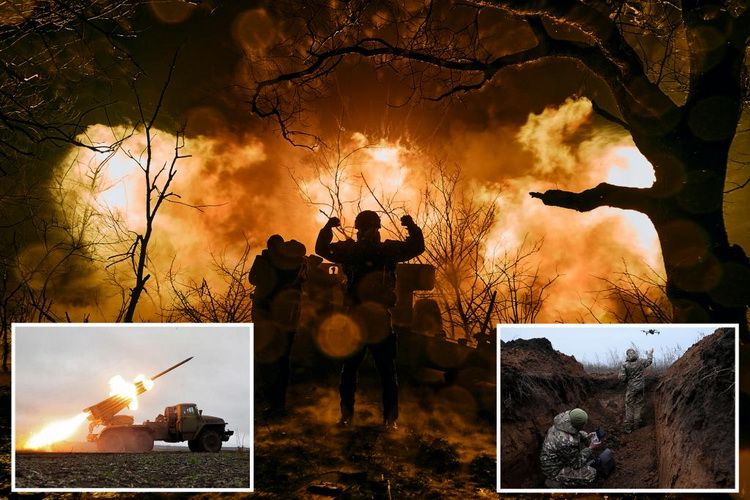 |
| The main attention of the Russian military command is paid to the capture of the city of Bakhmut. However, for about five months, Russian troops have not been able to seize the city |
And this already has some consequences. According to experts from the American Institute for the Study of War (ISW), Russia is exhausting its forces near Bakhmut, losing its offensive potential. Such conclusions are confirmed by the Ukrainian military, observing how the enemy’s superiority in forces and means is gradually decreasing, as well as how problems arise due to the lack of artillery shells.
Of course, Russian troops in the Bakhmut direction are still able to go on an offensive and will do it with all their might. Moreover, they have reserves — mobilized citizens and all sorts of mercenaries recruited by PMC Wagner, including those convicted in penal colonies. Moreover, the Russians may even capture Bakhmut, but after that they will be forced to take an operational pause in order to restore their combat capability. In turn, such a pause will be used by Ukrainian troops to prepare new frontiers to deter an enemy offensive. In fact, the same thing is happening in the Avdiivka direction, although in a slightly smaller scale. The aggressor has not yet stopped the offensive, but in some places it is forced to move to the defensive.
Besides, as noted above, the enemy performs local offensive actions in other parts of the front line in the Donbas. In particular, it systematically attacks the positions of Ukrainian troops in the areas of the settlements of Ploshanka and Bilohorivka in Luhansk region, as well as Berestove, Bilohorivka, Yakovlivka, Soledar, Vuhledar, Bakhmutske, Opytne, Klishchiivka, Andriivka, Kurdyumivka, Vodiane, Pervomaiske, Vesele, Maryinka and Novomykhailivka in Donetsk region.
For their part, Ukrainian troops are carrying out their offensive operation in the west of Luhansk region in order to guarantee the security of Sloviansk and Kramatorsk from the north and northeast, as well as to create preconditions for the liberation of Sievierodonetsk and Lysychansk and the north of Luhansk region. The main blows are inflicted by Ukrainian troops in the direction of the cities of Kreminna and Svatovo. To date, Ukrainian troops have already approached the city of Kreminna from the north and south, and taking it under control will open a direct path to the city of Rubizhne, and then — Sievierodonetsk. Thus, all the “successes” achieved by Russia at the beginning of the summer of 2022 on this section of the front line, will be leveled. At the same time, the losses suffered by the Russian army will also be in vain.
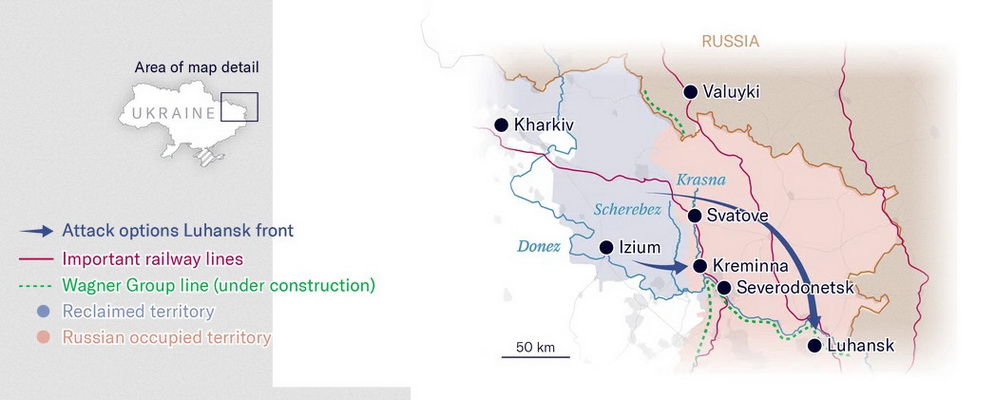 |
| Ukrainian troops are carrying out their offensive operation in the west of Luhansk region |
No less important in its significance will be the Ukrainian troops’ liberation of the city of Svatovo as a bridgehead for further attack on the city of Starobilsk. And this will make it possible to separate the northern part of Luhansk region from the “LPR”, to block the strategically important line of communication between Belgorod region of Russia and the city of Luhansk. Now it is one of the main logistics lines of Russian troops in the occupied territories of Luhansk region.
Given such circumstances, Russia is building a strong defense line in the northwestern part of Luhansk region. As in the Donetsk region, a significant role in this process is played by the armed formations of the PMC Wagner, operating on the front together with units of the RF Armed Forces. Besides, PMC Wagner is constructing a system of engineering barriers at the front and in the rear areas in the main directions of the offensive of the Ukrainian troops. First of all, barriers are built on western approaches to the cities of Svatovo, Kreminna, Sievierodonetsk and Lysychansk and Starobilsk.
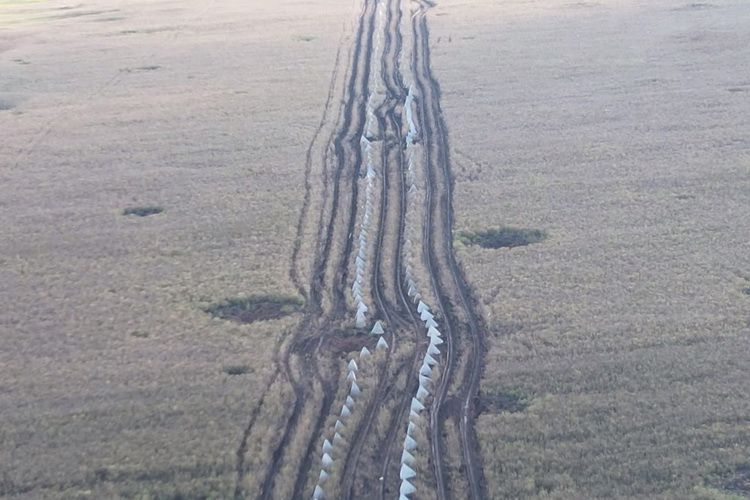 |
| Russia is building a strong defense line in the northwestern part of Luhansk region |
In order to strengthen the defense in those areas, Russia is transferring additional reserves from among the mobilized persons, as well as Russian troops withdrawn from the right-bank part of Kherson region. Part of the units of the RF Armed Forces from the occupied territories of the left-bank part of Luhansk region and the south of Zaporizhzhia region is probably also being sent there.
But then, so far Russia is not going to leave the region, which is strategically important for it as a land corridor to Crimea. Therefore, Moscow is limited only to the withdrawal of headquarters, warehouses, hospitals and other rear facilities away from the front line, so that they do not fall under the missile and artillery strikes of Ukrainian troops. Russians also are moving away from the front line some of the combat units, which were concentrated to perform offensive actions in the direction of Zaporizhzhia, but became excessive during the defense and suffered unjustified losses. Instead, a powerful system of engineering structures is being built in order to restrain the offensive of Ukrainian troops with minimal involvement of Russian troops. At the same time, the Russian Armed Forces are constantly shelling the positions of Ukrainian troops, as well as peaceful settlements, including the right-bank part of Kherson region, the cities of Zaporizhzhia, Dnipro and Nikopol and their southern districts. In this way, the Russian military command is trying to inflict maximum losses on Ukrainian troops, intimidate the local population and destroy the economic infrastructure of the region. At the same time, due to lack of strength, the enemy refrains even from small offensive actions.
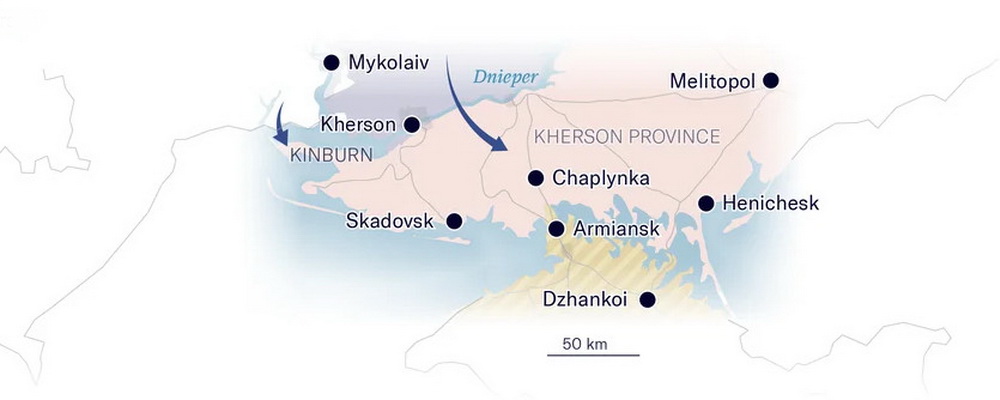 |
| So far Russia is not going to leave the south of Ukraine, which is strategically important for it as a land corridor to Crimea |
It is a pity that now the Ukrainian troops do not have sufficient resources for a powerful offensive to liberate the left-bank part of Kherson region and the south of Zaporizhzhia region. Besides, the attack on the enemy’s positions “head on” in order to crush it with a mass of the troops, as the Russians do, despite their losses, is absolutely unacceptable for us. Therefore, Ukrainian troops will resort to already proven methods to disrupt the control, communications and logistics systems of the Russian troops, inflicting high-precision missile and artillery strikes on their command points and headquarters, transport infrastructure facilities and places of concentration of personnel and military equipment. And in the occupied territories — our Special Operations Forces (SOF) and partisans are active. They contribute to the victory over the enemy. Now there are tangible achievements. Every day in the south of Ukraine, at least 1–2 command points, 2–3 warehouses with weapons, 1–2 bases or places of concentrations of occupying forces, in total, up to 100 soldiers and officers and about 10 pieces of military equipment are destroyed. The enemy practically does not have time to restore such losses. On the one hand, despite partial mobilization, Russia does not have enough trained reserves and military equipment, and on the other hand, it is extremely difficult to transfer them to the occupied territories of Kherson and Zaporizhzhia regions.
After the liberation by the Ukrainian troops of the right-bank part of Kherson region, the Crimean isthmus is in the zone of reaching of our long-range missile and artillery systems. This is the most vulnerable part of the transport communication line between the peninsula and the temporary occupied mainland of our state. At the same time, partial fire control was also established over the main highways and railways connecting the occupied areas of Kherson and Zaporizhzhia regions with Donetsk region. And key railway bridges have already been blown up or damaged by the SOF and partisans. All this allows Ukrainian troops to significantly weaken the enemy’s potential, and then go on the offensive. Taking into account the peculiarity of the situation in the south of Ukraine, offensive operations can be carried out in two main directions, namely — towards the city of Melitopol or bypassing it, and along the left bank of the Dnipro River. The success of such operations will make it possible to divide the enemy troops into two parts; of them to surround the one that will remain between the city of Melitopol and the Dnipro River with its subsequent defeat; to prevent shelling of the city of Kherson and the right-bank part of Kherson region, as well as the city of Ochakiv from barreled artillery and MLRS; to disrupt Russia’s land corridor to the Crimean peninsula and restore Ukraine’s access to the Sea of Azov; to block the Crimean isthmus and take control of the North Crimean Canal.
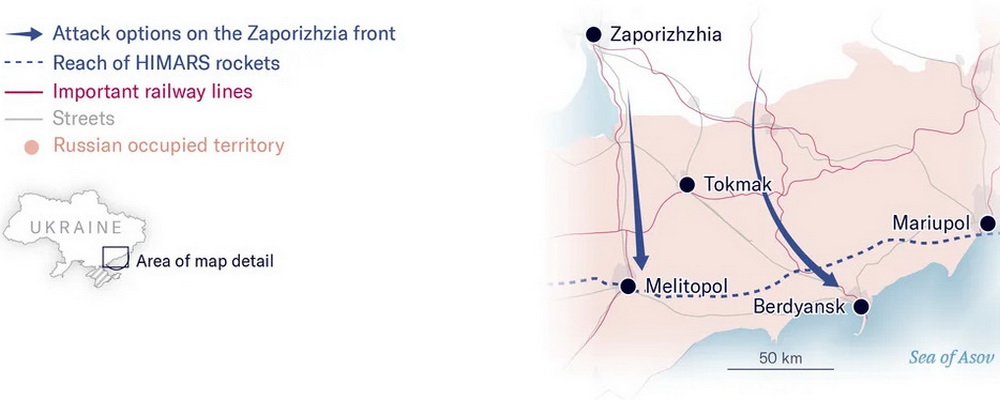 |
| In the south of Ukraine, offensive operations can be carried out in two main directions |
Subsequently, from these positions, it is possible to launch an offensive against the cities of Berdyansk and Mariupol. However, this will be the next stage, the implementation of which will depend on many, currently difficult to predict factors.
But Russia should not be underestimated. It is still strong enough and will make every possible effort to destroy Ukraine. Thus, training of recently mobilized Russian servicemen is currently being completed in training centers. Unlike those who were thrown into battle without proper training, they will have at least some experience and can become more or less high-quality replenishment of fighting troops and be used to form new units.
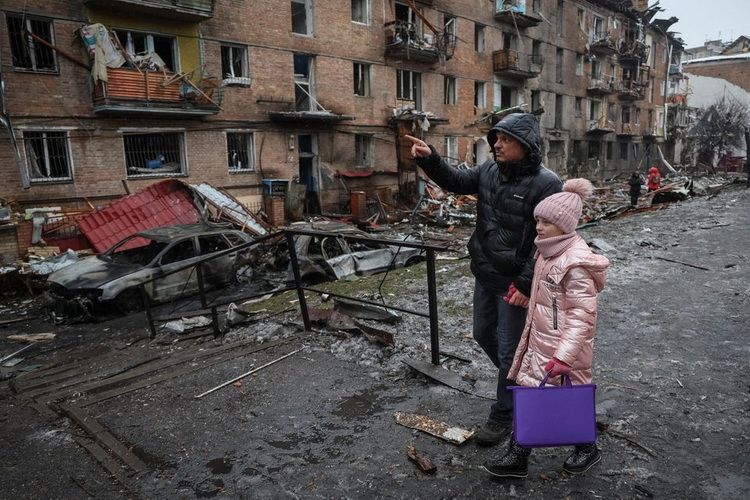 |
| Russia should not be underestimated. It is still strong enough and will make every possible effort to destroy Ukraine |
In this way, Russia will be able to strengthen its defenses (including in the south of Ukraine), as well as intensify its offensive both in the Donbas and in other areas. Among them, the greatest threat to Ukraine may be the re-invasion of Russian troops from the territory of Belarus and from Russian Bryansk, Kursk and Belgorod regions.
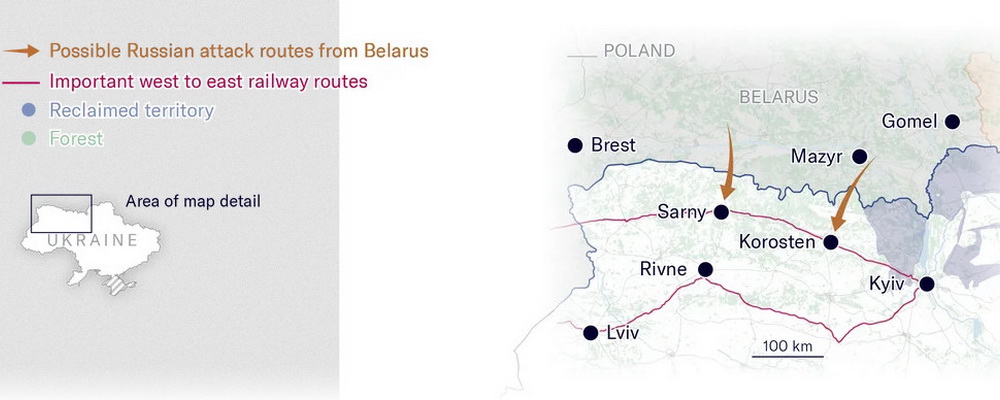 |
| The greatest threat to Ukraine may be the re-invasion of Russian troops from the territory of Belarus and from Russian Bryansk, Kursk and Belgorod regions |
And, of course, the RF Armed Forces will continue to launch terrorist missile strikes on critical objects of Ukrainian energy infrastructure and peaceful settlements in order to create unbearable conditions for the Ukrainian population to live, and to make Ukraine capitulate.
In case if Russia fails to achieve the desired results, the possibility of declaring a full mobilization should not be ruled out. Now the Russian society is already preparing for this. And although with the full mobilization that society will inevitably have even greater problems than with the partial mobilization, it will still make it possible to attract additional human resources to the army.
However, unlike in February 2022, we are now ready to effectively counter all these challenges and threats from Russia. Ukrainian troops are not only confidently defending in Donetsk region, but are also conducting a counter-offensive operation in Luhansk region. In case of an increase in the number of Russian troops in the Donbas, this will complicate the fulfillment of the tasks of the Ukrainian troops, but will not create any extraordinary problem for them. The same applies to the south of Ukraine. And the northern and northeastern borders of Ukraine are reliably protected by units of the Ukrainian Armed Forces, the National Guard and Territorial Defense. Every time our air defense destroys about 80 % of Russian missiles launched at Ukraine, which is one of the highest rates in the world. And the Armed Forces of Ukraine have even demonstrated their ability to strike at the airfields of Russia’s strategic aviation, located in the depths of its territory.
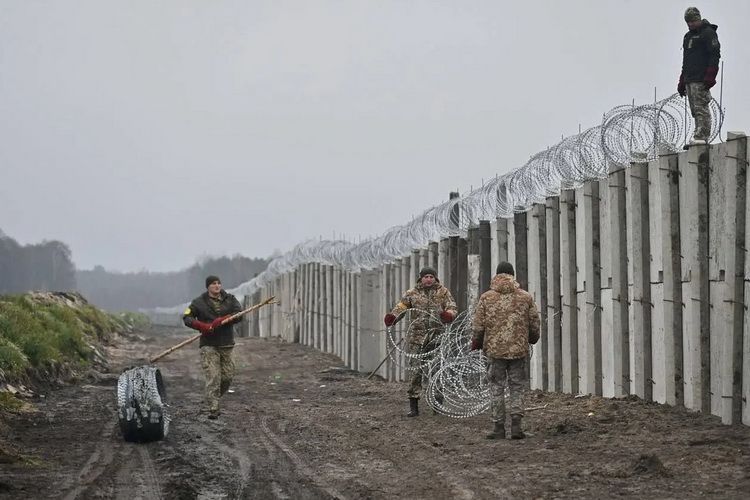 |
| Unlike in February 2022, Ukraine is now ready to effectively counter all challenges and threats from Russia |
Besides, we are also preparing reserves to replenish combat losses and to strengthen capabilities of Ukrainian troops, including with the assistance of our Western partners. All of them are ready to continue to help Ukraine until complete victory over Russia. And they prove it practically.
|
…At this, we are winning both on the battlefield and in the collective consciousness of Russian society… |
As a conclusion to the above said, one fact should be cited. In February-March 2022, Russia’s war against Ukraine was supported by more than 80 % of Russians, who were embraced by the euphoria of waiting for a quick victory. According to the latest data from sociological research, now their number has decreased to 25 %. 55 % of Russian citizens support the end of the war and negotiations with Ukraine. This means that we are winning both on the battlefield and in the collective consciousness of Russian society.


