
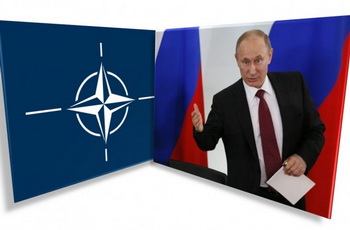
 Russia is trying to seize the initiative from the United States and other Western countries
Ivan Sichen
In June this year the Federal Chancellor of Germany and the President of France took the initiative to invite V. Putin to the EU summit. In their opinion, this would allow to launch a dialogue with Russia on resolving problems in relations between the parties, including over Ukraine.
Such a proposal provoked a rather mixed reaction in Europe. In particular, Austria agreed with it, while Poland and the Baltic states were strongly against it. And this is absolutely understandable. The closer to Russia is a country (except for China), the greater the danger it feels.
However, this does not mean that Russia is respected in the world. Moreover, it is in fact in international isolation, and its “friends” are exclusively in the “third world”. And what does Moscow do in such a situation? It covers himself with outright lies and blackmails the whole world with its military force. But then, it does begin to understand the irreversibility of its end.
June of this year was really rich in events that confirmed the trend of the world returning to the worst times of confrontation between different centers of power, including in the military sphere. On our website, we have already discussed this topic, however, the situation does not stand still, but keeps dynamically developing. Therefore, I would like to speak on this issue again, taking into account a number of new circumstances.
In particular, this applies to the holding of the IX Moscow Conference on International Security, V Putin’s phone-in (direct line) with the nation and his subsequent public statements, as well as a number of military measures by the United States, NATO, Ukraine, China and Russia. Again, we will not retell the details of all those events. Instead, we will draw conclusions from them which have to do with Ukraine’s interests:
Russia continues to see the United States and NATO as its main adversaries. At this, it is trying to shift responsibility for its own actions, which had led to the resumption of the new Cold War in the world. During the Moscow conference and the direct line, Putin and other officials again accused the United States and NATO of deterring Russia’s interests, building up their troops near its borders, and unreasonably withdrawing from international agreements in collective security. Despite this, Moscow still hopes for the possibility of “resetting” relations with Washington. This is exactly how V. Putin once again described the results of his meeting with J. Biden.
 |
| Russia continues to see the United States and NATO as its main adversaries |
|
…Moscow is shifting its focus to increasing its influence in the Asia-Pacific region… |
Given Russia’s de facto loss of its positions in Europe and its understanding of the impossibility of restoring them, Moscow is shifting its focus to increasing its influence in the Asia-Pacific region. In fact, the situation in the Asia-Pacific region was one of the main topics of the Moscow conference. Today, this is a practical implementation of the Kremlin’s plans to redirect economic and political ties from the West to the East. Besides, Russia is working to strengthen relations with countries of other regions of the “third world”, namely Africa, Latin America and Asia.
Within the framework of such policy, Russia is trying to seize the initiative in those regions from the United States and other Western countries. For example, Russian politicians and media placed special emphasis on the participation in the Moscow conference of representatives of the top military command of Vietnam, the Maldives, Egypt, Algeria, Sudan, Syria, Iran, the Republic of Cyprus, Mexico and Pakistan. At this, emphasis was placed on the Kremlin’s leading role in ensuring the security of those countries, primarily in terms of supplying them with weapons and training military specialists. Negative assessments were made of the USA’s actions to implement the concept of “A Free and Open Indo-Pacific” (adopted in 2019 and, according to Moscow, provides for the creation of a new architecture of collective security without the participation of Russia and China). The same attitude is caused by Washington’s plans to build the some kind of the Asian NATO — a coalition based on the so-called Quadrilateral Security Dialogue (Quad) between the United States, Japan, Australia and India. The Kremlin is especially irritated by the US steps to consolidate around the above-mentioned ideas other countries in the Asia-Pacific region, including Vietnam, Indonesia, Singapore, the Philippines, Thailand and New Zealand, whom Russia considers its potential partners.
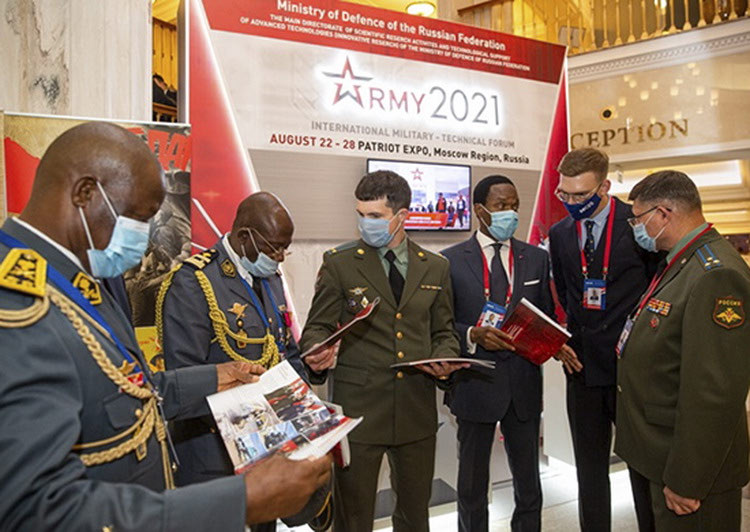 |
| Russia is trying to seize the initiative from the United States and other Western countries |
No matter how hard Russia tries to achieve its goals in the Asia-Pacific region, it actually understands the impossibility of doing so. The Moscow conference recognized the significant advantage of the US military forces in the region, which includes about 400,000 troops and more than 200 military facilities, including up to 50 US military bases. There is also a permanent aircraft carrier strike group led by the aircraft carrier USS Ronald Reagan, based in Japanese ports. And since 2020, the United States has simultaneously been deploying up to three such carrier strike groups in the region.
In addition, the United States has begun rebuilding the 1st Fleet, which will control the eastern part of the Indian Ocean. This will allow to use the resources of the US 7th Fleet to resolve problems in the East China and South China Seas, as well as intensify actions to deter Russia and China in the South and Southeast Asia. Besides, there are several air bases in the Asia-Pacific region with B-52, B-1B and B-2B strategic bombers and the F-35 fighters.
 |
| The Moscow conference recognized the significant advantage of the US military forces in the Asia-Pacific region |
In its confrontation with the West, Russia is still trying to rely on China. However, Beijing is not going to a direct confrontation with the United States and Europe on the side of Moscow. The Chinese military leadership actually ignored the Moscow conference. Chinese Defense Minister Wei Fenghe only made a video address to its participants, in which he did not mention the United States or NATO in any way.
Besides, China is Russia’s strong competitor in the Asia-Pacific region and is not going to yield its national interests there. At this, contrary to Moscow’s claims to build a strategic partnership with Beijing, Russian experts point out an increase in threats from China, which is building up military spending, increasing its military presence and modernizing its armed forces, which already outnumber the Russian army and navy qualitatively.
Under such circumstances, Moscow is conducting a large-scale information campaign to provoke additional tensions between the United States and China, aimed at creating a basis for deepening Russian-Chinese ties on an anti-American basis.
 |
| China is Russia’s strong competitor in the Asia-Pacific region and is not going to yield its national interests there |
Moscow continues to see Ukraine as an “the West’s anti-Russian project” and “part of the Russian world” that has no right to “its own self-identification, language, culture and statehood”. All this was confirmed by V. Putin during his direct line. Emphasis was placed on the inadmissibility for Russia of Ukraine’s accession to NATO, which is a “red line” for Russia’s interests and security.
Based on this, Moscow opposes the development of military and other forms of cooperation between Ukraine and the United States and NATO, including by demonstrating sharply negative reaction to the military exercise Sea Breeze 2021. Such actions of Russia are accompanied by the continuation of active information campaign to form a negative attitude to the idea of Ukraine’s Euro-Atlantic integration among both, the Ukrainian population and NATO member countries. In particular, it is argued that Ukraine’s joining the Alliance would mean “its loss of independence”, “escalation of the country’s civil war” and complication of the situation in Europe and the Alliance as a whole.
Unfortunately, Moscow’s efforts to counter Ukraine’s accession to NATO are yielding some results. A manifestation of this is the refusal of the leadership of the North Atlantic Alliance to grant Ukraine with the Membership Action Plan, which is explained by the reluctance to exacerbate relations with Russia.
 |
| Moscow continues to see Ukraine as an “the West’s anti-Russian project” |
Russia treats the entire post-Soviet space in a similar way, which it considers a “zone of its exclusive interests”. In particular, during the Moscow conference, V. Putin pointed out Russia’s “responsibility” for the situation in its neighboring countries. However, already during the direct line, the RF President acknowledged the actual impossibility of restoring the USSR, which makes Russia implement its geopolitical plans on its own.
In fact, Russia’s only partner from among the countries of the former Soviet Union remains the Lukashenko regime in Belarus, which hopes for Moscow’s support in maintaining its power in the country and confronting the West. To this end, Minsk is using the escalation of the Moscow-US/NATO confrontation, which allows it to get assistance from Russia. This issue was raised by the Minister of Defense of Belarus V. Khrenin during the Moscow conference. He once again accused the West of trying to organize “color revolutions” in Belarus and Russia, which creates a basis for cooperation between them in opposing such intentions.
 |
| Minister of Defense of Belarus V. Khrenin accused the West of trying to organize “color revolutions” in Belarus and Russia |
|
…Moscow is unable to achieve its strategic goal of restoring Russia as a “great world power”… |
Evidence of Moscow’s inability to achieve its strategic goal of restoring Russia as a “great world power” is also Putin’s factual confirmation of significant internal problems in the country. As in previous public speeches since the beginning of this year, he again refrained from setting large-scale tasks for the Russian government to strengthen the country’s economy and improve living standards.
Under these circumstances, the Kremlin continues to rely on military force and nuclear blackmail of its opponents. Speaking at the Moscow conference, Russian Defense Minister S. Shoigu stressed Russia’s readiness to preemptively use nuclear weapons, as well as all other possible means to protect its interests.
 |
| Russian Defense Minister S. Shoigu stressed Russia’s readiness to preemptively use nuclear weapons |
Demonstration of this was the intensification of Moscow’s military provocations against the United States and NATO. In particular, in May this year Russian Tu-22M3 long-range bombers simulated a missile strike on NATO warships and military bases in the Mediterranean.
And on June 26, 2021 warships of the Russian Navy, led by the missile cruiser Moskva of the RF Black Sea Fleet conducted missile launches in the Mediterranean Sea in close proximity to the British aircraft carrier HMS Queen Elizabeth. Missile strikes were also simulated by Russian Tu-22M3 bombers and high-altitude MiG-31BM interceptor aircrafts. The strikes was conducted immediately after the June 23 incident involving a Russian attack on the British destroyer HMS Defender in international waters near Crimea.
Similar provocations are organized by Russia also against the participants of the Sea Breeze 2021 exercise. In early July 2021 almost all naval forces of the RF Black Sea Fleet were brought to the area of the exercise.
At the same time, Russia has stepped up its military activity in the Asia-Pacific region. In June 2021 in the central part of the Pacific Ocean for the first time was conducted operational exercise of the Russian Navy. Tactical naval group of the Pacific Fleet made a transit to a range of about 4 thousand km. The exercise involved 20 surface ships, submarines and support vessels, including a missile cruiser, a large anti-submarine ship and several patrol ships. Besides, about 20 aircrafts were involved in the exercise, including long-range anti-submarine Tu-142M bombers and MiG-31BM interceptor aircrafts.
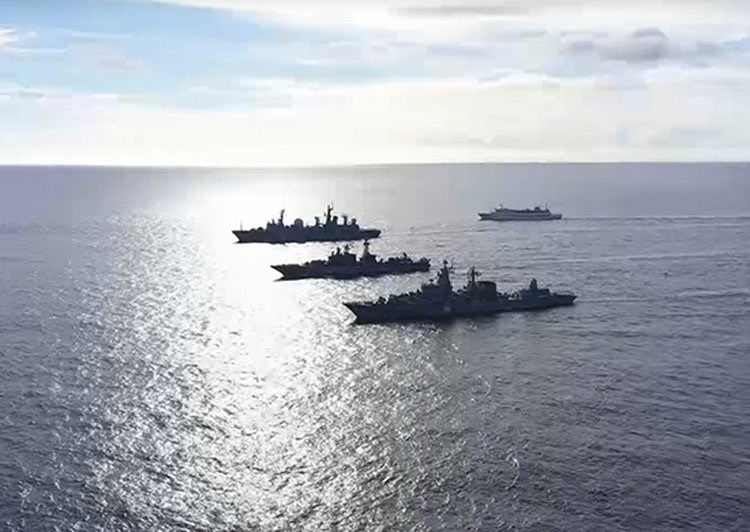 |
| In the central part of the Pacific Ocean for the first time was conducted operational exercise of the Russian Navy |
Against the background of these processes and trends, the Putin regime is trying to shift the focus of international attention from the problems associated with the Russian annexation of Crimea and occupation of the Donbas, human rights violations in Russia and other inconvenient issues. All of them were practically ignored both during the Moscow conference and the direct line and were touched upon by V. Putin only during bilateral phone talks with A. Merkel and E. Macron. During the direct line, V. Putin openly refused to meet with President of Ukraine V. Zelenskyi, citing the “destructive position of Kyiv”, which allegedly refuses to normalize relations with Russia. In reality, the reason for such a decision of V. Putin was his unwillingness to discuss with V. Zelenskyi the problems of Crimea and the Donbas.
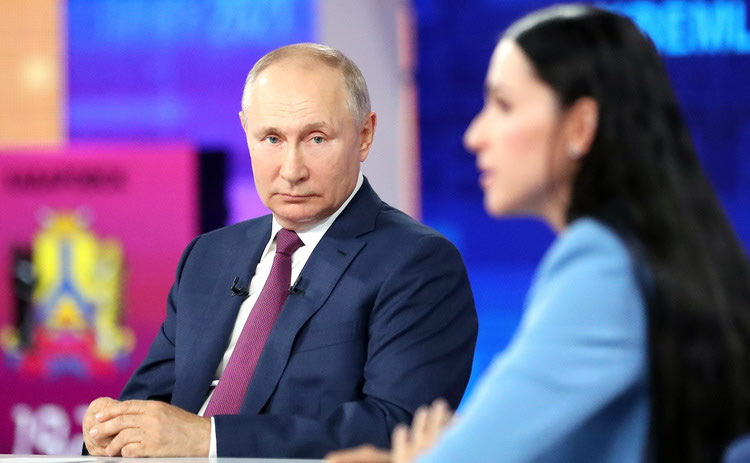 |
| The Putin regime is trying to shift the focus of international attention from the Russian annexation of Crimea and occupation of the Donbas |
|
…Because of the practical impossibility of a peaceful settlement of the situation around Ukraine, it will continue to be the main target of Russia’s aggression… |
All this once again proves the practical impossibility of a peaceful settlement of the situation around Ukraine, which will continue to be the main target of Russia’s aggression. In turn, the United States and NATO will increase support for Ukraine in the political, economic, and military spheres. In particular, the evidence of this is a qualitatively new level of the Sea Breeze exercises, which this year has acquired the largest scale since their inception.
At the same time, Ukraine’s defense capability is reaching a qualitatively new level, which is already a powerful deterrent for Russia. Of course, Moscow will continue to demonstrate military force to our state, but it will no longer dare to attack it openly, as it would make Russia pay an unacceptably high price.
 |
| Moscow’s provocations against US/NATO could cause armed incidents that could escalate into military conflict, or even war |
However, it’s not all that simple. Moscow’s move to open provocations against US/NATO warships and aircrafts in the Black and Mediterranean Seas, as well as in the Asia-Pacific region, threatens with armed incidents that could escalate into military conflict, or even war, between Russia and the West. Moreover, Ukraine would also be involved in it. In addition, Belarus’ final drifting to Moscow’s side up to its possible “absorption” by Russia, opens a new “northern front” against Ukraine.


