
 Roman Kot
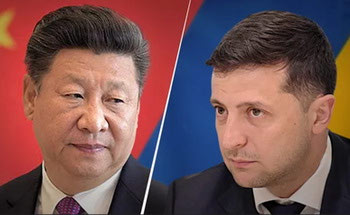
Recently, the political dialogue between Ukraine and China has become public: from the series of statements by the ruling Servant of the People party and the signing of an agreement on cooperation in construction of infrastructure, to President of Ukraine Volodymyr Zelenskyi’s phone conversation with President of the PRC Xi Jinping.
|
Note:
The President of Ukraine stressed the importance of the participation of Chinese investors in the implementation of a number of projects on the development of seaport infrastructure, construction and modernization of roads, development of railways and urban infrastructure and municipal services. It is noted that Xi Jinping pointed out the importance of the presidential project “Large Construction” and expressed China’s readiness to cooperate in this direction. The parties also paid attention to the potential of cooperation in trade and the possibility of increasing its volume. The heads of state also discussed the importance of developing interpersonal contacts between our countries and agreed to conclude a visa-free agreement between Ukraine and China. |
Such developments were met with criticism inside Ukraine, in particular from political commentators affiliated with the so-called pro-European opposition represented in the Verkhovna Rada. The main theses of criticism can be limited to several points:
- Ukraine blackmails the West by reorienting to China;
- such a step is dictated by the current political considerations of the Ukrainian authorities;
- increasing cooperation between Ukraine and China will slow down reforms in Ukraine, as Beijing does not demand internal reforms in Ukraine in exchange for loans.
We consider it necessary to express certain opinions on these theses.
Facts First
Ukraine’s interaction with China is systemic — a strategic partnership between the two countries has been established 10 years ago. After a certain lull during Poroshenko’s presidency, relations between Kyiv and Beijing have really intensified since the beginning of Zelenskyi’s presidency, and not only now. This was mainly manifested by contacts with business and specialized working groups.
Since 2019, China has been first among all trade partners of Ukraine. According to the State Statistics Service, in 2020 the bilateral trade turnover reached 15.4 billion US dollars. At this, exports of goods from Ukraine to China amounted to 7.1 billion US dollars (+98 % compared to 2019), imports of Chinese goods to Ukraine — 8.3 billion US dollars (-9.8 %). The negative balance of our foreign trade amounted to 1.2 billion US dollars.
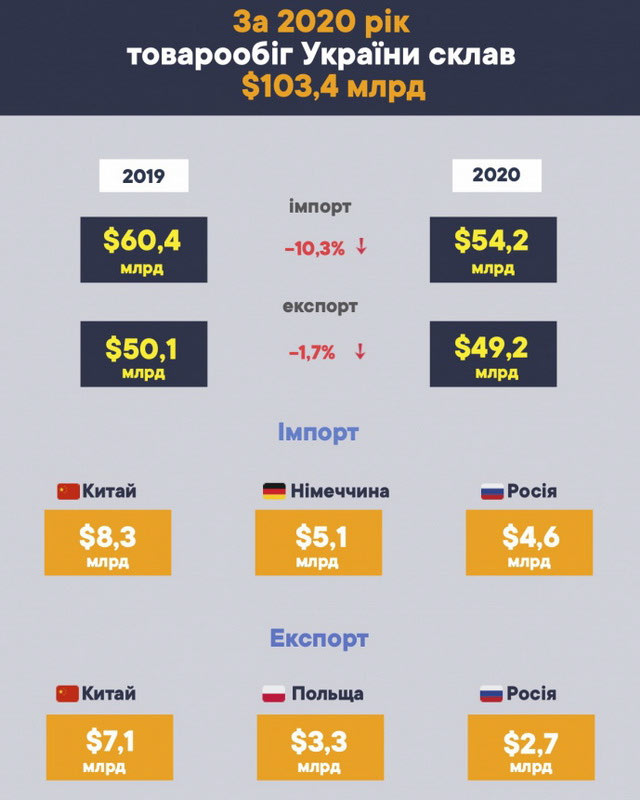 |
| Since 2019, China has been first among all trade partners of Ukraine |
Involving Chinese companies in Ukraine is more difficult — for various reasons. However, several recent joint projects are worth mentioning:
- Deepening of the bottom of the ports “Yuzhnyi” and “Chornomorsk”. In January 2018, China Harbor Engineering Company Ltd. completed the project on dredging of the water area of the seaport “Yuzhnyi” and in August 2018 began dredging in the port of “Chornomorsk”. Contracts worth 1.6 billion were signed in May 2017 with the Seaports Administration of Ukraine and were financed from the Ukrainian budget.
- Modernization of the Slovyansk thermal power plant. In December 2018, PJSC Donbasenergo and Dongfang Electric International Corporation signed a contract for the construction of two new power units at Slovyanska TPP. Under the terms of the tender, the winner must attract credit financing in the amount of at least 85 % of the project cost for a period of at least 15 years. Dongfang Electric International Corporation provided a letter of interest in financing from the Bank of China. Unit 6B is scheduled to be commissioned in July 2022, and Unit 6A — in July 2023.
- In 2020, a project to build 4G network in the Kyiv Metro (underground railway) was implemented with funding from Kyivstar, Vodafone and Lifecell, Ukraine’s leading mobile operators. The main supplier of equipment worth 150 million hryvnias was the Chinese company Huawei.
- Construction of the Nikopol solar power plant with a capacity of 200 MW. SPP was built by Solar-Pharm-1 (a subsidiary of DTEK) together with China Machinery Engineering Corporation. The plant was put into operation in mid-January this year and is the largest in Ukraine and one of the largest in Europe. Chinese investment in the project is about 230 million US dollars.
- In April 2019, an agreement was concluded between the State Export-Import Bank of Ukraine and the Chinese Export & Credit Insurance Corporation (SINOSURE). According to the agreement, SINOSURE must provide insurance support for projects submitted through Ukreximbank and contracts concluded by Chinese companies in Ukraine. The total insurance limit is 500 million US dollars.
|
…Ukraine has experience in defending its own interests in dialogue with Chinese investors… |
On the other hand, Ukraine has experience in defending its own interests in dialogue with Chinese investors. This is not just the case with Motor Sich. Let me remind you that in March of this year, the company was nationalized in accordance with the decision of the National Security and Defense Council of Ukraine.
Another case: in October 2017, Ukravtodor and China’s Xinjiang Communications Construction Group signed two contracts totaling 95.8 million US dollars (backed by the World Bank). One of them provides for the reconstruction and overhaul of the M-03 Kyiv — Kharkiv — Dovzhanskyi motorway (contract amount — 57.3 million US dollars). But in June 2019, Ukravtodor terminated the contract. The reason was that by the date of termination of the contract the contractor had performed only certain types of work, which was less than 1 % of their total volume. At this, by the date of termination of the contract, the contractor had to have performed 70 % of the work.
We should also mention the banking sector. Back in May 2019, it received the international identification code LEI, and in the autumn of this year, the Ukrainian Bank for Reconstruction and Development began to function fully in Ukraine — the first such institution with entirely Chinese capital. In November 2017, the Chinese Bohai Commodity Exchange Co. Ltd. (BOCE) bought from the state of Ukraine 99.9 % of the shares of this financial institution for 82.83 million hryvnias.
|
…At present, the level of Ukraine’s interaction with China is not even close to that of Ukraine’s economic relations with the EU, and Ukraine’s military-political cooperation with the United States… |
However, at present, the level of Ukraine’s interaction with China is not even close to that of Ukraine’s economic relations with the EU, and Ukraine’s military-political cooperation with the United States. To begin with, the course for European and Euro-Atlantic integration is enshrined in the Constitution of Ukraine. Secondly, the Association Agreement between Ukraine and the EU allows us to consider China at best as an additional partner.
On the other hand, the intensification of the confrontation between China and the United States imposes restrictions on the list of spheres where Ukrainian-Chinese cooperation is possible. In particular, this applies to restrictions on defense industry, as well as Chinese investment in critical infrastructure. However, as the situation with Motor Sich shows, China is ready to accept the lack of progress in these areas, and at the same time increase cooperation in others.
Political Considerations
|
…Unlike economic dialogue, political dialogue of Ukraine with China has lagged far behind until recently… |
Unlike economic dialogue, political dialogue has lagged far behind until recently. The phone conversation of the leaders of the two countries on July 13 was their first direct contact.
It is also known about the preparation of a future grand tour of the President of Ukraine to Asia, including China. According to available information, the tour was postponed several times due to quarantine restrictions and may take place no earlier than the end of autumn–winter of this year due to the busy schedule of the Ukrainian leadership in preparation for the visit to the United States and the Crimean Platform summit. Both of these events are scheduled for August this year. Another factor hindering the development of Ukrainian-Chinese relations is the absence of Ukraine’s ambassador to Beijing…
The intensification of political contacts between Ukraine and China right now has several aspects. The first is the celebration of the 100th anniversary of the Chinese Communist Party. Secondly, this is Kyiv’s attempt to use the Chinese factor in the dialogue with the United States. Although Joe Biden has been President of the United States for more than six months, the US administration’s policy toward Russia and wider Central and Eastern Europe has not been finalized.
Russia’s involvement in the USA-China confrontation and settling the Donbas conflict as part of this process are currently being discussed in the White House between supporters of the implementation of the Minsk Agreements in their current form and supporters of other ORDLO reintegration conditions. The resignation of the decisive opponent of this development, the Minister of Internal Affairs of Ukraine A. Avakov, may further contribute to this.
In general, such messages should be interpreted as an attempt to play in favor of the representatives of the part of the American establishment that is against any concessions to Russia. The problem is the form of such messages.
The other day, the statements of the adviser to the head of the Office of the President of Ukraine O. Arestovich made much ado.
|
Note:
|

The experience of other countries shows that such sharp statements are immediately perceived negatively, in contrast to softer wording through diplomatic channels, and work on the so-called one-and-a-half track in bilateral relations — at the level of analysts and experts, especially if such statements are supported by certain symbolic actions.
What’s Next
|
…Regardless of how the Chinese factor is used in the dialogue with the United States, direct contacts will do good to relations between Ukraine and China… |
At the moment, the political dialogue is hampered by the lack of a full-fledged diplomatic mission of Ukraine in China. In February of this year, the Ambassador of Ukraine to China Serhiy Kamyshev, appointed by V. Zelenskyi, died of a heart attack.
However, to establish even purely economic cooperation with China, in any case, it would be necessary to start a political dialogue, sooner or later. Regardless of how the Chinese factor is used in the dialogue with the United States, such direct contacts will do good to relations between Ukraine and China.
And here’s the thing to keep in mind: the failure of Chinese investment is largely due to the attempts of local elites to profit from Chinese investment through corruption. In such cases, their payment is a burden on the state budget or has to be exchanged for political concessions to China. The positive experience of other countries, including such important countries in the Ukrainian context as Italy or Georgia, shows that any joint projects with China must be economically viable and profitable for both parties to benefit.


