
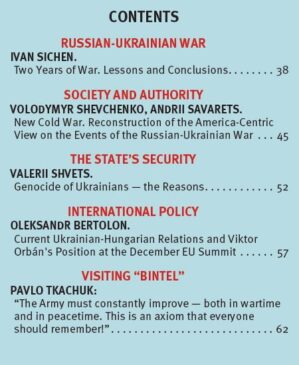
 The New Issue of “BINTEL” Geopolitical Analytics Journal Has Been Published

In each issue of the “BINTEL” Geopolitical Analytics Journal, the tradition of publishing analytical materials is preserved, the authors of which present their, as a rule, somewhat different from others, point of view on current events. However, there is something in common here: the developments in Ukraine are always in the center of attention. This includes Ukrainian history, its connection with the present, political events, important decisions of the leaders of our state, consequences of certain government decisions, as well as the war waged by Russia against Ukraine. So, once you start looking through journal’s pages, you will find materials with exactly these narratives.
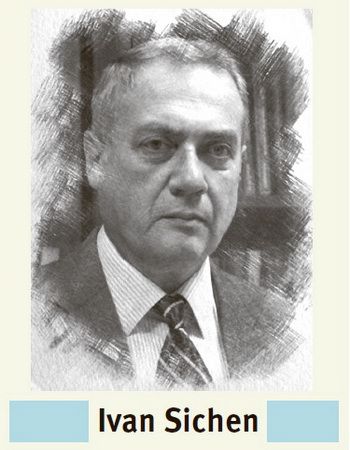 The first article of the journal under the heading “RUSSIAN-UKRAINIAN WAR” is about the hostilities in the East of our country. The title of the article by Ivan Sichen, military and political expert, is unambiguous — “Two Years of War. Lessons and Conclusions”, its content is specific, and the given facts comment on the peculiarities of our resistance to the Russian attacker last year.
The author points out that during the last two years of active hostilities, Russia did not manage to achieve what it wanted — to destroy Ukraine. And this became our Ukrainian, main achievement. And then the author moves on to the analysis of combat operations.
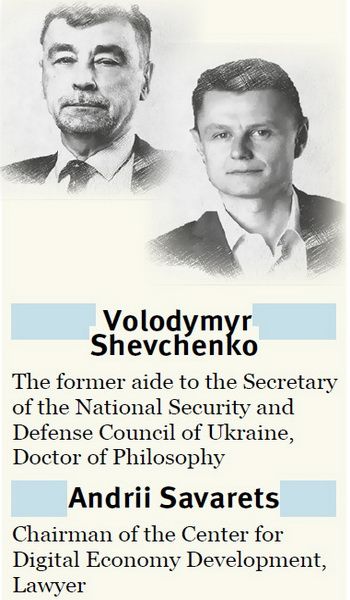 Under the rubric “SOCIETY AND AUTHORITY” the reader is offered another article, “New Cold War. Reconstruction of the America-Centric View on the Events of the Russian-Ukrainian War”, by our regular authors Volodymyr Shevchenko and Andrii Savarets. Our readers have already had the opportunity to familiarize themselves with their analytical thematic works, especially since they were published both in the journal and as special editions, and were posted on other popular websites. This time, the authors analyze the new Western strategies of action in relation to the Russian-Ukrainian war, the basis of those strategies, their authors, the content of political developments, which become the basis not only for political, but also for economic calculations.
As an example, it is sufficient to quote a piece from the text of this respectable work. For one, the authors draw attention to the fact that “It will already be difficult for the same Europe to ignore the red arrows drawn on the map of Russia’s alleged attack on NATO countries, since past arrows painted on the map of Ukraine exactly coincided with reality and turned into the horror of the war, unprecedented for the 21st century. The rapid end of the war in Ukraine with a decisive defeat of the Russian army and the fall of the Kremlin regime will not give time, and most importantly, sufficient motives for global reconstruction. And the failure to create a new system of international security, with the complete degradation of the old one, would inevitably lead to an unpredictable, and, therefore, poorly controlled consequences from the point of view of the USA… From this point of view, it is fair to talk not about a local protracted conflict, but about a new Cold War, in which hot clashes will be dropped into the external contour of global macro-clusters”.
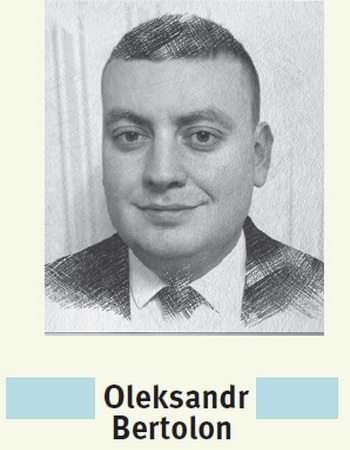 Under the heading “INTERNATIONAL POLICY”, this time we offer the article “Current Ukrainian-Hungarian Relations and Viktor Orbán’s Position at the December EU Summit”. Its author Oleksandr Bertolon constantly monitors Ukraine’s relations with Hungary (with one of our closest western neighbors), as he also serves as Deputy Chairman of the NGO “Association of Political and International Relations Scientists of Uzhhorod National University”.
He constantly participates in various Ukrainian-Hungarian events taking place in Uzhhorod, communicates with distinguished guests who arrive in Transcarpathia, prepares relevant analytical materials for scientific publications. Given the relevance of such events, we hope that our readers will continue to be able to familiarize themselves with Oleksandr Bertolon’s thorough analyses. And there will always be enough material for such analyses, as we have seen for ourselves more than once.
One of our regular authors, Valerii Shvets, is known to a wide readership for his research of the Holodomor in Ukraine. The materials thoroughly prepared by him on this historical topic can be considered original, since they are based on an analysis of the events of the last century related to the purposeful genocide of Ukrainians. In particular, the author supports his conclusions with indisputable indicators, among which is the average age of Ukrainians in different years of the last century, when Bolsheviks wars raged on Ukrainian territory, Red Army units sent by Moscow seized grain and food from the peasants, as a result of which the local population died out and, by and large, the future of the Ukrainian nation was being destroyed. This is exactly what Valerii Shvets’ article “Genocide of Ukrainians — the Reasons”, published in the journal under the heading “THE STATE’S SECURITY”, is about.
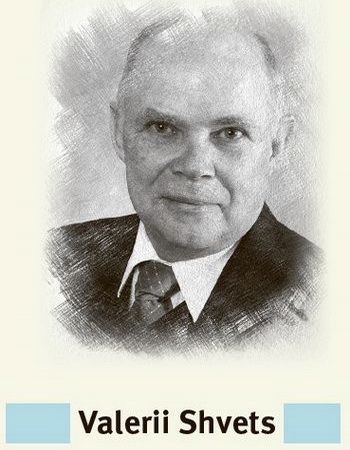 The author points out that “When studying this unprecedented tragedy of the Ukrainian people, the first question that arises is whether we should talk about three separate acts of genocide: 1921–1923, 1932–1933, and 1946–1947? Or are these acts just a significant intensification of the genocide of the Ukrainian people, which lasted throughout the years of Bolshevism in its most aggressive form, Stalinism?” Indicating that he is a supporter of the latter, the author presents indisputable facts, including many testimonies of the genocide of his acquaintances and relatives who managed to survive in those distant stormy times. It should be noted that the events in Odesa and Kherson regions are described not only for the 1930s, but also during the Second World War and subsequent years, when Ukrainians also suffered from famine. At the same time, the article also tells about how Ukrainians had to survive in the territories captured by the Germans or Romanians. The author considers it appropriate that his colleagues’ research in such an important activity should be supported by indicators of the average life expectancy of the rural population during all the years of Stalinism in all regions of Ukraine. The following lines of his article will be relevant, as they are related to the current hostilities in Ukraine: “To try and make Europeans understand the “uniqueness” of the Russian mentality, I will quote the words of George Smith Patton Jr., commander of the Third United States Army: “The difficulty in understanding the Russian is that we do not take cognizance of the fact that he is not a European but an Asiatic and therefore thinks deviously… In addition to his other amiable characteristics, the Russian has no regard for human life and is an all out son of bitch, a barbarian and a chronic drunk” (Berlin, 1945)”.
And in the last paragraph of his article, Valerii Shvets points out the following: “While holding the aggressor state, the current Russian Federation, responsible for the genocide of the Ukrainian people, all legal aspects of bringing all parties involved in the crime to justice should be considered”.
Under the heading “VISITING “BINTEL” we offer an interview with Head of the Hetman Petro Sahaidachnyi National Army Academy, Lieutenant General Pavlo Tkachuk. Traditionally, the title of the interview includes a phrase that demonstrates both the topic of the conversation and the position of the person answering the questions: “The Army must constantly improve — both in wartime and in peacetime. This is an axiom that everyone should remember!”
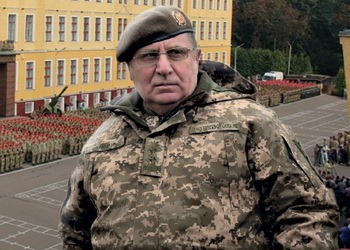 Of course, there can be no “peaceful” questions during the war with the Russian aggressor against Ukraine, especially since a lot depends on the training of Academy graduates on the real battlefield. That is why, in the conversation with the Head of the Academy, we discussed the specifics of the current training of future officers, peculiarities of modern tactics, the cadets’ attitude to the performance of their duties, improvement of the educational process, as well as cooperation with our foreign colleagues. By the way, they are extremely interested in such cooperation, taking into account the combat experience we gained in battles with the invader with the use of the newest weapons. After all, it is sufficient to keep in mind the number of graduates of the Academy who were awarded the high title of Hero of Ukraine for their heroic deeds on the battlefield. And as confirmation, we can cite what Lieutenant General Petro Tkachuk said about this: “It is very important, and I am extremely proud that the graduates of the National Army Academy at that extremely important and critical for Ukraine moment were and remain the backbone of the Ukrainian army, which stood in the way of the Muscovites’ ambitious invasion plans”.
Oleh Makhno, Chief Editor of the “BINTEL” Geopolitical Analytics Journal
“BINTEL” Journal, № 1–2024


