
Pandemic and Crisis as Factors of Geopolitics
Victor Hvozd
Doctor of Military Sciences
“…We’re the most powerful nation, and Russia used to be one”.
US President D. Trump’s remarks to the media
According to most political science concepts, one of the driving forces in the development of mankind is various crises that periodically arise in the world for one reason or another. Depending on the scale of such crises, their consequences may be a change in the balance of forces in the world or in individual regions, as well as new geopolitical and geo-economic formations.
|
…The main role in the process of building a future world order will be played by China and the United States as the two great powers… |
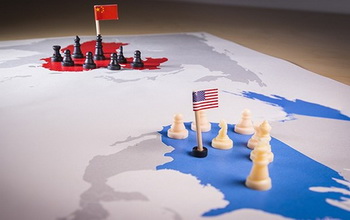
This applies to the current situation in the world, which, in fact, has the character of a new global crisis and leads to another transformation of the entire system of international relations. Thus, the multi-polar world, which has begun to take shape in recent years with several centers of power at different levels, is again being replaced by a bipolar model of world order, now led by the United States and China.
All other centers of power, including the United Europe (EU) and Russia, cannot compete with them and are gradually losing ground. Moreover, some of them are in the American or Chinese spheres of influence. This is evidenced by the consequences of the coronavirus pandemic and the destabilization of the world oil market.
At the same time, the pandemic and the oil crisis have become just catalysts or manifestations of the intensification of the struggle between different centers of power for realization of their interests. This struggle is much broader and deeper, and its results depend on superiority of the economic and political systems of rival countries. Of course, it is impossible to describe all aspects of the theme in one article. Therefore, we will focus only on the most significant ones.
To date, China has shown the greatest success in overcoming the crisis, and thus in strengthening its position in the geopolitical confrontation in the world. The reason for this is the high efficiency of the political and economic system of China, which combines the positive aspects of state-run methods of management, market and innovation economy, as well as socialist approaches to meeting the needs of the population.
|
…China has shown the greatest success in overcoming the crisis, and thus in strengthening its position in the geopolitical confrontation in the world… |
During the pandemic, China’s state-run methods of management allowed for a strict quarantine regime, as well as effective care for the sick. Including by expanding the network of hospitals, mobilizing medical staff and allocating the needed material and technical resources (drugs, protective and special equipment, etc.). Due to this, the Chinese leadership managed to quickly overcome the epidemic with relatively few casualties among the population.
The Chinese government also provided targeted financial assistance to all economic actors affected by the epidemic, from state-owned enterprises and large private companies to small and medium-sized businesses. In turn, this allowed to restrain the crisis in the Chinese economy at a appropriate level. According to different estimates, the coronavirus epidemic caused an about 6 % year-on-year GDP decline in China’s economy. However, from April to May this year it began to grow gradually. At this, a favorable factor for China, as the world’s largest consumer of energy carriers, was the decline in oil prices.
Unlike China, the democratic and largely bureaucratic government system in the United States did not allow for a strict quarantine regime in the country. In fact, uncontrolled remain some areas of New York City and some other cities, which became centers of spread of infection. There were also some problems with the mobilization of medical personnel. These circumstances caused the rapid spread of the coronavirus infection in the United States, which ranked first in the world in the number of patients.
|
…The availability of significant resources in the United States allowed the country’s leadership to quickly establish a system to counteract the epidemic. A powerful stabilizer of the US economic system was its advanced innovative nature… |
At the same time, the availability of significant resources in the United States allowed the country’s leadership to quickly establish a system to counteract the epidemic and provide it with all means needed. At this, restrictive measures were strengthened and a number of mobilization steps were taken.
The US economy also faced significant challenges, which included, first of all, partial suspension of production due to the quarantine, and losses of the oil industry due to falling world oil prices. The latter factor was particularly negative for the United States as one of the world’s largest oil producers. However, all this did not become a catastrophe for the US economy, which lost only 5 % of GDP. A powerful stabilizer of the American economic system was its advanced innovative nature, which provides high productivity, ability to quickly redistribute investment (capital) between different industries, as well as the use of new (including remote) methods of work based on digital technologies.
The European Union has faced even greater problems. Thus, at the initial stage of the pandemic in the world, the spread of coronavirus in Europe was facilitated by the same factors as in the United States. Plus, additional obstacles in the fight against the pandemic were: disagreements between EU countries over the methods of joint action in this sphere; transparency of internal European borders; mass movements of people and goods; illegal migration to Europe from the Middle East and North Africa.
|
…EU countries have managed to turn the tide and succeed in addressing the epidemic at both European and national levels… |
This mainly applies to the most developed members of the EU — Germany, France and the United Kingdom, as well as the countries of Southern Europe, in particular — Italy and Spain, which are mostly chosen by migrants. It is these countries that have largely suffered from the pandemic and faced the most acute economic problems. All in all, the decline in the aggregate GDP of the euro-area countries is estimated at 7.7 % year-on-year.
Yet, again, these problems did not cause a catastrophe in Europe. For example, EU countries have managed to turn the tide and succeed in addressing the epidemic at both European and national levels. This created preconditions for Europe’s gradual exit from the crisis.
|
…Russia is on the verge of a deep crisis… |
Absolutely different is the situation in Russia, which is in fact on the verge of a deep crisis. According to the forecasts of the Central Bank of Russia, by the end of the year the country’s economy may fall by 4–6 %. In contrast, the Institute of Economics and the Institute of Economic Forecasting of the Russian Academy of Sciences estimate the decline in Russia’s GDP in 2020 at 12–20 %. Even more negative prospects are expected by a number of other experts, who do not rule out the possibility of Russia’s economic downturn of 40–80 %.
All this is the result of the de facto failure of Putin’s policy, which showed the Kremlin’s inability to effectively counter powerful challenges and threats that Russia faces. Thus, despite Putin’s construction of a rigid totalitarian power system in the country, it has, in fact, failed to curb the rapid spread of the epidemic. The reasons for this were: lack of resources needed; a low level of executive discipline at all levels; the populist position of the Russian ruling elite, which for a long time refrained from imposing strict quarantine in order to demonstrate Russia’s “superiority” over other countries.
Moreover, the weakening of the “manual” mode of ruling Russia immediately led to the beginning of “self-isolation” of Russian regions. Citing V. Putin’s decree on granting the regions additional powers to counter the pandemic, local authorities began to take their own quarantine measures, including with violations of the Constitution of the RF. Such practices also pave the way for the development of regional separatism, which will intensify as the economic situation in the country deteriorates.
|
…Failure of Putin’s policy showed the Kremlin’s inability to effectively counter powerful challenges and threats that Russia faces… |
Russia’s economic system, built by V. Putin on the archaic methods of state-oligarchic management of the most important sectors of the Russian economy, also showed its inefficiency. At this, they mainly remain focused on the extraction and export of natural resources. This is what created the basis for Russia’s economic problems and the practical impossibility of their independent solution.
Today Russia can count only on its financial reserves, accumulated in the country’s National Welfare Fund. At this, according to Russian experts, in case of a continuation of the pandemic in Russia and further instability in the world oil market, these funds will have been spent before the beginning of next year.
In general, these factors will determine the architecture of the future world order. At this, the main role in the process of building a new world will be played by China and the United States as the two great powers. In fact, the struggle between them began long before the current crisis, but today it is taking on new manifestations and forms.
|
…China is stepping up measures to expand its sphere of influence in the world, for which purpose it takes advantage of other countries’ economic problems… |
Thus, based on the progress made in overcoming the crisis, China is stepping up measures to expand its sphere of influence in the world, for which purpose it takes advantage of other countries’ economic problems. According to a number of world media reports, Chinese business is actively buying up companies from neighboring countries that have gone bankrupt or are in dire straits. First of all, such actions of China are aimed at India, which is China’s rival in Southeast Asia, as well as the countries of the Asia-Pacific region, Central Asia, Africa and South America. Special attention is paid to Russia. At the same time, Chinese media spread in the information spaces of neighboring countries the idea of China’s advantages over them in economic, medical and other fields. This suggests a conclusion that they should unite around China on the basis of common interests and historical past.
In response, the United States is stepping up its efforts to maintain its dominance in the world and counter the Chinese expansion. In particular, they include the uniting of Western countries around the United States, this time — on an anti-Chinese basis. At this, the United States is moving from the isolationist policy that was characteristic of the initial stage of Trump’s presidency to the traditional Euro-Atlantic and Trans-Pacific course.
|
…The United States is stepping up its efforts to maintain its dominance in the world and counter the Chinese expansion… |
This was evidenced by the United States and its allies (Great Britain, Canada, Australia and New Zealand)’s accusations against China for “deliberately concealing information about a new viral infection” and for “developing and using COVID-19”. Thus, according to US Secretary of State M. Pompeo on May 3, “There’s enormous evidence that that’s [Chinese laboratory in Wuhan] where this [coronavirus] began”.
These steps of the USA are confirmed by the US assistance to European and other countries in fighting the pandemic. Despite its own problems with the epidemic, the United States has allocated about a 1 billion US dollars for these purposes. Of these, 100 million US dollars were provided to Italy as the most affected EU country. Significant sums have been allocated to the countries of Central America, Asia-Pacific, Africa and the former Soviet Union. In particular, 9.1 million US dollars were provided to Ukraine (as the United States’ main partner in the post-Soviet space); Georgia, Azerbaijan and Armenia got 1.7 million US dollars each (as countries in the Caucasus region, which is of particular importance to the United States); 1.3 million US dollars went to Belarus (as a country that is beginning to change its policy towards improving relations with the West).
To counteract China’s economic expansion in Europe, the United States has resumed the practical implementation of the idea of integrating American and European markets. In May 2020 the United States and the UK returned to a free trade talks. If successful, dialogue can also be resumed on creation of a free trade area between the US and the EU.
We should also mention the United States’ moving to a new stage of economic war with China. One form of such war is the transfer of American capital and enterprises to other countries, India included.
In general, the USA’s policy towards China is supported by Europe. In particular, the NATO summit in December 2019, emphasized the increase in China’s threats to the West. At the same time, the leading EU countries have begun their own steps to curb China’s economic expansion by imposing restrictions on Chinese investment in most important sectors of the European economy. As a result, the EU’s policy is increasingly beginning to follow American interests.
|
…The United States/NATO and the EU are severely blocking Russia’s attempts to achieve international recognition of its exclusive sphere of influence in the world… |
Against this background, Russia is beginning to lose its position in the world and is gradually being pushed to the international stage background. This process was initiated in 2014 as part of the USA and the EU’s imposition of political and economic sanctions against Russia and is now reaching a qualitatively new level. Thus, the world’s leading powers, in fact, cease to reckon with Russia, except for certain aspects that are mostly formal in nature and do not have a real impact on the world situation. In particular, the United States and leading EU countries continue their dialogue with Russia on international security issues. Besides, in 2019, Russia’s full membership in the Parliamentary Assembly of the Council of Europe was restored. Moreover, against the background of the threat of a new global crisis, some European politicians and organizations are intensifying calls to lift sanctions from Russia and move to full cooperation with it. Cooperation between Russia and China, India and other “third world” countries also continues.
At the same time, the United States/NATO and the EU not only do not abandon the policy of restraining Moscow’s neo-imperial course, they consistently increase pressure on it. Within the framework of such a policy, Russia’s attempts to achieve international recognition of its exclusive sphere of influence in the world are severely blocked. At this, Western countries and international organizations have effectively excluded Russia from important international decision-making processes and their economic system. Evidence of this is the failure of Moscow’s attempts to achieve lifting of Western sanctions under the pretext of joint counteraction to crisis situations in the world. According to the leaderships of the United States, the European Union and leading European countries, the coronavirus epidemic in the world cannot be a reason to lift sanctions from Russia. Moreover, in early May this year, the United States expressed readiness to take much tougher actions against Moscow in case of its attempts to annex Ukraine or Belarus.
This position of the West is completely different from the situation during the global financial and economic crisis of 2008–2009, when the United States and the European Union went for “resetting” relations with Russia after its attack on Georgia.
|
…Russian’s aggression against Ukraine was perceived by the United States and Europe as a threat to their own security, which became a “point of no return” in their relations with Russia… |
All this was the result of Moscow’s crossing the “red line” in its foreign policy, which was for the West Russian’s aggression against Ukraine. Such actions by Moscow were perceived by the United States and Europe as a threat to their own security, which became a “point of no return” in their relations with Russia. In addition, in recent years there has been a gradual decline in Russia’s importance to the West, which has an additional impact on its attitude to it. In particular:
- the growth of China’s nuclear and missile capabilities, as well as the emergence of new countries with nuclear and missile potential, have virtually eliminated Russia’s sole role as a major source of threats to US strategic security. So, the agreements between the United States and Russia in this sphere have actually lost their validity;
- measures taken by the EU leadership, with the assistance of the United States, to strengthen European energy security have already significantly diversified the sources of gas and oil supplies to the European market. The result is the weakening of Russia’s position in the EU’s energy sector. This trend has become apparent in the current situation of excess energy carriers in the world market;
- stagnation of the Russian economy under Western sanctions, and now the consequences of crisis processes in the world, significantly narrows the Russian market for European goods. This reduces the importance of Russia as a trading partner of the European Union.
|
…Evidence of this is the failure of Moscow’s attempts to achieve lifting of Western sanctions under the pretext of joint counteraction to crisis situations in the world… |
These circumstances, in fact, have caused the failure of Russia’s plans to undermine the unity of the Western world and to “attract” to its side individual EU countries by organizing various information and propaganda campaigns around the coronavirus epidemic in the world.
Moscow’s actions included spreading outright lies about “the USA’s developing and spreading COVID-19 as a biological weapon against other countries,” “Europe’s inability to cope with the epidemic on its own,” and “Washington’s refusal to support its European allies.” On this basis, Russia has launched demonstration campaigns to help individual EU countries fight the pandemic. Despite the fact that such assistance was purely symbolic, Moscow actively used it as an informational pretext to attract to its side some European countries and to introduce split between them, including over anti-Russian sanctions.
However, the RF failed to achieve its goals. In this regard, the most illustrative was the position of Italy, which occupied a special place in the above-mentioned plans of Moscow. According to Italian Prime Minister G. Conte, “with regards to the geopolitics of who has received aid, I can confirm that our foreign policy today is identical to yesterday’s”. The pillars of Italy’s security are NATO and the European Union.
|
…Russia is already moving from attempts to reach an agreement with the West to regular demonstrations of force. With this in mind, we should also expect Moscow to intensify its actions to pursue its interests in Ukraine… |
Of course, this will not stop Russia, which will try to pursue its neo-imperial policy to the last. For example, it is already moving from attempts to reach an agreement with the West to regular demonstrations of force, including intimidation of the United States and Europe with the latest weapons. With this in mind, we should also expect Moscow to intensify its actions to pursue its interests in Ukraine, including intensifying provocations in the Donbas. In this way Russia will try to somehow compensate for the failures of its policy in relations with the West.
Given the above, Moscow will not make concessions to Ukraine, no matter how much we hope for such prospects. It is the understanding of this fact, not illusory “hopes for the best”, that should be the basis of Ukraine’s strategy to restore the territorial integrity of the state.


