
 French historian, author of the monograph “The Azov Regiment. Ukrainian Nationalism at War”
— You are professionally engaged in geopolitics and political studies. Recently, you have published a monograph “The Azov Regiment. Ukrainian Nationalism at War”. If it weren’t for the Russian-Ukrainian war, could the topic be different?
— I became interested in the politics and history of Ukraine at least seven years ago, and it did not depend on Russia’s invasion of your land. And when the active phase of the Russian-Ukrainian war began in 2022, I lost direct access to Ukraine itself and its scientific sources, which allowed me, as a graduate student, to carry out the planned tasks. The management of my university forbade me to come to Kyiv, where I visited as a researcher, but it was the war that pushed me to expand my scientific activity, which began to cover the Baltic countries and Poland. However, due to the ban, I did not curtail my work, in particular, I did not stop studying the Ukrainian language, which is also provided for by the field of my specialization.
|
…Ukraine is interesting just because it has been fighting Russia since 2014. I am sure that the war has only accelerated and strengthened the already growing global scientific interest in Ukraine… |
By the way, when my colleagues express their fears in view of the hostilities, I often quote the first lines of the Ukrainian national anthem: “Neither glory nor freedom of Ukraine has died yet…” And that means I’m really not a pessimist. Because Ukrainians demonstrate to the world exceptional courage and fortitude in the face of any trials that befall them. Wishing them to defeat the enemy, I have no doubt that Ukraine will exist as an independent state and will prompt, in particular, scholars to study the historical processes that took place on its territory in the past and are taking place today. After all, its history is rich in events, and so is its culture, and its society is quite dynamic.
Back to your question, I can’t say that the topic of Ukraine is interesting just because it has been fighting Russia since 2014. I am sure that the war has only accelerated and strengthened the already growing global scientific interest in Ukraine. So, answering, I would like to emphasize once again that even if there had been no war, I would still continue to do what I am doing now: scientific researches about Ukraine.
— What caused the choice of specifically military topic and the writing of such a meaningful monograph?
|
…The main reason for writing this monograph was, first of all, the desire to make a reasoned study of the “Azov” military formation and the movement associated with it in French… |
— The main reason for writing this monograph was, first of all, the desire to make a reasoned study of the “Azov” military formation and the movement associated with it in French. In order to separate “true from false”, if you understand me correctly… After all, with the Russian invasion, Vladimir Putin’s absurd statements about the so-called denazification of Ukraine and especially about the battle of Mariupol, which were widely covered live on all TV channels around the world, many people had a desire to learn more about “Azov” and the history of its creation. To tell the truth, this topic is not too easy to cover and present it in a modest article or in a few sentences in a short interview. Taking into account what I was able to learn and research, I decided to give clear and reliable answers to numerous questions with the help of such a monograph, to present my most objective view. I think that the peculiarity of my work is that it is based on facts obtained directly on the ground through communication and observation, discussions with those who are somehow involved in the activities of the “Azov” fighters.
By the way, some analysts have already tried to study this topic using all sorts of open sources, but I consider this approach irresponsible. One can always put forward a number of hypotheses by watching a particular Telegram channel or analyzing a particular photo. But sometimes even the very grounds for conclusions can raise questions. Therefore, I thought that with my seven years of experience in this field, I could offer something new, useful and interesting enough to be able to refute certain clichés or common misconceptions.
Of course, I cannot help agreeing with some colleagues who believe that it would be extremely foolish to speak about “Azov” and radical nationalism today, since this is at the heart of Russian propaganda, which seeks to demonize Ukraine and justify the horrors committed by the Russians, such as the massacre in Bucha. However, at the heart of my thoughts is something completely different. Since these terrible horrors take place, it is IMPOSSIBLE to ignore them, to keep silent about them, especially when we realize that we, in Europe, also have radical political movements, and that they are dangerous for peace and stability on the continent, because they are close to Russian narratives. Therefore, in my humble opinion, I should raise these topics on the basis of my research experience, and not consider them as developed by someone with malicious purposes. Therefore, the aim of my work is to present those arguments that I hope will become prominent in France and will help to debunk the falsehood.
As for your question itself, I cannot say that I am greatly interested in military topic. In my research, of course, I describe the evolution of “Azov”, which has turned from a volunteer battalion into a large unit of the National Guard, and now has also become an assault brigade. The research mainly concerns the war, as a fact of a certain functioning of society and an intellectual concept. What struck me the most was how such a force emerged during the war and managed to become legitimate and, above all, I wanted to understand how the “Azov” people perceived the war.
— Is there a difference in your perception of the Russian-Ukrainian war from the moment it began and when you became more deeply interested in these tragic events?
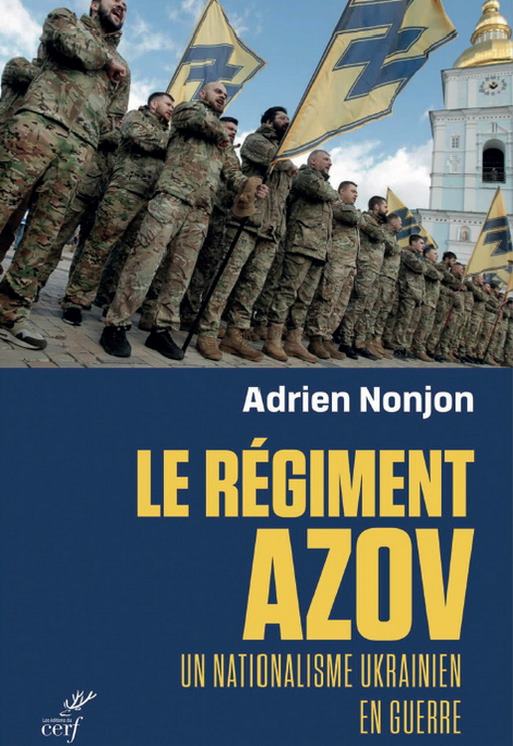 |
| Adrien Nonjon’s monograph “The Azov Regiment. Ukrainian Nationalism at War” |
— Personally, I don’t see any difference between 2014, when the war began, and 2022, which is the second phase of the conflict, when Russia decided to intensify its invasion of Ukraine. Here the stakes are the same: one nation fights for its right to be independent, while the other pursues imperialist policy in its near abroad in order to reassert itself as a leading power. Anyway, I cannot hide the fact that the attack on Ukraine on February 24, 2022 came as a shock to me, as well as to many of my colleagues. Speaking about the change in the perception of the situation, I can say that I was still horrified, especially when I saw numerous documentary media reports from the front.
Today we are worried about our loved ones and friends; we lose sleep because we are glued to our phones waiting for news, or we are monitoring all the news coming from Ukraine every minute. Perhaps more than ever, it has strengthened our already wholehearted support for Ukraine and its citizens. I feel that my affection has increased tenfold. Providing humanitarian aid on my own, I understood that its scale was quite modest. But it is necessary to somehow influence the French to increase such assistance. For example, to raise the topic of this war in our media in order to separate the truth from the lies and clearly understand the reality of this war and the problems associated with it on the basis of the information received. Because both France and the rest of Western Europe are engulfed in frenzied Russian propaganda.
— Regarding the formation of the Azov Regiment… Did it become the subject of your study by accident? Wasn’t there an alternative?
— You may be surprised, but it’s true: I started working on the topic of this regiment quite by accident, and, to be honest, I don’t regret my choice at all. “Azov”, like the history of the Ukrainian national movement, is a multifaceted topic, it goes far beyond the usual political dimension. Besides, unlike in other countries, in France this topic is still practically unknown. And although this theme is complicated, its importance in our understanding of Ukraine and its history is difficult to overestimate. Having familiarized myself with some works by such authors as Anton Shekhovtsov, Andreas Umland, Andrew Wilson, Taras Kuzio and Dominique Arel, I came to the conclusion that I need to continue the scientific work I have begun. As I mentioned, I don’t really see an alternative.
— “Azov” was considered an integral part of the National Guard of Ukraine. In the past, such military units of the National Guard were called Internal Troops. Do you know how they differed from military units of the Armed Forces of Ukraine?
— Today, “Azov” is a separate unit of the Armed Forces of Ukraine in many respects. First of all, regarding its origin, and I don’t mean only political one here. As in many volunteer battalions, there were many non-professional fighters in its initial composition, who, nevertheless, gained some combat experience due to their active participation in special paramilitary units of the national movement or those that some of you considered, to put it mildly, illegal. However, I think that the difference is especially noticeable at the level of some structures. For example, “Azov” has a school for non-commissioned officers named after Yevhen Konovalets, and, of course, “Azov” is, first of all, a direction of national movement. Originally being volunteer battalion with about a hundred soldiers, it turned into a regiment of the National Guard in a short time and finally became a brigade integrated into the Armed Forces of Ukraine. It is no less interesting that, unlike other military formations, “Azov” has managed to integrate into the socio-political life of Ukraine, in particular, thanks to the creation of a political movement by some of its veterans. After all, we can speak of its noble intentions, based on a certain vision of national patriotism, which is based on extremely strong discipline and a sense of duty.
— Can we talk about the peculiarities in the analysis of the facts that you were able to obtain? For example, did you have to rewrite some of your conclusions?
|
…“Azov” managed to establish itself as a separate and particularly innovative trend in terms of ideology, ambitions and activity… |
— It is absolutely obvious that the monograph traces the history of “Azov” from the moment of its formation in 2014 to the siege of Mariupol. Besides, I tried to outline the contours of the above-mentioned movement, being especially interested in the National Corps party, founded by the veterans of the regiment. Much could be said about its peculiarities and place in the Ukrainian national movement, since “Azov” differs in every way from the Ukrainian historical radical nationalism that originated in Halychyna and is known today as the Svoboda party. If nothing else, “Azov” with this party managed, in my opinion, to establish itself as a separate and particularly innovative trend in terms of ideology, ambitions and activity compared to what one could learn about Ukrainian radical nationalism.
You know, the fact that “Azov” arose can be due, in particular, to Russian aggression. That’s the first thing. Secondly, I hope that my analytical work will greatly help the reader to rethink some things about the real place of the far-right movement in Ukraine, which is considered marginal in the political field. Similarly, it was important for me to distinguish between “Azov” and a military unit that is actively involved in the defense of Ukraine’s territory, and in which various warriors serve today who have nothing to do with the nationalist movement, in particular, the radical political party National Corps. So, I tried to objectively cover the peculiarity of this situation. My conclusions were in no way affected by the Russian invasion of Ukraine. If there will be a need to add something, I would say that in my book I would try to predict the future of the “Azov” movement depending on the consequences of the war. Will there be a radical revival of this nationalist movement, or, on the contrary, will it fade away? Without giving unequivocal answers, I think that this topic deserves to be studied.
 |
| Adrien Nonjon presents his monograph in Paris |
— “Azov” was formed in rather difficult times for Ukraine, when the “Azov” fighters had to, as we say, “go into battle from the wheels”. From the first days, there were many volunteers who proved to be true patriots. Did you notice that?
— The principle of my research is to understand and explain events, and not to blame someone for their actions. Not all the ideas of individual “Azov” fighters, veterans of the regiment who became members of the National Corps party, are absolutely clear to me. After all, there is no need to mention the role they played in the first days of the war in 2014. If nothing else, because at that time Ukrainian Army was not what it is today, and due to great material and logistical challenges, it was difficult for it to repulse the offensive of the separatists, who were supported by Russian troops. By voluntarily joining the military service, the “Azov” fighters managed to turn the tide of events, as evidenced by the liberation and defense of Mariupol in the period from 2014 to 2015.
Of course, there are Ukrainian patriots not only in “Azov”. In general, this is the attitude of civil society, as a result of which many volunteers with different political views, taking up arms, stood up to defend their country. Undoubtedly, “Azov” was able to show itself to be effective and an example for those who wanted to perform their duty in proper conditions by joining a well-equipped, disciplined unit that positively showed itself on the battlefield. Much can be written about this, but the conclusions will remain unchanged. I would like to point out that the peculiarities of some military units cannot generally relate to the half a million of Ukrainians who resist the invaders every day. This is the main idea in my work, and it should never be forgotten if we want to understand the content of my reflections correctly.
— The question that the very title of the book “The Azov Regiment. Ukrainian Nationalism at War” raised in my mind: in your opinion, is there a difference between a nationalist and a nationally conscious person? If so, what’s the difference?
|
…Patriotism, which is literally interpreted as “love for the motherland”, means readiness for self-sacrifice and has been the basis of the Ukrainian national feeling since the spring of 2014… |
— First of all, the name emphasizes one thing. Nationalism, representative of which I consider “Azov” and the National Corps political party, is just one trend out of many. I think it’s important here to draw the primary distinction between “ethnic” nationalism, which is claimed by some Ukrainian nationalist movements, such as Svoboda, and which believe that Ukrainian affiliation is determined by language and identity, and “civic” nationalism, which not only means being part of a national community in terms of one’s attitude to common values such as democracy, freedom or dignity — exactly what today’s Ukraine represents — regardless of its ethnic, religious, or linguistic background. To understand this, it is enough to observe how today the Russian-speaking population of Ukraine is serving together with the Ukrainian-speaking population to defend the Motherland. What you call “a person with national identity” makes me think more about the concept of patriotism. It is important to make this term clear. In France, for example, patriotism is often associated with negativity, as most right-wing and left-wing political parties largely ignore it, thus leaving ownership of it to the far-rights. Patriotism, which is literally interpreted as “love for the motherland”, means readiness for self-sacrifice and has been the basis of the Ukrainian national feeling since the spring of 2014. To some extent, it is a continuation of the assertion of civic national consciousness, which is now observed throughout Ukraine.
— What do you think is inherent in the Ukrainian society that cannot be seen in other communities of the world?
— Resilience, without a doubt. Since the beginning of the war, Ukrainians have demonstrated extraordinary courage and dedication to the Motherland. I think this is a real lesson in humanism when compared to other modern societies. Your longing for freedom and your European destiny is deep — and today it is sealed with blood. This is especially clear when one is in Ukraine, communicates with Ukrainians in person. Obviously, there is something that makes a Western European feel shocked when he learns about all this. Anyway, that’s what I point out first of all. I would also like to add that Ukrainians are more inclined to solidarity compared to Western societies, where individualistic patterns prevail for the most part. This is certainly your strength. This is what makes you different.
— What do you think was the reason for the Russian-Ukrainian war, that is, the grounds for Russia’s attack on Ukraine?
|
…Russia has never wanted to recognize the legitimacy of Ukraine’s democratic aspirations, because it was afraid of being “’infected” with freedom… |
— We remember that until 1989, Russia, considering itself a great power, had had significant influence in Central and Eastern Europe. The “near abroad”, to which Ukraine belonged, was firmly tied to the USSR and its only ruling party. At the same time, there was the so-called Iron Curtain, and the Warsaw Pact in a state of confrontation with the West and NATO. With the fall of the communist regime, Russia could not accept its defeat. The loss of Ukraine, 90 % of the population of which voted for its independence in 1991, was perceived by Moscow as a loss not only of its influence in Europe, but also of a large part of the territory that had been the cornerstone of the imperial economy throughout the Soviet period. At that time, Moscow was trying to keep Ukraine within the new Eurasian space. But the revolution on the Maidan and Ukraine’s legitimate desire to restore its European position became for Russia the last chapter in the history of the events of that time. Vladimir Putin considers such events “a greatest catastrophe of the twentieth century”. Feeling deprived of attention and excluded from the great world game of states since the early 2000s, Russia cannot come to terms with the fact that the West acts as the main pole and even an irreconcilable adversary. That is why Russia has never wanted to recognize the legitimacy of Ukraine’s democratic aspirations, because it was afraid of being “’infected” with freedom and that its authoritarian model would cease to be accepted by the Russian population and would follow the example of the Ukrainian people. Whether it’s the revolution in Belarus in August 2020 and the uncertainty associated with it, the Azerbaijani-Turkish victory in Nagorno-Karabakh or the tensions that arose in Kazakhstan in January 2022, all of this has caused Russia to feel like a “fortress-under-siege syndrome”. It “had spasms” just at the thought of being surrounded and conquered. This fear intensified because it was, so to speak, at a crossroads. The empire that only a few years ago persuaded us to believe in the idea of a “common European home” and “democracy” is now increasingly looking towards Asia and China, which it considers a partner, albeit an unpredictable one.
|
…Since its founding, Russia has nurtured an insatiable desire for self-determination of identity. This obsession, in reality is just a reflection of the disease of the state located in both Asia and Europe… |
At the time when Vladimir Putin is intensively thinking about a new constitution, radical and even neo-fascist “preachers”, as some researchers argue, are spreading their dreams of Russia achieving its greatness by 2032. I would add that Putin’s Russia is built on the idea of restoring a state in which borders are an existential issue. Let us recall what the master of the Kremlin said in 2014: “For Russia, real state sovereignty is an indispensable condition for its existence… Either we will be sovereign or we will dissolve in the world”. Let us recall how, since its founding in the 13th century, Russia has nurtured an insatiable desire for self-determination of identity. This obsession, which in reality is just a reflection of the disease of the state located in both Asia and Europe, has largely conditioned Russian statism (etatism) and its attitude to its surroundings. In Kant’s words, “Physical geography is the foundation for history”. Isolated from the rest of the world, Russia fell victim to successive invasions from both the East (the Golden Horde) and from the West (in the 17th century, the Poles). So, autarky being imposed and cultivated in Russia.
This refers to a citadel state that cannot suffer from “amputations” or political upheavals that will lead to its disappearance. After the collapse of the Soviet Union and the resulting political chaos, Putin decided to restore Russian influence by spreading old historical and geographical myths about both the imperial and Soviet periods to Ukraine and its borders. Of course, we remember his article published in the summer of 2021, which was mandatory for all servicemen of the Russian army. In it, the Russian President argued that Ukrainian and the Russian peoples constitute a single community, so there are no legal grounds for the existence of the Ukrainian state. For Vladimir Putin, the aim of such theses, which expropriate Ukraine, is more practical than academic: to justify the so-called historical reunification in advance. In addition, it was for these reasons that Putin’s Russia adopted the project on “Novorossiya” (“New Russia”), inspired by the “Greek Plan” of Catherine II and her minister Grigory Potemkin. By supporting various separatist movements in the region and annexing it, Russia would not only deprive Ukraine of any access to the Black Sea and strengthen its control over this maritime space at the expense of NATO member states — Turkey, Bulgaria, Romania — but would also annex these countries to its territory…
 If the annexation of Crimea was presented as an act corresponding to both the national feeling, disappointed by Nikita Khrushchev’s decision of 1954 to transfer Crimea to Ukraine, and a historical mission, it remained to convince the Russian population, which for the most part does not understand why it is necessary to send an army to Crimea, to the country that does not threaten Russia. The latest narrative used by the Kremlin to recreate the expansionist geopolitical models that allowed it to achieve its historical power and glory has its roots in World War II.
For Russians, Putin associated with ethnic Russia “the need to save the Russian-speaking population of the Donbas”, without worrying about history. By seeking to demonize the adversary, Russia has thus intensified the “’hate speech” that I call “rude”. This is largely based on the concept of “Ukrainophobia” and is a pretext for unleashing war.
— And yet, is there a difference between what you observe when you come to Ukraine and how the Russian-Ukrainian war is covered, for example, in France?
|
…For the first time we were finally able to get to know Ukraine and understand that this country and nation are very different from Russia and Russians… |
— After the Russian invasion of Ukraine in February 2022, a lot has changed in the French media’s reports about your country. What was once a secondary topic, only occasionally raised at a diplomatic summit, election, or speech, has become a daily, topical issue. And for the first time — I’m sorry to say this now — we were finally able to get to know Ukraine and understand that this country and nation are very different from Russia and Russians. Thus, I consider today’s information about Ukraine to be of much higher quality than in the past. And also, in my opinion, it takes much more time to explain, to return to the details of the issues on the agenda. After all, experts also have the opportunity to speak. This does not mean that sometimes there cannot be adjustments that are made out of ignorance or by analogy with Russia, but in any case, I can say that progress is already noticeable.
You obviously know that despite the fact that there is a brutal war going on in Europe, Kyiv and Ukraine seem quite distant from them to many French. I would like to note that Ukrainian people in France are supported. However, we also have our own pressing problems and everyday uncertainty, which are used by some groups and political parties to distract our attention from this war. Therefore, it is quite clear that today the media, along with other topics, should not forget about Ukraine…
— By the way, there are reports that the Ukrainian language and culture will be studied at the Sorbonne…
— Of course, when we regularly hear about a country, we want to know more about it. And it is true that learning a language naturally allows one to access broader knowledge and sources of information. I remember that the day after Volodymyr Zelenskyi was elected President, there was a boom in enrollment in Ukrainian language courses. Given Zelenskyi’s atypical path to politics, there was media interest in that topic. It went on for a year, but anyway it was very interesting to observe…
|
…According to historian Mykola Riabchuk, it is important to abandon “imperial knowledge”, in other words, the entire analysis of the situation from the Russian point of view. That is, we are talking about the final “decolonization” of regional studies related to the post-Soviet world… |
I think that the opening of the Ukrainian language course at the Sorbonne indicates a trend that has been observed for more than 10 years, at the least, and which has accelerated since February 24, 2022. In general, since the collapse of the Soviet Union, a lot of regional studies have been done. Gradually, we came to understanding that it is pointless to consider the study of Ukraine, the Baltic states, Moldova or Kazakhstan as something “holistic”, uniting them within the framework of the same historiography and language: Russian. According to historian Mykola Riabchuk, it is important to abandon “imperial knowledge”, in other words, the entire analysis of the situation from the Russian point of view. That is, we are talking about the final “decolonization” of regional studies related to the post-Soviet world and its transformation into a purely national topic. In my opinion, the opening of language courses that are not Russian is an important first step, and then professionals from these countries should be involved, who will be able to pass on to students the knowledge different from those given in the past.
— Thank you for your informative answers. I wish you success in your new studies, especially those related to Ukraine.
Recorded by Oleh Makhno
The full interview you can read in the
“BINTEL” Geopolitical Analytics Journal, Issue 4, 2023


