
 Ivan Sichen
“Borysfen Intel” has already touched upon the theme of changes in the content and tone of the Kremlin’s public statements in terms of moving from claims about the possibility of Russia’s rapid reaching the level of a leading economically developed state of the world to acknowledging significant problems that prevent it from achieving this goal. In particular, the above-mentioned issue was considered in the article of the founder of the Independent Analytical Center “Borysfen Intel” V. Hvozd “Anaconda” in Full Play: How Russia Is Losing the New Cold War”. The further development of events in and around Russia fully confirms the conclusions made in it.
In early June this year, another milestone for the Russian Federation was the 24th St. Petersburg International Economic Forum, which was called one of the greatest such events since the beginning of the COVID-19 pandemic. The Forum was attended by Russian President V. Putin, representatives of the Russian parliament and government, as well as entrepreneurs and economic experts from around the world. As always, the event was accompanied by an active information campaign to form a positive image of Russia and its economy in the eyes of national and foreign investors. Its main allegations were Russia’s beginning to emerge from the crisis associated with the pandemic, the recovery of the Russian economy, its insensitivity to sanctions, as well as the possibility and profitability of financial and economic projects in the country.
Most of the speeches at the Forum of the Russian participants were similar. However, they were quite contradictory and included both blatantly false allegations and acknowledgments of real problems that exist in the country. The same applied to V. Putin’s speech. According to him, “Russia has endured the negative consequences of the pandemic best of all other countries and is already approaching the pre-crisis levels”. This is an obvious lie, which has long been proven wrong by independent experts, and, in fact, was acknowledged by V. Putin himself. In particular, he pointed out the growth of unemployment in the country and falling real incomes. In addition, as in his message to the Federal Assembly in April this year, V. Putin avoided reaffirming his strategic tasks to the government to bring Russia’s GDP growth to a level exceeding the development of the world economy, as well as to continue large-scale social projects. Instead, V. Putin again cited only a number of tactical steps planned by Russia’s leadership, including: extending the term of a preferential mortgage; exemption from value added tax of catering enterprises with revenue over 2 billion rubles a year; support for small and medium-sized businesses by launching a state guarantee program for loans; creation of a system of fast payments with the participation of leading Russian banks; abolition of a significant part of building norms; creation of a regulatory framework for the implementation of climate projects in Russia. Also, the President of the Russian Federation emphasized the plans to complete the construction of the Nord Stream 2 gas pipeline and promote Russian vaccines against COVID-19 in the world market.
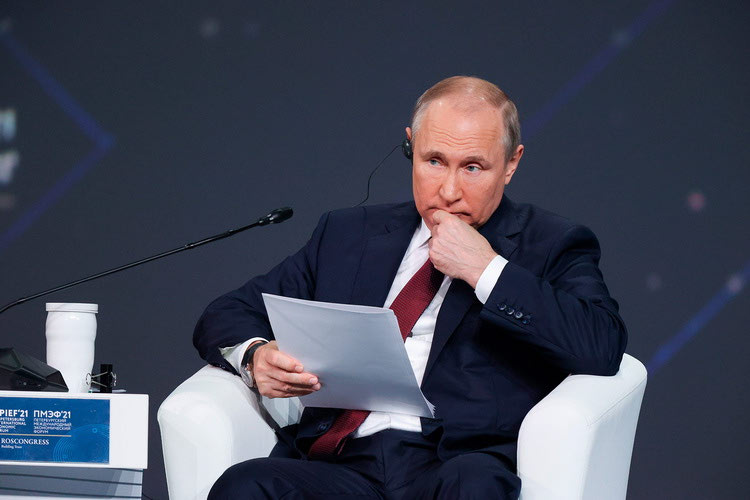 |
| In his usual manner, V. Putin ignored the fact that it was Moscow’s aggressive policy that caused the destabilization of international order |
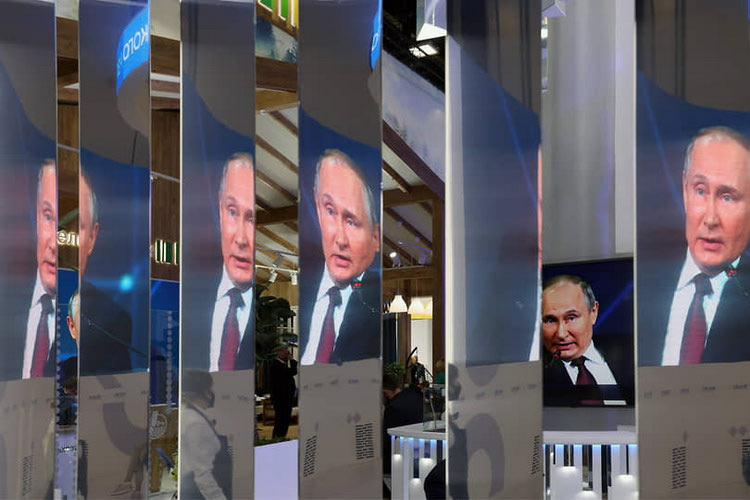
At the same time, V. Putin actually acknowledged the negative impact of Western sanctions on the Russian economy. This is how his appeal to the United States about the need to normalize US-Russian relations can be seen. According to V. Putin, this will increase global stability, and will allow the United States and Russia to abandon sanctions that cause damage to both countries. Despite this, the Russian President again accused Washington of pursuing a destructive policy towards Russia, as well as trying to maintain the dominant role of the United States in the world. At this, in his usual manner, he ignored the fact that it was Moscow’s aggressive policy that caused the destabilization of international order.
To one degree or another, V. Putin’s speech was supplemented and expanded by other participants in the Forum, who pointed out both the achievements and shortcomings of the Russian economy. As a result, they stressed the importance of measures, which allow to deepen ties between Russian and foreign entrepreneurs. In the Forum, a number of agreements were signed on the implementation of joint economic and investment projects with Russian, Chinese, Qatari, Saudi and other companies (on Russian gas supplies, natural resource development, transport infrastructure, and production of electronic equipment and vaccines against COVID-19, etc.). But not a single Western company concluded agreements with Russian business.
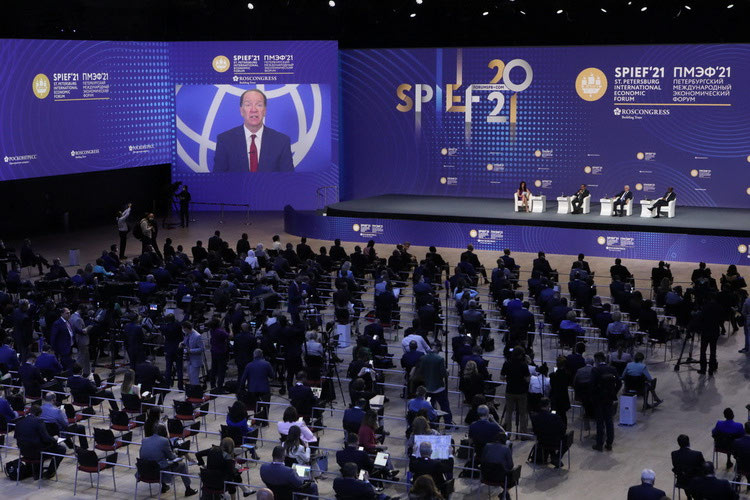 |
| Independent observers expect the Russian economy to remain low at no more than 1–1.5 % per year |
The St. Petersburg International Economic Forum caused another surge in various media publications and expert assessments of the state and prospects of the Russian economy. Moreover, they also had significant differences depending on the positions and views of certain experts. Thus, according to the RF government officials, which were made during the forum and in their subsequent speeches in the media, the Russian economy may recover to the level of the fourth quarter of 2019 in June–July 2021. And by the end of this year, Russia’s GDP could grow by 2.9–3.5 %. In contrast, independent observers expect the Russian economy to remain low at no more than 1–1.5 % per year. And this is only at best.
At the same time, both pro-government and independent experts agree on the critical dependence of Russia’s economic development on government, private and foreign investments. First of all, this applies to the oil and gas industry of the Russian Federation, which remains the basis of its economy. In particular, according to the management of the Russian state company Rosneft, the country’s oil and gas industry is in dire need of increased investment in the development of new oil and gas fields and has already faced significant problems due to lack of funds.
 |
| In 2020, the net capital outflow from Russia doubled compared to the previous year to more than 50 billion US dollars |
In this regard, a positive factor is the intention of the state development corporation VEB.RF to allocate by 2022 3 trillion rubles in support of the Russian economy, which is 70 % more than last year. At the same time, it is recognized that the negative investment climate in Russia persists, which leads to the capital flows from Russian economy. For example, in 2020, the net capital outflow from Russia doubled compared to the previous year to more than 50 billion US dollars. In the first quarter of this year, this figure was about 20 billion US dollars. The reasons for this trend are first of all related to Western sanctions, unsatisfactory state of the Russian economy, corruption and bad investment regulation, as well as persecution of businessmen and the forced redistribution of their business.
Critical problems of the Russian economy also include the acceleration of inflation, which is becoming sustainable. According to official data, in 2020 its average level was 5.6 %, and in 2021 may increase to 6 %. However, prices for certain groups of goods, in particular food, increased by more than 20 %. As a result, real incomes have fallen, forcing the Russian government to apply, for the first time since the 1990s, methods of state regulation of prices for basic foodstuffs. At this, pro-government and independent experts provide different assessments of the reasons for the price growth. The first is mainly due to external factors, including rising world food prices and declining demand for oil and other crude resources, which has led to a fall in the Russian ruble. Others believe that the inflation was caused by miscalculations in the work of Russian government.
The situation around the rising unemployment in Russia is also quite ambiguous. According to official data, today the number of the unemployed in the country is 4 million people. In contrast, independent experts mention the figure of 10 million. However, they all agree that the reason for the job cuts was the closure of enterprises due to quarantine measures, as well as a decrease in external and domestic demand for Russian goods and services.
At the same time, attention is drawn to the opposite trend, namely the reduction of the working population in Russia, which has already led to a shortage of workers in a number of sectors of the Russian economy — from construction and catering to logistics. For example, according to Rosstat, in the first quarter of this year, Russia’s population decreased by more than 190 thousand people. For comparison: for the same period last year, this figure was 78 thousand people. At this, the increase in migration compensated for the natural decrease of the population by only 22 %. In general, as of the beginning of 2021, the working population in Russia is estimated at 82 million people, while ten years ago it was 88 million people. According to independent experts, the demographic crisis in Russia is the result of the aging population, exacerbation of economic problems, pandemics, as well as the failure of the Russian government’s health care, motherhood and childhood programs.
 |
| According to some data, the losses suffered by Russia as a result of the annexation of Crimea and occupation of the Donbas, have already reached 500 billion US dollars |
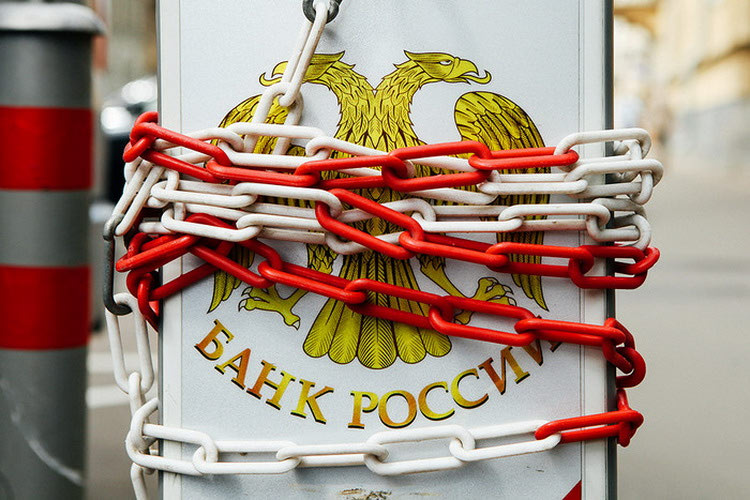
Against the background of these assessments, most experts expect maintaining and further strengthening of Western sanctions against Russia. At this, the possibility of the worst case scenario like the “Iranian scenario” is not ruled out. In particular, the sanctions that have already been imposed on Russia may be supplemented by its disconnection from the international payment system SWIFT, a total ban on transactions with Russia’s foreign debts in Western banks, and an embargo on the Russian Federation’s oil export.
Given these prospects, Moscow is taking precautionary steps to protect its interests. For example, steps are being taken to create its own financial transfer system, remove US dollar from the National Wealth Fund and replace it with the yuan, transfer foreign debts to Asian banks and reorient oil export to China and other Russia’s partners.
However, this can in no way compensate for the losses suffered by Russia as a result of the annexation of Crimea and occupation of the Donbas. According to some data, they have already reached 500 billion US dollars.
Despite all of these problems, the vast majority of Russian politicians and experts, including those from Putin’s “unsystematic” opposition, disagree with the need to change Russia’s policy toward Ukraine. Not to mention the return of Crimea to Ukraine and leave the Donbas. In a way, it is a question of the possibility of reaching certain compromises with the West, but exclusively on the basis of Russian interests.
 |
| Worsening of the economic situation in Russia is a powerful deterrent to its aggressive policy |
In general, the above-mentioned circumstances allow us to draw the following conclusions:
- the economy of the Russian Federation remains in a difficult position, which is the consequence of Western sanctions, unfavorable external conditions and the inefficiency of the Russian economic system;
- worsening of the economic situation in Russia is a powerful deterrent to its aggressive policy. At the same time, Moscow is still capable of aggressive actions against both the West and Ukraine;
- the negative impact of Western sanctions, and especially the threat of their further toughening, are forcing the Putin regime to look for ways to restore relations with the United States and Europe. At the same time, Moscow refuses to compromise with them on issues of its strategic interests, including with regard to Ukraine;
- all this makes it impossible to peacefully resolve the situation around Ukraine not only in the short term but also in the medium term. In turn, this requires Ukraine to make a final transition from hoping for the possibility of agreements with Russia, to mobilizing all its forces to succeed in confronting it.


