
Ivan Sichen, military and political expert
Nine years ago, in 2007, the third President of Ukraine V. Yushchenko made a strategic policy initiative “Common Europe — Common Memory”, which included creation of the ideological ground for the Ukrainian State’s European and Euro-Atlantic integration based on reconciliation of the peoples of all European countries after the Second World War.
Today, this issue is especially acute and urgent in the context of Ukraine’s having chosen its clear and non-alternative course for membership in NATO and the EU and Germany’s role in this process. On the one hand, it refers to Germany’s leading role in deterring Russia’s armed aggression against Ukraine, and on the other — to V. Putin’s regime’s using the theme of the war between Germany and the Soviet Union as one of the main factors of consolidation of the Russian population on the ideas of “historic confrontation between Russia and the West,” as well as discrediting the democratic and European choice of post-Soviet countries, as “traitors” of the common “Russian world”.
All this objectively needs the Ukrainian and international communities to revise certain estimates concerning the Second World War, which still quite noticeably influence the situation in Ukraine and around it. This is especially true of the current situation, when the new democratic and European authorities of Ukraine are presented by Moscow as a “fascist Bandera” and “nationalist” regime, as well as a “military junta” which has seized power in Ukraine despite “the desire of the majority of the Ukrainian population to reunite with Russia”.
Events of the Second World War were slightly different than they were and are presented by Moscow. In fact, the territory of Ukraine was a battlefield, where the geopolitical interests of the then two world national-socialist and communist empires clashed. Naturally, representatives of the Ukrainian population, depending on their political views, took one side or the other. Especially because the Ukrainian people’s losses from the actions of Nazi Germany were not greater than from Russia’s oppression under all its regimes — from the Russian tsars to Lenin, Stalin and Putin.
Of course, nothing can justify fascism and the damage caused by it to Ukraine and other countries. However, no one will ever forgive the organized by Moscow in 1932-1933 Holodomor (artificial famine) in Ukraine, which had cut more than two-thirds of the Ukrainian peasantry — the basis of the Ukrainian nation.
However, Ukraine suffered even greater losses from Stalin’s regime during the Second World War. This theme is endless and cannot be covered in one article. However, it can be characterized just by three examples, namely: the destruction by the Red Army and the People’s Commissariat for Internal Affairs (NKVD) of the central part of Kyiv in September 1941 without warning the local population; the Soviet troops’ undermining the Dnieper Dam (again, without taking into consideration the inhabitants of lowlands around the River Dnieper), and the Stalinist regime’s purposeful liquidation of young people in Eastern Ukraine in autumn of 1943.
At one time photos of the destroyed Khreshchatyk spread all over the world and in no way were inferior to the images of the ruins of the Russian Stalingrad, German Dresden and British Coventry. The Polish Krakow would have shared the same fate, if the legendary “Major Vykhor” had not saved it from total destruction by the Nazis. But, in contrast to all these cases, the situation in Ukraine was fundamentally different when the destruction of Ukrainian cities and their population was planned not by the enemy, but by the “native” troops.
Thus, Kyiv became the only European city, destroyed by its own “defenders”. Of course, the official Soviet (now Russian), historiography claims that the center of Kyiv was destroyed by German troops after they entered the city September 19, 1941. But in reality it was not so.
In summer of 1941, long before Kyiv was occupied by the Germans, under the leadership of the Defence Staff of the capital of the Soviet Ukraine, a great many of government offices, industrial buildings and houses had been mined. The major work was carried out on Khreshchatyk, Prorizna, Institutska and Pushkinskaya Streets. At this, both, classic and the then latest technologies of radio-controlled mines were used.
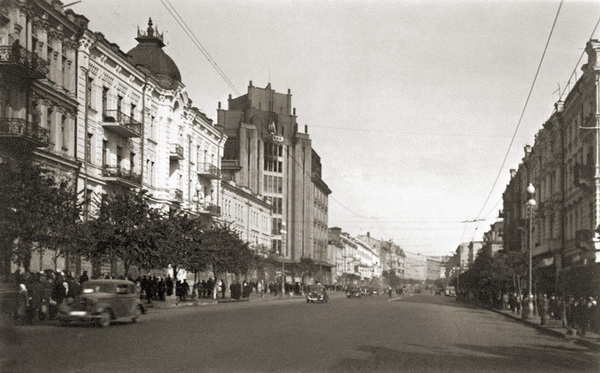
Kyiv in the last days before the occupation by the Germans
Destruction of Kyiv began on the day of the Red Army’s leaving the city. The Soviets blasted the Church of Tithes and a number of buildings on the hills of the Dnipro, which could have been used by Germans as observation posts to watch the Soviet troops’ actions in the area of Boryspil and Brovary, where at that moment there was the Staff of the Southwestern Front.
But the real tragedy occurred in Kyiv five days later — September 24, 1941. With the help of radio signals from the Russian Voronezh, as well as due to the left by NKVD local underground’s actions, were blown up the building of the Post Office, Radio Center, “Grand Hotel”, the Stock Exchange, the largest in Europe Krutikov’s Circus, the most prestigious residential house in Kyiv — a 12-storey building with 90 flats and 500 rooms (the so-called “Ginzburg’s House”), mansions, rail and road bridges.
Explosions on Khreshchatyk escalated into massive fires in the city center, and they blazed till early October, 1941. In fact, the whole Khreshchatyk, half of Prorizna, and Gorodetsky Streets, partially Lutheranska, Institutska, Zankovetskoi, Hrushevskoho Streets, Shevchenka Boulevard and Velyka Vasylkivska were completely turned into ruins.

Fires in the city center as a result of the Red Army and the NKVD’s acts of sabotage
The center of Kyiv turned into a conflagration that destroyed the best examples of Kyiv’s history and architecture, inclusive of the houses in the style of Renaissance, classical, religious shrines of not just Ukrainian, but of the whole Slavic civilization.
Apart from the Tithes Church, the Soviet troops destroyed the Cathedral of the Assumption of the Blessed Virgin Mary — the pantheon of Ukrainian princes, metropolitans and archimandrites.
All in all, more than a thousand large residential and administrative buildings were burnt. Plus five of the best Kyiv theaters, Conservatory, Theatre for Young People and the Kyiv Military District Theatre, the House of the City Council, two largest department stores, five largest hotels, city’s Central Railway Station, Houses of Architects and Scientists, more than a hundred different shops, schools and libraries. In fact, the historical center of Kyiv — its glory and pride — no longer existed.
But the heaviest loss for Kyiv was that, according to different estimates, those explosions and fires killed at least 60 thousand Ukrainian citizens, which no one had even tried to warn about those “planned” terrorist acts.
Unlike the Red Army and the NKVD, who destroyed the Ukrainian capital, it was the then German government who tried to save Kyiv. Having received from its agents information about the mining of the city, the Germans immediately began to search for and neutralize the explosive devices. In particular, this way they saved the Opera House, some government buildings, Lenin Museum, from which three tons of explosives were taken out.
The German administration formed special groups to examine the central part of Kyiv, which would persuade local residents to leave their mined homes, to evacuate children, the elderly and the sick. Some were rescued. People ran to the parks on the Dnieper, to Volodymyr Hill, to the Spartak Stadium.
However, it was, as they say, “a drop in the ocean”. Even the fire-fighting equipment (which Germans immediately brought by planes and used it instantly) did not rescue Kyiv. For example, on the banks of the Dnieper, mobile pumping stations were working, pouring water on Khreshchatyk and Pecherskyi District — the epicenter of fires in Kyiv. Against all notions of humanity, the Soviet underground remaining in the city after the retreat of the Red Army, was trying to incapacitate or destroy the German fire equipment.

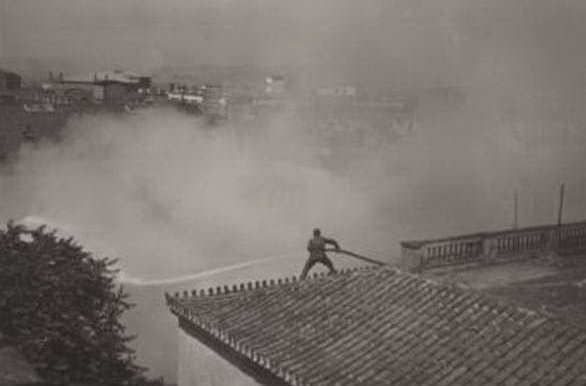
German troops trying to rescue Kyiv
After a desperate, many-days fighting fires in the center of Kyiv, the Germans realized that they could not save the city, of which almost nothing survived. Flames and smoke were seen over Kyiv for many tens of kilometers, and served as signals for planes, including Soviet ones. On Khreshchatyk explosions continued until September 28, and the ruins in central streets smoldered till December 1941.

Results of the Bolsheviks’ actions to destroy Kyiv
Another great crime against the Ukrainian nation was the Red Army’s blowing up the dam of the Dnieper Hydro-Electric Power Station on the 18th of August, 1941 in order not to allow German troops to cross the Dnieper. After the detonation of more than 20 tons of ammonal, a huge hole got formed in the dam, which caused a huge wave of several tens of meters high. The handmade “tsunami” washed away the coastal strip of Zaporizhzhya, the marshes of Khortytsya, and reached the neighboring Ukrainian cities — Nikopol and Marganets.
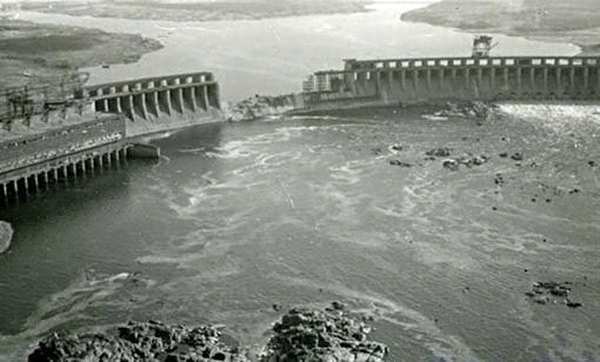
The dam of the Dnipro HPP, blown up by Soviet troops after their withdrawal from the Right-Bank Ukraine
At this, as already mentioned, the Soviet Command had not warned even its own troops, let alone the local population. As a result, about 100 thousand civilians and 20 thousand soldiers from the Infantry Division, NKVD Regiment, two Artillery Regiments and small units were killed.
At the same time, like in most cases, such actions of the Soviet side did not cause any harm to the Germans, who were watching with horror the events in Zaporizhzhya.
Like in the case with the destruction of the central part of Kyiv, the responsibility for undermining the dam of the Dnieper HPP was later shifted onto the Germans, who supposedly did it in autumn 1943, during their withdrawal from the Left-Bank Ukraine. The truth about the real events in Zaporozhzhya was disclosed only after Ukraine’s having restored its independence and the fall of the communist regime in 1991.
The systematic destruction of the Ukrainian people by the Stalinist regime continued during the second half of the Great Patriotic War, which was not critical to Moscow and did not need such victims. Russia simply did not want to forgive Ukraine for the years of the German occupation, which demonstrated the complete identity of both totalitarian systems, and in a certain way, Moscow’s even greater cruelty towards the Ukrainian population.
This is evidenced by the citizens, who had been under the German occupation, and whose conclusions are not in favor of the previous years of mass repressions, Holodomor and horrors of the Civil War. In particular, one of such evidences is the memoirs of the legendary Soviet actress Ada Rogovtseva, who as a child lived during the occupation in the town of Hlukhiv, Sumy region, and had indelible impressions. The actress remembers that, in contrast to the pre-war years, she at least did not feel hunger and together with other children received food from the German soldiers. [Magazine «Тайны звезд» (“Secrets of the Stars”) Issue 29 (225) of July 17, 2013].
Of course, Russia could not forgive all this and thought it to be a suitable occasion for another action of genocide of the Ukrainian people through the mass mobilization of the youth of Eastern Ukraine, and casting it into battle without training, weapons and even armor.
Recruiting was performed by the so-called “field military enlistment offices” consisting of several officers and a platoon of soldiers of the force support to the mobilization actions that, quite naturally, did not cause enthusiasm among the local population. Especially because everybody was recruited, regardless of age, state of health and other circumstances, beginning with teenagers under 16 years of age, and ending with former soldiers of the Red Army who remained in the occupied territories of Ukraine after severe injuries in autumn of 1941.
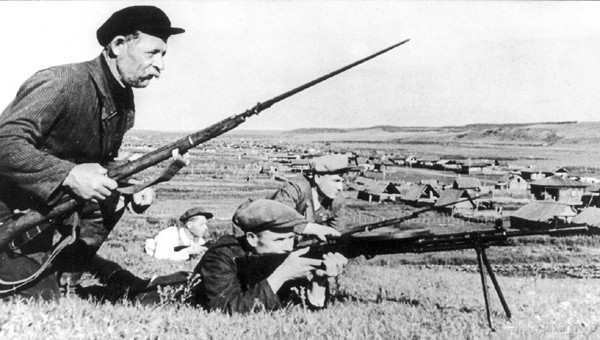
Residents of Eastern Ukraine were mobilized by force and sent to the front regardless of their experience, health condition and age, senior, sick people, and teenagers included.
According to Ukrainian historians, in particular, Doctor of Historical Sciences Professor V. Korol, the practice of creating and functioning of field military enlistment offices was especially widely spread in the Voronezh (later — the First Ukrainian) Front under the command of M. Vatutin, which had enormous losses because of the barbaric tactics of ruthless use of manpower for attacking German positions without proper reconnaissance, fire training (support) and logistics.
M. Vatutin’s tactics and methods of its implementation, including the loss replacement with unprepared and unarmed recruits, was fully supported by G. Zhukov, who was at the front in the status of the Deputy Supreme Commander — the representative of the Supreme Command, and had in fact unlimited powers. Such powers were also based on the order of the Stavka (General Staff) № 089 of February 9, 1942, according to which military councils of armies and commanders of divisions were granted the right to unlimitedly conscript people who had lived previously in the “liberated territories”. All in all, about 900 thousand Ukrainian citizens were recruited that way, of whom in the assault crossing of the Dnieper alone, more than 450 thousand were killed.
Could these losses not be so terrible? Of course, they could. If not for the inhuman principles of J. Stalin, G. Zhukov, M. Vatutin and N. Khrushchev (at the time — a member of the Military Council, and in fact the main political commissar of the First Ukrainian Front), who on the one hand, were deliberately destroying the Ukrainian nation and on the other — were putting into practice their own political interests, career plans and personal ambitions as “winners over Germany”.
The awful truth of those events has been particularly exposed by the “Facts” Ukrainian newspaper with reference to the Ukrainian researchers and historians.
The elements of Moscow’s such practices became the creation of the Bukrin and Lyutezh bridgeheads North and South of Kyiv in September-November 1943 as part of the Red Army’s Kyiv offensive.
At that time the forces of the 13th , 60th and 61st Armies of the Central (later — the First Belorussian) Front under K. Rokossovsky had already captured significant enough foothold near Dymer, 30 kilometers from Kyiv, which did not need any other actions to force the Dnieper on the controlled by Germans sites. Moreover, fast and skillful use of existing bridgeheads would have allowed to quickly cut off the German troops, which were on the right bank of the Dnieper, in particular, near Darnytsya.
But, on Zhukov, Vatutin and Khrushchev’s advice, Stalin rejected the decision and ordered the assault of Kyiv to be under the command of the First Ukrainian Front, which guaranteed it the fame of “liberators of the Ukrainian capital”. The result was the tragedy of the Red Army, but in fact — of the Ukrainian nation near Kyiv, when the Dnieper water turned red from the blood loss of the soldiers mobilized in the East of Ukraine, and their bodies were floating “like logs during floating of wood”.
The frank folly of such actions of the Soviet military command has been recognized even by German officers and soldiers who participated in combat actions. Even they were horrified by such a use of human resources.
These examples are only a meager, though quite demonstrative part of all the processes and events that took place in Ukraine during the Second World War. However, one way or another, they have become one of the most striking evidence of the equal responsibility of Berlin and Moscow for the terrible losses suffered by Ukraine.
At the same time, de facto responsible for these victims were solely the leaders of the Nazi and Stalinist regimes, but not ordinary soldiers and officers, most of whom had no desire to take part in the bloody military adventures of the Nazi “the Fuhrers” and communist “leaders”.
Besides, as evidenced by the facts of World War II, the vast majority of officers and soldiers, both from the German and the Soviet sides (except for the monsters from special forces of the SS and NKVD), were quite tolerant to the Ukrainian people.
In turn, this requires adequate and respectful attitude to the graves of soldiers of the Red Army and the Wehrmacht in Ukraine. An example of this, in particular, may be a memorial cemetery for German soldiers in Poltava. It is looked after equally as are looked after the graves of Soviet soldiers and officers.
During the Second World War, a similar situation was in the relations between Germany and other Western countries, especially France, Britain, Belgium, the Netherlands, Denmark, Norway and the United States. However, the understanding of shared responsibility for the causes, events and consequences of the military confrontation in Europe and confidence in the impossibility of its recurrence in the future allowed to achieve total reconciliation of the parties, which was the basis for the creation of NATO and the European Union.


