
What does Gazprom gain from building the South Stream?
From the moment when in 2015 the South Stream gas pipeline with power of 60 billion cubic meters of gas, begins to work, Russia can give up Ukraine’s service of the transporter of the gas to Europe. Gazprom will be exporting all gas via the existing North and South Streams (total more than 110 billion cubic meters of gas). And 110 billion cubic meters is perhaps the greatest volume of gas transit through Ukraine, which was done in 2008.
All the expectations of Gazprom that Europe will increase the purchase of Russian gas, so far are groundless. Even if Europe‘s gas consuming grows, it does not necessarily mean that it will prefer Russian deliveries to some other country’s.
Already now, to load these pipelines, Moscow has to redistribute the export gas by decreasing the volumes of the transit through Ukraine.
To all this, the realization of the project of the development of Russia’s Shtokman field in the North Sea has been stopped for an indefinite period of time. That resource was planned to keep the North Stream busy.
 In favor of the decreasing of the Ukrainian transit also works losing by Russia of its positions at the European gas market as well as the crisis, which leads to all sorts of decrease, decrease of economy included.
Appearance at the European market of the liquated gas earlier meant for America. The USA and Canada refused to import it after they had started producing slate gas which considerably covers their needs in import.
So Gazprom, to put it mildly, is not getting anything new in Europe.
Political sequences of the South Stream for Ukraine
Certainly, Moscow will be abandoning the Ukrainian service (in particular, it will be shortening the volumes to an unprofitable level) with certain aplomb – as the “punishment” of Ukrainians. They have not thought of what to punish us for, but in two and a half year they will have made up something. In this context the main task of the power in Ukraine is to use Moscow’s intentions in our own interests instead of begging, like now, “with the stretched out hand”. In a word, we should turn the gas whip in the opposite direction.
Increasing of the cheap transit via Ukraine in favor of bypasses, should certainly be taken for an unfriendly gesture regarding our country. They mean, this way the RF will deprive us of earnings for the transit.
Economic consequences of the South Stream for Ukraine
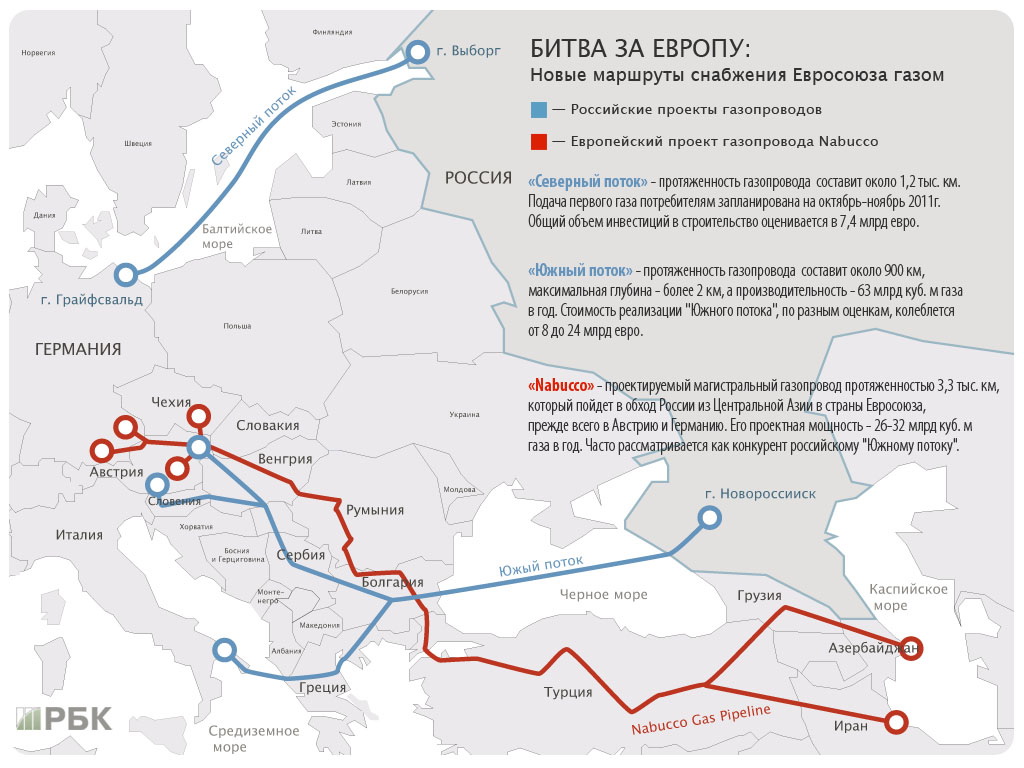 We should thoroughly analyze the conditions, circumstances and volumes of the Russian gas transit via Ukraine as well as the possibility to maintain a reasonable energetic independence of Ukraine after the construction of the South Stream.
Firstly, additional volumes of gas at the European gas market will lead to increasing competition and as a result – to the price reduction.
The North and South Streams will assist this. Then Ukraine, after the opening of the South Stream in 2015, will be able, nearly painlessly, to ensure the proper “reverse” of its GTS and thus to minimize its dependence from Russia.
Secondly, for the gas transit the Ukrainian side in the person of NJSC “Naftogaz of Ukraine” gets 1.5 billion US dollars per year (this, by the way, with the deduction of the expenses on technological gas, needed for securing the transit). At the first sight, it is a sufficient sum for a state company. But, taking into consideration Russian problems, which Ukraine has nearly every year because of these “transit” earnings, this sum is not worth constant lowering(deserved or not deserved) of a 46 million population state like Ukraine.(By the way, Much smaller Hungary and many other countries somehow cope without “transit” money).
Thirdly, as we have already mentioned, the start of the South Stream brings us closer to the relatively painless “reverse” of the Ukrainian GTS (for both, outer and inner supply). Right, our GTS has to be modernized first (for this we may invite on a commercial basis both, Russia, and EU countries) — so that it could supply with gas an inner domestic consumer for a long time and from any direction (from West to East, or vice versa, from South to North or from North to South). The first step in this direction has been taken: the documents on gas supply from the German company RWE via Poland have been signed.
We should understand that this is a positive moment. As to the proper reverse, it can be realized only if we stop the transit of Russian gas. So it is clear, that the next step should be securing the proper “reverse” of the whole GTS. That is complete giving up Russian gas transit, with what, by the way, Russia wants to frighten us in 2015. And in the nearest future, it will begin to prepare the basis for it. In particular, Moscow, at a not little cost, will be trying to demonstrate to Europe that we are not worth being dealt with.Vladimir
Putin at the presentation of December 20, 2012
What should Ukraine do now?
Firstly, Moscow’s “gift” in the form of stopping gas transit should be accepted by us with dignity. There is also enough time (2.5 years) to get prepared properly.
During these 2.5 years, apart from official explanations to the world all the economic absurdity of the South Stream (which we should keep doing as nobody will hear us anyway), unofficially we should push both, Europe and Russia to the realization of the project as soon as possible.
Within this period of time we should settle many important technical questions with the deliverer and each buyer. For example, how to deliver the Russian gas to Moldova, Turkey and Romania, at what terms and who can hire Ukrainian gas-proof shelters and use them in case of a cold spell, etc. For example, we could offer Russians together with some Europeans to build a new transit pipeline via Ukraine, which would not be completely connected with the domestic supply (which we suggested more than once). But Russians and some Europeans have determined the round about routes, 10 times more expensive. But then it is their right. A sovereign should be respected!
While offering all this, we should pursue our own country’s interests. In particular, in case of building a new transit pipeline, to give 100% guarantee of its security, in no case agreeing to this gas pipeline’s ex-territoriality, even if a considerable part of military units had to be re-orientated. In this case Ukraine would get complete understanding and support of EU, which is getting tired of Russian non-transparency.
Secondly, the sum of 1.5 billion US dollars per year has to be “covered” by creation and development of new branches to replace the liquidated, unprofitable for Ukraine in the strategic sense, former soviet industry’s “pottery fragments”.
Why, for example, not to create and develop the IT- industry or the agriculture production processing branch through the conversion of gas-wasteful industries? First of all, we mean here metallurgy and chemical industry. Certainly, this conversion of industries should be a concern of Ukraine’s governments and parliaments. But sadly, they have not been doing anything about it for 20 years! Instead, they were concerned with tactic questions, dictated by the next in turn elections, by private interests and … by Moscow!
Instead of a generalization
So, we, as a state, worth a part of a solid one, in the historically formed situation in our relations with the RF, would better not to play a part of a “gas transit” state, which to all that constantly depends on accidental direct foreign gas dealers.
Transit income is not bad, but it is not worth counting on it, budget income included. It would be better if it were made on our terms and were a sort of a positive surprise, additional income!
Instead of setting to it, we should carry out a proper restructuring of the economy with the “far-sighted aiming” at the development of the country. But here we should remember that such decisions are not popular. And the terms of the realization of “restructuring” projects are often longer that the time periods between the elections, even the presidential ones. So, we can predict, that those statesmen, who dare to restructuring the Ukrainian economy, will fail at the following elections, and in general, they will be condemned to the political non-apprehension by the society. Like it happened, for example, to President V. Yushchenko in Ukraine, who dared to “restructuring” the Ukrainian mentality, or to L. Bal’zerovich in Poland, who began to introduce new economic principles in his state.
…But, as we are persuaded, not the science alone needs a sacrifice, – the economy needs it too. Nowadays, perhaps more so than the science.

