
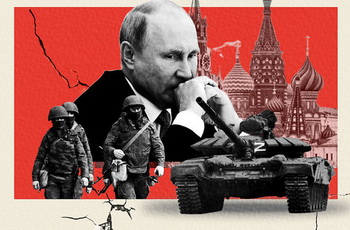
 What Pushes Him to Do So and What Does He Strive to Achieve?
Ivan Sichen
Lately, the Kremlin’s rhetoric regarding the war against Ukraine has somewhat changed. Thus, according to Russian President’s Press Secretary Peskov, Putin is open to negotiations and is ready to achieve the goals of a “special military operation” in Ukraine by other methods. Of course, this does not mean that the so-called SMO will cease in the near future. However, it is quite obvious that the Kremlin is increasingly aware of the lack of real prospects for its success, as well as the negative consequences of the war for the Russian Federation itself. That’s what we will analyze in more detail.
The Failure of the Strategic Plans of the “Special Military Operation” in Ukraine and the Cost of the War
To begin with, we would like to draw attention to another statement, now by the First Deputy Chairman of the State Duma Committee on CIS Affairs — the known Russian chauvinist K. Zatulin. Thus, he frankly admitted that Russia has failed to achieve any of its goals, for which it started a war against Ukraine. All of them are well known, but let us mention them again.
|
…Russia has failed to achieve any of its goals, for which it started a war against Ukraine… |
As a minimum, they included the change of power in Ukraine and the final blocking of the prospects of its accession to NATO and the EU, leveling the national consciousness of Ukrainians and their Russification, undermining the defense potential of our state and returning it to Moscow’s sphere of influence. As a maximum — destruction of Ukraine’s statehood and inclusion of its parts into the Russian Federation, as happened, for example, with Crimea. And as an intermediate option — the complete seizure of Donetsk and Luhansk regions, along with the creation of a land corridor to Crimea.
At the beginning of the war, such plans were presented as “denazification and demilitarization” of Ukraine, as well as “liberation and protection of the Russian-speaking population”. And after the first setbacks on the front, Russia began to change its narratives and call the war “countering an attack from Ukraine and the collective West”. And also — “fighting Satanists”, or in Kadyrov’s version — “’jihad”. From all this, Russia was only able to expand the territories of Donbas under its control and break through the land corridor to Crimea along the coast of the Sea of Azov. However, at the cost of incomparably great losses and damages to its military, political and economic interests. This has been repeatedly covered in the media, in our previous articles included. However, for a clear understanding of the situation, we would like to remind you once again about them, given recent events.
For example, according to the General Staff of the Armed Forces of Ukraine, as of early June 2023, Russia has lost at the front in Ukraine about 210 thousand soldiers and officers, almost 4 thousand tanks, 7.5 thousand armored combat vehicles, 3.5 thousand guns, about 600 MLRS, 350 different air defense systems, more than 300 aircrafts and about the same number of helicopters, 3.3 thousand UAVs, 1.1 thousand cruise missiles, 18 warships and boats, 6.3 thousand automobiles, 450 pieces of special equipment. Thus, more than half of the personnel of the ground and airborne forces of the RF Armed Forces, almost all tanks and armored combat vehicles and a third of the artillery and MLRS that were in service at the beginning of the war, as well as ten regiments of aircrafts and helicopters were destroyed. At this, Russian troops were driven out of most of Kharkiv region and from the right bank of Kherson region, and the Russian Federation was forced to declare partial mobilization. However, as evidenced by the course of hostilities in the Donbas in the winter and spring of 2023, mobilization did not help Russia much in achieving the desired. Russian troops and units of the private military company Wagner, where criminals from prisons and penal colonies were forcibly recruited, failed to completely capture even the city of Bakhmut, which is semi-surrounded by Ukrainian troops. And the Russian army again largely lost its offensive potential.
The War Returns to Russia
In February 2022, residents of the border areas of Russia openly rejoiced at the invasion of the Russian Armed Forces into Ukraine, while hoping for a quick victory. But then they found themselves in the war zone. Moreover, this applies not only to artillery shelling and UAV attacks in the Russian territories adjacent to Ukraine, from where the positions of Ukrainian troops are shelled, but also to armed clashes between Russian rebels and Russian troops on Russian territory.
|
…The ultimate goal of rebels is to overthrow Putin’s regime, so they are determined to come to other regions of Russia and to Moscow itself… |
In particular, since May 2023, detachments of the Russian Volunteer Corps and the Freedom of Russia Legion have already liberated several border settlements in Belgorod region of the Russian Federation and reached the suburbs of Shebekino. And none of the defensive lines, ditches, minefields and strongholds that Russia has been building since last autumn have prevented them from doing so. According to rebel leaders, Belgorod region is only the beginning. Their ultimate goal is to overthrow Putin’s regime, so they are determined to come to other regions of Russia and to Moscow itself.
By the way, in the depths of the territory of Russia, all is not well either. Ukrainian UAVs are already reaching Moscow region and Moscow itself, including the Kremlin, as well as strategic aviation airfields and other military facilities in Ryazan, Kaluga, Tula, Saratov, Rostov and other western and central regions of Russia. And the actions of Russian partisans are beginning to spread over the entire territory of the Russian Federation. This is evidenced by an increase in the number of “incomprehensible” explosions and fires at oil and military enterprises, as well as sabotage on railways and freight train disasters. And then there is the counteroffensive of Ukrainian troops, which is actually taking place, albeit on a limited scale. Resources for the counteroffensive are provided by Ukraine’s Western partners and include several hundred tanks and armored combat vehicles, a significant number of rocket and artillery systems, engineering vehicles and helicopters, and MiG-29 aircrafts. American F-16 aircrafts are also on the way.
This development of events makes Moscow reinforce defenses at the front, strengthen border protection, as well as intensify the fight against partisans inside the country. At the same time, this requires a significant amount of forces and means that Russia simply does not have. Therefore, the issue of conducting a general mobilization of both citizens and industry is being considered. However, the implementation of such plans is extremely difficult. For example, in Russia there is already a significant shortage of workers in various sectors of the economy, and their further withdrawal may stop production altogether. Besides, general mobilization will inevitably create a threat of critical increase in social tensions in the Russian society.
Putin Is Losing Control Both over Foreign Policy Processes Around Russia and over the Situation in the Country Itself
|
…A full-scale groundless attack on Ukraine became an act of open aggression, which finally undermined Russia’s international positions… |
A full-scale groundless attack on Ukraine became an act of open aggression, finally undermined Russia’s international positions and made it an even greater pariah on the world stage than it was before. Russia is still a member of the UN Security Council and a number of other international organizations. However, virtually no one pays attention to it. At this, rejected are all its attempts to justify its policy towards Ukraine and shift to it the responsibility for unleashing the war, which is called “Russia’s forced step to ensure its security”.
And Western countries and international organizations have stopped dialogue with Putin’s regime altogether and are only increasing sanctions pressure on it. Moreover, Russia’s full-scale attack on Ukraine only consolidated the Western world on the basis of the idea of deterring Russia.
Contrary to the expectations of the Kremlin itself, the West currently maintains unity and in no way feels tired of Ukraine. According to the leaders of the United States and NATO, they will continue to support Ukraine in order to achieve victory over the Russian Federation. Russia is shunned even by its strategic partner — China, which is in no hurry to support this aggression against Ukraine and recognize the “Russian status” of the Russian-occupied territories of Ukraine. Besides, China refused to implement a number of joint economic projects with Russia, which were strategically important for the Russian Federation, including the construction of a China — Russia — Europe high-speed railway and new oil and gas pipelines. And this can be understood. Why would Beijing need a toxic partner like Russia that could hinder its economic ties with the United States and Europe, which have much larger economic volumes, despite contradictions between them?
Indicative was the meeting of Ministers of Defense of Ukraine O. Reznikov and of China Li Shangfu on June 3, 2023, during the Security Forum in Singapore. The head of the Chinese Ministry of Defence proposed to use all possible means to end Russia’s war in Ukraine, and also expressed readiness to expand military cooperation with Kyiv. This position of the PRC caused a real shock in Moscow.
Quite restrained is the attitude to Russia of its closest allies and partners in the post-Soviet space within the framework of the Collective Security Treaty Organization and the Eurasian Economic Union. None of the member countries of those structures supported Russia’s attack on Ukraine and none recognized Russian territorial claims. And the countries of Central Asia in general began to actively reorient themselves to China. As a result, these integration associations created by Russia have actually become purely formal in nature, and it itself is losing influence on ex-Soviet territories. In fact, as before, Russia’s only partners that openly support its actions are the same rogue states as itself, that is, Belarus, Syria, North Korea, Nicaragua or Iran. At this, Belarus continues to provide its territory and airspace for the deployment of Russian units and the actions of Russian aviation, and Tehran massively supplies Moscow with strike UAVs, although it hides this fact.
Besides, these partners of Russia, as well as some other countries of Southeast Asia, Africa and South America, assist it in evading Western sanctions. In view of this, at the G7 summit in May 2023, they were given a tough ultimatum to stop such activities. Even under the threat of secondary sanctions against them. Thus, the ability of the Russian Federation to avoid external economic restrictions has been significantly reduced.
|
…Moscow’s intentions to stop the process of NATO enlargement have completely failed… |
Finally, Moscow’s intentions to stop the process of NATO enlargement, to prevent the approach of NATO troops and weapons, and to block the process of Ukraine’s Euro-Atlantic integration, which was the main content of Russia’s well-known ultimatum to the United States and NATO in December 2021, have completely failed. This once again showed how the West perceives Russian ultimatums and demands.
For example, Finland and Sweden have practically become NATO members, which has increased the length of Russia’s border with the Alliance by almost 1200 km and forces it to deploy additional troops there. While it is already short of them. At the same time, the United States and NATO have stepped up their troop build-up in eastern Poland, as well as in Lithuania, Latvia and Estonia. Now they already exceed the forces of the Western Military District of the Russian Armed Forces, especially when most of them are fighting against Ukraine and have already been partially destroyed.
|
…Ukraine is one of the main factors in deterring Russia’s armed expansion and ensuring European security… |
And, most importantly, as mentioned above, Russia has failed to achieve any of its goals with regard to Ukraine. Instead, its full-scale attack on Ukraine contributes to the growth of national consciousness of Ukrainians and their hatred of Russia, as well as strengthening Ukrainian Armed Forces (with the help of our partners included) as a necessary prerequisite for successful deterrence of the aggressor.
The role and importance of Ukraine for the West, as one of the main factors in deterring Russia’s armed expansion and ensuring European security, have reached a fundamentally new level. Ukraine has not yet become a member of NATO and the EU, but closely cooperates with them, in fact, at the level of a full-fledged participant. And it has completely left the sphere of influence of Russia.
The above-mentioned processes make it completely impossible to implement V. Putin’s geopolitical plans to turn Russia into a “great world power” by reviving a replica of the USSR along with its sphere of influence in the world. At the same time, the rigid system of power vertical in Russia, which was built by V. Putin and provided for his sole ruling the country, is rapidly collapsing. Formally, it is allegedly still preserved. But V. Putin is clearly losing control over many internal processes in the country.
|
…V. Putin is clearly losing control over many internal processes in the country… |
The spread of corruption in Russia, which is systemic in nature at all levels of government, law enforcement agencies and private business, is quite well known. At the same time, earlier it was somehow controlled by the authorities within a certain framework, which allowed preserving, at least, the foundations of Russian statehood. At present, this is no longer the case, as shown by Russia’s “special military operation” against Ukraine as the most resonant event of recent decades. Thus, in the “second army of the world” everything that could be stolen, is stolen and sold, including military equipment at storage bases, military gear and uniforms, food, building materials, etc. For a bribe, one can buy off conscription into the army or leave it, or go not to the front, but to the rear units. Abuses with the state procurement in the defense industry of the country are flourishing. In particular, they deliberately inflate prices for products, as well as steal and resell components and materials.
Russian special services are also completely corrupt, including the FSB of the Russian Federation, which is precisely the main controlling body in the country. Thus, even before the war, the leadership of FSB stole about a billion US dollars, which were allocated to undermine stability in Ukraine. While the leadership of Russia and personally V. Putin were given false information about the situation in our country. Against this background, there is a tough confrontation between the command of the RF Armed Forces and the leaders of all sorts of private “armies” such as PMC Wagner or Chechen detachments, which is sometimes accompanied by armed clashes between their units. One of the manifestations of this trend is public criticism of Russian Defense Minister S. Shoigu and Chief of the General Staff V. Gerasimov by the founder of PMC Wagner Ye. Prigozhin, which is personal and obscene in nature. It is likely that in response to this, on their orders, regular Russian troops tried to destroy the Wagnerites during their withdrawal from Bakhmut. The same relations develop between Ye. Prigozhin and R. Kadyrov.
These processes reduce Russia’s ability to continue the “special military operation” in Ukraine, undermine the unity of the country’s power bloc, which is turning into a set of various kinds of warring armed formations, and cause a negative reaction in the Russian society. However, V. Putin does not take measures to correct the situation and pretends not to notice any problems.
Contrary to normal logic, he is not capable of punishing those responsible for failures of Russia’s war against Ukraine or even for strange flights of “unknown” UAVs over the Kremlin. And some people are even promoted in positions and ranks. The reason is that all such persons are representatives of different clans from Putin’s environment. Therefore, in his policy, he is forced to proceed not from the state’s, but from their interests.
|
…Western sanctions do have extremely negative consequences for the Russian economy, regardless of how hard Moscow tries to deny it… |
Finally, Western sanctions do have extremely negative consequences for the Russian economy, regardless of how hard Moscow tries to deny it. We will not consider this issue in detail, economists can explain it better. So, here are just two illustrative examples. Back in January 2023, the state budget deficit of the Russian Federation amounted to 60 % of the amount that was determined for the year. And in April 2023, its spending reached a critical level. The Russian government still somehow manages to keep the situation under control through the use of reserve funds. But there are fewer and fewer such opportunities. This already affects both the power structure in Russia in the form of an intensification of the struggle between competing political-oligarchic clans of the country, and the mood of representatives of medium and small businesses and ordinary people who are dissatisfied with what is happening.
Conclusion. Or What V. Putin Is Afraid Of and What He Is Trying to Do
|
…Russia is approaching a full-scale crisis with unpredictable consequences, which poses a direct threat to V. Putin’s power and makes him panic… |
In general, Russia is approaching a full-scale crisis with unpredictable consequences, which poses a direct threat to V. Putin’s power and makes him panic. Because after losing power, he will have to answer for his actions. There are many options here: following the example of his “political double” A. Hitler, who shot himself in his bunker; dictators of Italy B. Mussolini and Romania M. Ceausescu, as well as the last Russian Tsar Nicholas II, who were executed by the rebels; another international criminal, Yugoslavia’s President S. Milošević, who was punished by the International Court of Justice in the Hague and died in custody. One can also die as a result of an internal rebellion, as happened with another Russian Tsar Pavel I and, probably, the communist dictator of the USSR J. Stalin.
|
…That is why V. Putin has resorted to finding opportunities to achieve his goals regarding Ukraine not by military, but by other methods… |
That is why V. Putin has resorted to finding opportunities to achieve his goals regarding Ukraine not by military, but by other methods, which would allow him to avoid such problematic prospects or at least reduce their severity. First of all, this concerns Moscow’s attempts to encourage Kyiv to negotiate, including with the involvement of Russian partners. In order to make the Kyiv leadership more accommodating, the Russians continue to put military pressure on Ukraine, including systematic missile strikes on the capital of our state. In the same context, we can consider the blowing up of the dam of the Kakhovka HPP by Russians, which was intended to show Ukraine and the whole world what Russia is capable of if someone does not listen to its demands.
But Moscow will not be able to achieve anything. Now is not 2014 or 2015. Ukraine has strong Armed Forces that are capable of giving a decent rebuff to the attacker. Therefore, all Putin’s fears will surely come true, the collapse of the Russian Federation and termination of its existence as a integral state included.


