
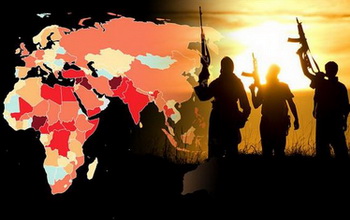
 Reasons and Consequences for the World and Ukraine
Victor Hvozd
Doctor of Military Sciences
“Terrorism is the modern plague of humanity”. In recent decades, this assessment of political and security experts has acquired a qualitatively new meaning. Indeed, experience shows that terrorism is increasingly turning from an instrument of individuals, organizations or countries to achieve their goals into one of the factors influencing the geopolitical situation in the world.
This is evidenced by the terrorist attacks in the United States on September 11, 2001, carried out by Islamic extremists, which marked the beginning of a new phase of confrontation between Islamic and Western civilizations. After all, in response to the extremist attack, the United States and its allies launched a global war on terrorism, involving all components of their armed forces except for the nuclear ones. The most widespread manifestations of such a war were anti-terrorist operations against the Taliban in Afghanistan and the Islamic State in Syria and Iraq.
|
…Terrorism is the modern plague of humanity and is increasingly turning into one of the factors influencing the geopolitical situation in the world… |
Islamist organizations, in turn, have resorted to more active use of asymmetric methods of action against Western countries, including large-scale terrorist attacks on their territory. These included: explosions on suburban trains in Madrid on 11 March, 2004 (killing 190 people and injuring 2,050); explosions on London Underground trains on 7 July, 2005 (killing 52 people and injuring more than 700); assassination attempt on the Royal Family of the Netherlands on 30 April, 2009 (killing 8 and injuring 10); terrorist attack on American soldiers at Frankfurt airport on March 2, 2011.
|
…French President E. Macron called Islam “a religion that is in crisis all over the world”… |
Despite the destruction by the international coalition of the main organizational structures of the Taliban and the Islamic State, this did not mean that Islamic terrorists were completely defeated. They just moved to new methods of action, which manifested themselves in the next wave of violence in Europe and the United States in the fall of 2020. The most high-profile of these was the murder of a French teacher on October 16, 2020, in a suburb of Paris, for showing caricatures of the Prophet Muhammad as an example of freedom of speech. As expected, this attack provoked a sharply negative reaction in France and other EU countries. At this, French President E. Macron called Islam “a religion that is in crisis all over the world”.
However, this did not stop the Islamists, on the contrary, it pushed them to further aggression. Thus, E. Macron’s position was officially condemned in many Muslim countries. October 29, 2020, Islamists carried out three new attacks on passers-by and law enforcement officials in France and near the French consulate in Saudi Arabia. A total of three people were killed and one was injured. An even more daring terrorist attack took place on November 2, 2020, in the center of the Austrian capital, Vienna, killing 8 people and injuring about 20.
|
…COVID-19 pandemic became the catalyst for the existing problems, including inter-religious and interethnic ones, and, as a consequence, the intensification of extremism… |
Other acts of violence intensified, which included outwardly unmotivated actions by individuals to open fire from small arms in public places and to purposefully direct cars into crowds. At first glance, such actions were not directly related. However, in fact, they have a number of common features. Thus, in most of these cases, the violence was carried out by people from Muslim countries and regions — supporters of radical Islam, or people with mental disorders. Besides, they took place during the escalation of social tensions in the world over COVID-19. In fact, it was the pandemic that became the catalyst for the existing problems, including inter-religious and interethnic ones, and, as a consequence, the intensification of extremism.
|
…Terrorism is just an external manifestation of the global confrontation between the Islamic and Western worlds… |
However, all this is just an external manifestation of the global confrontation between the Islamic and Western worlds, which has deep historical roots. Despite its various forms, the confrontation has, in fact, been and remains a struggle between two opposing groups of humanity for access to resources and influence in the world. Depending on a number of political, socio-economic and other factors, the confrontation of such parties periodically intensifies and turns into wars and conflicts with the use of various types of violence, including terrorism.
These circumstances are also characteristic of the current stage of development of the situation in the world. Moreover, the reasons for the escalation of the confrontation between Islamic and Western countries in the early 2000s arose before that, in fact, immediately after the end of the Cold War between the Western and Eastern (Soviet) blocs. On the one hand, the disappearance of a rigid system of distribution of spheres of influence in the world contributed to the improvement of international relations, and on the other — launched a series of opposing processes that led to the spread of Islamist extremism and terrorism. In this connection we should point out:
— Acceleration of globalization due to lower barriers between different countries. This situation has created favorable conditions for the development of trade and economic cooperation in the world, including between Western and Muslim countries, which has opened up positive prospects for bilateral relations. This applies even to countries with the most radical Islamic regimes. In particular, in the first nine months of 2020, the volume of mutual trade between Iran and Europe amounted to 8.8 billion US dollars, which exceeds last year’s figure.
But there were also other consequences. For example, with the penetration of American and European capital into Muslim countries, the intervention of the United States and Europe in their internal affairs intensified. In turn, this provoked a negative reaction from the Islamic world and, as a result, the spread of anti-Western sentiments among the Muslim population.
At the same time, the increased transparency of American and European borders has led to a mass movement of migrants from Muslim countries. Powerful Muslim centers emerged in the United States and Europe, provoking various conflicts between Islamists and locals.
Today, the number of Muslim migrants in the EU already reaches more than 15 million people, which is 5 % of the total population of the European Union. If the current rate of migration is maintained, the share of Muslims in Europe could reach 11 % over the next thirty years. Most Muslims live in France — 4–5 million people (8–9 % of the total population); Germany — 3 million people (up to 4 %); United Kingdom — 1.5 million people (2.6 %);
— Western countries’ actions to strengthen their positions and expand access to natural resources of Muslim regions. According to a number of estimates, this factor caused mass riots in the Middle East and North Africa in early 2010, which were provoked by certain forces in the United States and Europe.
At this, one of the forms of realization of their interests was the international military operation in Libya in 2011 with the leading role of the United States and the participation of France, Britain, Italy, Spain and Greece. As a result of the operation carried out under the pretext of protecting the country’s population from oppression by the Gaddafi regime, the United States and its partners effectively took control of most of Libya’s territory.
At the same time, this led to an increase in anti-Western sentiments in the Islamic world and the active spread of Islamic extremism and terrorism. This is what caused the large-scale terrorist attacks in Europe in 2010. Besides, conflicts in the Middle East and North Africa were reason for refugee flows to European countries and led to a significant increase in the number of Muslims in Europe and caused the so-called migration crisis in the EU;
— Deepening social inequality between different countries and regions, as well as within individual countries. According to experts of the World Economic Forum, since the financial crisis of 2007–2008, the number of billionaires in the world has doubled, to about 2 thousand people. Of these, the 26 richest have a combined wealth of 1.4 trillion US dollars, which is equals the total income of 3.8 billion average people.
In 2019, the fortune of billionaires increased by about 1 trillion US dollars, while the resources of the poor have shrunk by more than 10 %. At this, the largest number of poor people is concentrated in the Muslim countries of North Africa and the Middle East, in particular, Libya, Syria, the Palestinian Autonomy, Afghanistan and Pakistan.
People from Muslim countries are also the main part of the needy in the European Union. Moreover, in many cases, they, in fact, are left to their own devices.
This situation causes dissatisfaction among the Muslim population of the world, which is another reason for the growing protest mood and the growth of extremism and terrorism. This problem has become especially relevant in the context of the active development of the social media and telecommunications, which clearly demonstrates the level of contrast between the rich and the poor;
— Miscalculations of the United States and European countries in the struggle against terrorism. In particular, this applies to D. Trump’s decisions to withdraw US troops from Iraq, Afghanistan and Syria. Although such decisions have not been fully implemented, the weakening of the US military presence in those countries has allowed Islamists to intensify their activities and, even more, to spread them across the neighboring regions.
The attempts of European countries to build constructive relations with Muslim migrants on the principles of Western democracy have rather ambiguous consequences. In most cases, such principles, including financial assistance from the EU countries, are used by Muslim communities solely to strengthen their positions and not to counter Islamic extremism.
For example, under the auspices of Muslim organizations in the EU countries, various religious and educational institutions are being opened that promote the ideas of radical Islamism. Subsequently, graduates of such institutions, having acquired the citizenship of the host countries, are appointed to positions in government agencies, where they promote the interests of the Muslim community, as well as contribute to the spread of Islamist ideology.
There are also ineffective and irresponsible actions of law enforcement agencies of European countries, as well as a low level of interaction between them. In particular, a number of people involved in terrorist attacks in EU member states in the autumn of 2020 had a criminal record for collaborating with Islamist organizations. However, they did not come under police surveillance and were able to move freely. At this, in some cases the information of the special services of other countries about the preparation of the mentioned persons for terrorist attacks was ignored;
— Support for Islamic extremists by some countries that use them for their political purposes. Thus, Russia’s actions to destabilize the situation in the EU countries with the involvement of representatives of the Chechen diaspora on their territory are quite obvious. This is evidenced by V. Putin’s close ties with Chechen leader R. Kadyrov, who effectively controls Chechen communities abroad.
However, in the spring of this year, US intelligence released information about Russia’s ties to the Taliban extremist in Afghanistan, namely, the provision of financial rewards to the Taliban for attacks on US troops. Based on this, the US Congress raised the issue to determine Russia as a “State Sponsor of Terrorism.” Iran and North Korea are also accused of supporting terrorism.
|
…The reduction of terrorist activity is temporary in nature. After all, most of the problems that create the basis for its restoring have persisted… |
In general, these factors confirm the high level of threats posed by Islamic extremism in the world and in Europe. At this, the prolonged absence of large-scale terrorist attacks, similar to those that took place in the 2000s and 2010s, in no way reduces the danger of terrorism.
Thus, the reduction of terrorist activity and the transition of extremists to local or individual actions are temporary in nature. As noted above, this is largely due to some of the international community’s successes in countering terrorism, but it does not mean that it has been defeated.
After all, most of the problems that create the basis for restoring the potential of international terrorist organizations and intensifying their activities have persisted. Catalysts could be new crises in the world, including the effects of the COVID-19 pandemic and global climate change. According to UN experts, in 2021 there may be a catastrophic global famine that will lead to new conflicts and struggle for resources between different countries and groups. As a result, there will be another outbreak of terrorism.
Besides, if the United States pursues a tougher policy toward Russia, the RF could increase its support for Islamic extremists in the United States, NATO and the EU countries. At this, Russia can help them organize high-tech computer attacks.
Iran can take similar steps using terrorist methods. Especially after the assassination by his rivals of the leading Iranian nuclear physicist (the so-called father of Iranian nuclear bomb) M. Fakhrizadeh in November 2020.
|
…In general, terrorist threats do not directly concern Ukraine but we must take appropriate measures to counter the security challenges posed by Islamic extremism… |
In general, these threats do not directly concern Ukraine, as there are no critical problems in its relations with the Islamic world. However, the danger for Ukraine and its people is posed by:
- possible casualties among Ukrainian citizens in the United States and the EU countries as a result of terrorist attacks by Islamic extremists on their territory;
- passing through Ukraine of one of the routes of movement of migrants from Muslim countries to the EU. At this, they may include illegal migrants and Islamic extremists, which creates grounds for accusing Ukraine of “indulging” the penetration of such persons into Europe;
- increase in the number of the Muslim diaspora in Ukraine, which may create for it the same problems that already exist in the countries of the European Union;
- Russia’s possible recruiting immigrants from Chechnya and other Muslim regions of the North Caucasus to carry out terrorist attacks in Ukraine or as a part of illegal armed groups in the occupied territories of the Donbas (as was the case in 2014);
- aggravation of socio-economic problems in the Russian Federation, which may lead to new conflicts in the North Caucasus and Islamic extremism’s penetration into Ukraine.
Ukraine must take all this into consideration and take appropriate measures to counter the security challenges posed by Islamic extremism.


