
 Western partners will continue to help Ukraine, but they will not do our job for us
Ivan Sichen
June 2024 saw a kind of “marathon” of international events dedicated to Ukraine. All of them were important for our country and confirmed its support by the United States, NATO, and the EU. These trends were reflected during the European Council meeting held on June 27–28 in Brussels. The decisions taken at the EU Summit are in line with our previous conclusions drawn from recent meetings of leaders of Western countries and international organizations. On the one hand, this coincidence is quite understandable, since most of Western countries represent the European Union, are its members or maintain close relations with it, and on the other hand, it is a completely objective trend. Therefore, in the context of the EU Summit, I propose to forecast the future policy of the European Union towards Ukraine and Russia, as well as concerning Russia’s war waged against our country. This issue is especially relevant for Ukraine in terms of determining the prospects for the development of the situation around our country and its ability to resist the aggressor with the help of European partners.
As at other international events held recently, the central topic of the discussion at the EU Summit in June 2024 were the challenges related to Russia’s war against Ukraine. Threats on Europe’s eastern flank also affected other directions of the work of the EU Summit, including the election of a new EU leadership and the development of relations with countries in other regions. Given the decisions of the EU leaders on these and other issues, in the short and medium term, the EU’s policy will be consistent in protecting the interests of European countries in view of Russia’s full-scale attack on Ukraine. In this regard, several forecasts can be made.
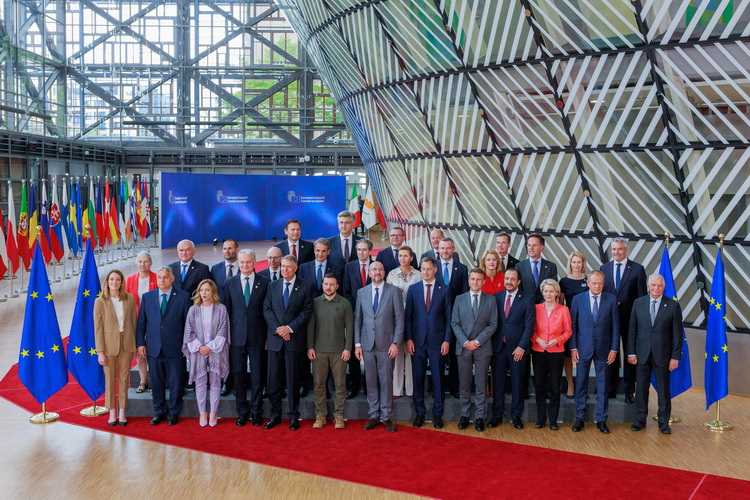
The EU’s leaders will keep a rigid and unyielding position on Russia and its aggressive policy. First of all, this concerns Russia’s war against Ukraine.
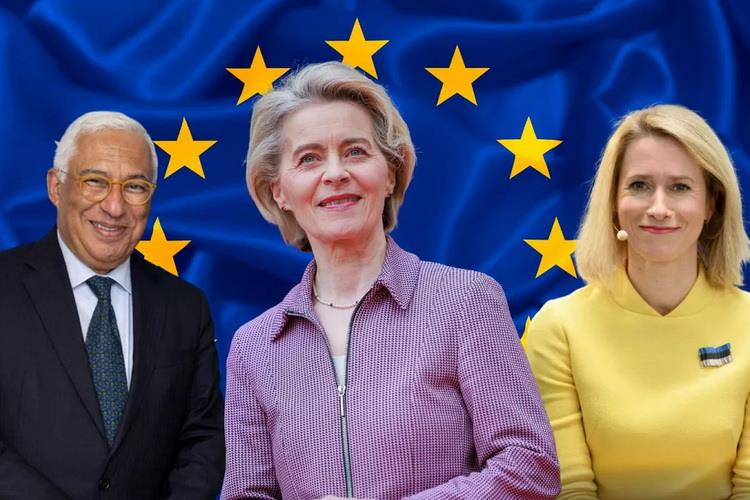 Thus, all the top officials of the European Union who were re-elected or elected at the EU Summit are undisputed opponents of Russia and at the same time supporters of Ukraine. Ursula von der Leyen, who is one of the main initiators and leaders of the EU’s firm course of pressure on Russia and assistance to Ukraine, remained in office as President of the European Commission. Estonian Prime Minister Kaja Kallas, who has a tough and uncompromising attitude to the Kremlin’s policy (she is on a Moscow’s wanted list for “hostile actions against historical memory”, namely the demolition of Soviet monuments in Estonia), was elected High Representative of the EU for Foreign Affairs and Security Policy. Former Prime Minister of Portugal António Costa, who has consistently condemned Russia’s actions and advocated for military assistance to Ukraine, has been elected President of the European Council (Portugal was one of the first countries to promise to provide Ukraine with European-made tanks). Roberta Metsola, who also has strong pro-Ukrainian positions, is expected to be re-elected President of the European Parliament (she visited Kyiv on April 1, 2022, and addressed the Verkhovna Rada of Ukraine).
This trend was manifested by the EU’s introduction (on the eve of the EU Summit) of another package of economic and individual sanctions against Russia for its continued illegal war against Ukraine. The new restrictions are mainly designed to make it more difficult to circumvent European sanctions and relate to the energy, finance, and trade sectors.
|
Note: The new (14th) package of EU sanctions includes: a ban on transshipment services for Russian liquefied natural gas in the EU; a ban on new investments in Russian LNG projects; a ban on the use of the Russian financial messaging system (SPFS) by European banks; a ban on access to ports and provision of services to vessels that contribute to Russia’s war (including tankers that are part of Russia’s dark fleet); extension of the ban on Russian aircrafts’ flights to EU member states; increased control and restrictions on exports of goods that contribute to the growth of Russian industrial potential; prohibition of political parties, foundations and non-governmental organizations to receive funding from Russia; sanctions against 116 legal and financial entities. |
The European Union will increase the scale and forms of its support for Ukraine in countering Russia’s aggression. At the same time, internal problems in the EU that may negatively affect the unity of EU member states in supporting Ukraine will be eliminated.
These intentions of Brussels are enshrined in the Conclusions of the European Council meeting. The document outlines Ukraine’s inherent right to self-defense, which is fully in line with the UN Charter and other norms of international law. In view of this, the EU intends to increase the supply of weapons and military equipment to Ukraine, including air defense systems, armored vehicles, and ammunition. Besides, Ukraine will receive additional equipment to rebuild the energy infrastructure destroyed by Russia.
The EU leaders believe that Russia should not defeat Ukraine and dictate its will to the Western world. This determines Europe’s firm position on Russia and its aggressive policy. The consolidation of the EU around the idea of deterring Moscow is a powerful factor of influence on the leaders of individual EU member states who take pro-Moscow positions.
The process of signing security agreements between Ukraine and its partners will accelerate. Such a process will be facilitated by the EU’s security commitments for Ukraine, signed during the EU Summit.
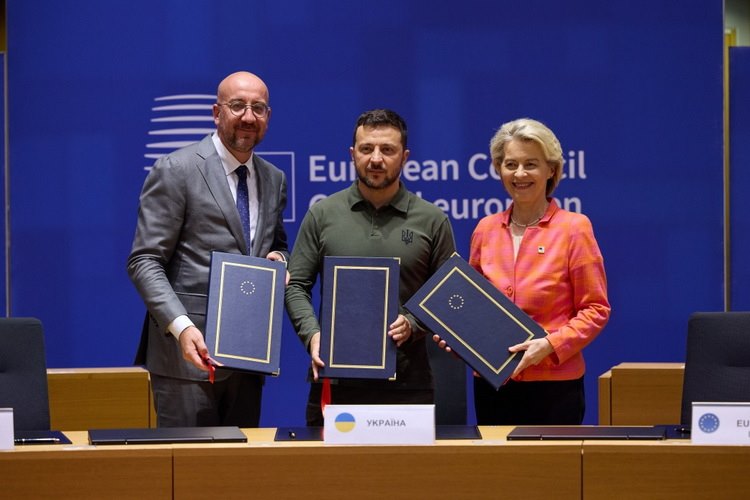 For the first time, the document enshrines multilateral long-term commitments of all EU member states to provide broad support to Ukraine in military, financial, humanitarian, political, and other spheres. According to the security commitments provided to Ukraine, in case of an attack, it can count on military support from EU member states, including with all necessary weapons. For the first time, a document signed by the EU with a third country provides for the establishment of a consultative mechanism to make appropriate decisions in case of aggression against it. It is planned to open a defense innovation office of the European Union in Kyiv, as well as to deepen cooperation between defense industries of the parties, in countering hybrid and cyber threats, and in ensuring free navigation in the Black and Azov Seas.
According to most experts, the joint security commitments between the European Union and Ukraine will facilitate the signing of additional bilateral security agreements between Ukraine and individual EU member states. Currently, such agreements have already been signed with such European countries as the United Kingdom, Germany, France, Denmark, Italy, the Netherlands, Finland, Latvia, Spain, Belgium, Portugal, Sweden, Iceland, Norway, Estonia, and Lithuania. Negotiations on concluding such an agreement with Poland are nearing completion.
As a result (together with other countries that have already signed security agreements with Ukraine or are planning to do so, namely Canada, the United States, and Japan), a strategic coalition of Ukraine’s partners will be formed to guarantee its security. Of course, such guarantees (commitments) will not have direct effect, since most of these countries are unlikely to send their troops to defend Ukraine. However, by combining their efforts, they will be able to strengthen the defense potential of our country to the point where it will not only be able to stop Russia’s invasion and launch a counteroffensive, but also to deter Moscow from a new attack on Ukraine.
Negotiations on Ukraine’s accession to the European Union will receive a new impetus.
On the eve of the EU Summit, the European Commission confirmed that Ukraine has taken all the necessary steps to start negotiations on this issue. So, the text of the EU’s security commitments for Ukraine includes a clause on supporting our country on its way to EU membership.
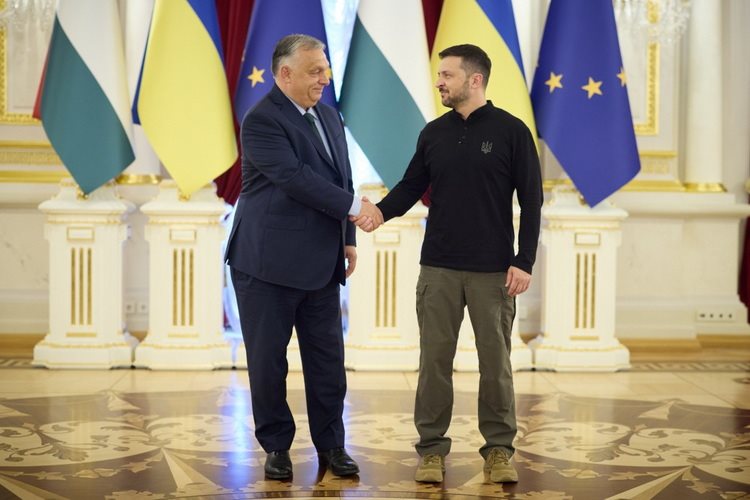 Such a consolidation of the EU countries has affected the positions of Moscow’s apologists in some EU member states. In particular, in June 2024, Hungary gave up blocking negotiations on Ukraine’s European integration, and in early July 2024, Hungarian Prime Minister Viktor Orbán visited Ukraine for the first time in a long time.
However, support for Ukraine’s European integration is not on Hungary’s list of priorities during its six-month presidency of the Council of the European Union starting July 1, 2024. Therefore, the negotiation process on Ukraine’s EU membership is likely to really accelerate only after the presidency is transferred to Poland on January 1, 2025. According to European experts, in any case, the process will not take many decades, as in the case with Turkey. Thus, according to some forecasts, negotiations on Ukraine’s accession to the EU could be completed by 2030.
The process of deepening cooperation between the EU and NATO in joint supporting Ukraine will intensify.
Most European countries are members of both organizations and implement joint programs in defense, crisis and conflict prevention and rapid response, and security programs in cyber, maritime, and space domains. Given Russia’s ongoing war against Ukraine, the EU leaders decided to intensify cooperation with NATO in all these spheres. As a result, the strategic coalition of Ukraine’s partners will become even more powerful and effective.
It is clear that until the war is over, Ukraine will not be able to join either the European Union or North Atlantic Union as a full member. However, in a number of spheres of cooperation with them, Ukraine does not differ from the EU and NATO members. Moreover, it is, in fact, already an integral part of European security and an outpost of the Western world in deterring threats from Russia.
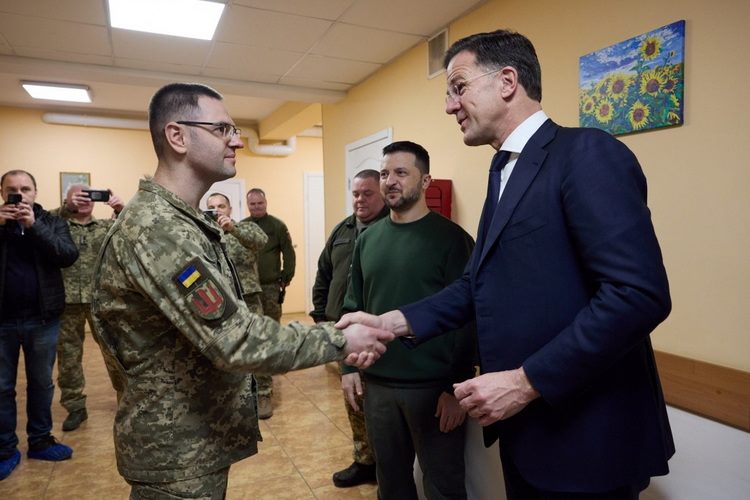 In this regard, the election of Prime Minister of the Netherlands Mark Rutte as the new NATO Secretary General is of positive importance, as he unequivocally supports Ukraine and condemns Russia’s aggressive policy. According to him, peace in Ukraine is important both for the Netherlands and for the whole of Europe. Therefore, Ukraine’s full integration into the EU and NATO is in the European interest. Currently, Mark Rutte is seen in the West as a leader who can ensure Europe’s further military, technical and other assistance to Ukraine, even if the new US President refuses to support our country.
|
…Under any scenario, it is Ukraine that will play a decisive role in defeating Russia… |
The results of the EU Summit in no way gives rise to euphoria or guarantees Ukraine a quick victory in the war against the powerful Russian aggressor. They only create additional opportunities for Ukraine to achieve success. Not only on the battlefield, but also in the political, economic, humanitarian and other spheres.
Let me remind you that today all interested parties recognize the need to peacefully resolve Russian-Ukrainian relations, while keeping in mind their own interests. In principle, Ukraine also agrees to negotiations, but again on its own terms. Under these circumstances, the decisions of the EU Summit will help strengthen Ukraine’s future negotiating position.
However, under any scenario, it is Ukraine that will play a decisive role in defeating Russia. The European Union, NATO, and other partners will continue to help Ukraine, but they will not do our job for us.


