
 Ivan Sichen
After the Putin regime seized power in Russia, one of its main focus was to increase the country’s military potential. It was to become a powerful tool for implementing the Kremlin’s foreign policy, as well as deterring internal threats to the Russian Federation and protecting the positions of the current government.
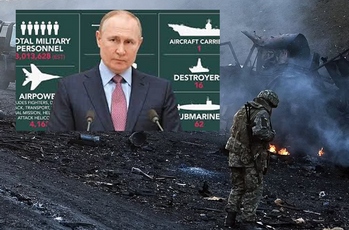
In order to implement these plans, measures were taken to deploy groups of the RF Armed Forces in the most important areas, re-equip them with new weapons and military equipment, as well as improve the forms and methods of combat use of the army and navy. The measures taken were tested in practice during various military exercises, as well as during the attacks on Georgia in 2008 and Ukraine in 2014, the military intervention in Syria in 2015. Building on the “successes achieved”, the Kremlin had declared Russia’s Armed Forces “the second most powerful in the world” and had started to actively blackmail its opponents, including the United States, Europe and Ukraine.
However, Russia’s full-scale war against Ukraine in 2022 completely dispelled this myth. The failure of Putin’s “blitzkrieg” in Ukraine was a clear indication of the real state of Russia’s Armed Forces. That’s what we would like to talk about.
As the Russian proverb goes, “it was smooth on paper, but the ravines were forgotten”. Sorry for the Russian language, the problems of the Russian Armed Forces cannot be explained only in Ukrainian. There are simply no words for this in our language. Indeed, how can we describe what is happening to the Russian army in Ukraine without the above-mentioned expression.
Russia’s Armed Forces always “won” during the exercises, which addressed issues of war with Ukraine and NATO. The same “successes and victories” were achieved by Russian troops during the attacks on obviously weaker opponents. Apparently, the plans for Moscow’s war against Ukraine in 2022 looked “smooth on paper”.
And how well their implementation began for Russia. Everything went almost “smoothly on paper” for two or even three days. And then the same “ravines” appeared and everything went according to a completely different scenario. In principle, what happened is well known, however, we consider it appropriate to look at the situation again in a single context.
For example, it is generally accepted that the RF Armed Forces did not fulfill the tasks set before them, despite the suddenness of their attack on Ukraine and the advantage over it in the number of personnel, tanks and armored vehicles, aircrafts, artillery and missile systems. Based on the analysis of the circumstances related to the actions of the Russian army in Ukraine, the reasons for this were:
- Russian intelligence’s mistakes at both the strategic and tactical levels. First of all, it is important to note the inability of the Russian intelligence services to forecast: the ability of the Ukrainian authorities to quickly organize a tough response to the aggressor in most of the directions; the high level of training of the Armed Forces of Ukraine, including the use of new, unexpected for the Russians, forms and methods of combat warfare; the mass resistance movement of Ukrainian citizens; the strong support for Ukraine from Western partners (including financial assistance and modern ATGMs, MANPADS and strike UAVs); the USA and EU’s imposing devastating sanctions against the Russian government, oligarchs and the economy.
This once again confirms the fundamental importance of the intelligence in the implementation of foreign policy, especially by military means. The obvious reason for the miscalculations of the Russian intelligence services was the adjustment of the results of their assessments to what the Russian leadership and Putin personally expected from them. This situation is typical of most totalitarian regimes, which in many cases creates critical problems for them;
- unpreparedness of Russian troops for modern warfare. The high level of combat skills of the Russian Armed Forces was declared only by Russian propagandists. However, during the actual fighting on the territory of Ukraine, the Russian Armed Forces mostly use outdated tactics typical of the Second World War. In particular, they include artillery strikes on Ukrainian positions with subsequent direct assaults by infantry and tanks, despite the loss of personnel and equipment.
The command of Russian troops and individual units in many cases neglects such important elements of combat warfare as suppression of enemy control and communication systems, providing camouflage and engineering preparation for their positions, providing quality medical care to the wounded directly on the battlefield. In addition, engineering units of the RF Armed Forces have shown an inability to build river crossings and ensure the movement of troops in combat conditions.
Significant shortcomings were in the organization of airborne landings, which achieved some success only on the first day of the war. Later, most of the units that were air-dropped and air-landed from helicopters were immediately destroyed by the Ukrainian defenders, while military transport aircrafts with paratroopers were shot down in the air. As a result, Russia was forced to use airborne troops as ordinary infantry, which is not typical of them. And the Russian Armed Forces refrained from amphibious landings in general due to Ukraine’s coastal defense strength.
Air support for ground forces is also relatively limited. Thus, no more than a pair of aircrafts or one or three pairs of helicopters are involved to support the actions of a battalion tactical group. Until recently, air support of convoys of combat units on the routes of their movement (even on the approaches to the areas of combat clashes) was not carried out at all. The same applied to the air cover of transport convoys with weapons and supplies.
Much more attention has been paid by the Russian military leadership to intimidating the Ukrainian population by carrying out terrorist attacks on peaceful settlements, as well as destroying the rear of the Armed Forces of Ukraine, defense industry, fuel storage and food depots. In general, about 70 % of Russian combat aircrafts are involved in these tasks. Up to 80 % of cruise and ballistic missile launches are carried out in the same interests. However, such strikes, in fact, have no real impact on the course of hostilities.
These methods of Russian aviation had led to the dispersal of its forces and had made it easier for Ukrainian air defense to destroy individual aircrafts and their small groups.
Another problem was the low efficiency of the command and control system of the Russian Armed Forces in Ukraine, namely: the lack of clear plans for war at the level of the highest military command (as a result of the failure of the Russian “blitzkrieg”); poor coordination of actions of units and troops in different directions; loss of commanders and headquarters of the invaders as a result of their destroying by Ukrainian special forces and artillery; shortcomings in maintaining stable communications at all levels;
- the moral and physical obsolescence of the military equipment of the Russian Armed Forces, which in fact cannot withstand the modern Western weapons that Ukraine has. The American FGM-148 Javelin’s and the British NLAW’s successfully destroy modernized Russian T-80U and T-72B3 tanks, which Moscow declared to be “modern” and nearly “the best in the world”. Newer models of Russian armored vehicles, including the BMP-3 and BTR-82, are also completely defenseless against truly modern Western portable anti-tank systems. The same applies to the “newest” infantry fighting vehicles T-15 and “Kurganets-25” together with the armored personnel carrier K-16 “Boomerang”.
The same fate befalls Russian aviation. Not surprisingly, Ukraine’s air defense is successfully destroying obsolete Russian Su-25 attack aircrafts and Su-24 front-line bombers. Ukrainian air defense systems of the same generation S-300, “Buk-M1”, MANPADS “Strela-2M” are efficient enough to destroy them as well as MiG-29 fighters.
But then, Ukraine is also successfully using its air defense against the new Su-30M and Su-34 fighter-bombers, which are again called by Russia “unique in the world”. Russian Ka-52 “Alligator”, Mi-24, Mi-8MTSh and all other helicopters are also being successfully destroyed. And Ukraine’s having received the FIM-92 Stinger MANPADS from the United States and the United Kingdom, and the latest Starstreak MANPADS, has allowed Ukraine to close most of its skies. This also applies to a large extent to “Iskander” ballistic missiles, sea-based “Caliber” cruise missiles and air-launched Kh-22 and Kh-55 cruise missiles.
Russia’s electronic equipment, including control systems, communications, electronic reconnaissance and electronic warfare systems, has traditionally lagged behind. Despite the traditional claims of the Kremlin’s propaganda about the “superiority” of such technology, it lags behind the Western models by 30–40 years, as in the case of the USSR. In particular, the vaunted EW stations failed to harm the actions of Ukrainian-Turkish Bayraktar TB2 UAVs, which have shown extremely high efficiency in destroying enemy targets.
What kind of “high technology” can we talk about when Russian officers continue to prepare artillery calculations with a protractor and a ruler. And this is when all over the world, automatic devices are used for this, no more complicated than a calculator.
Confirmation of this trend is the general condition of the outdated Russian defense industry. By the way, after the collapse of the Soviet Union, it did not make a single new tank, but only modernized those that remained in Russia from the Soviet Union. Therefore, there is nothing to compensate for the loss of such weapons in Ukraine;
- Russia’s inability to organize the normal logistics of its troops in Ukraine. Much has been said on this and is common knowledge. There is nothing special to add here. One can only express surprise that the “second army of the world” not only failed to fulfill its task, but also brought its army to a state where its servicemen in Ukraine are no different from homeless people and are forced to beg to feed themselves.
How to understand the situation, when all aspects of the logistics of the Russian Armed Forces are systematically practiced during exercises. For example, as part of the preparation of the West-2021 strategic exercise, last summer alone, a special training was conducted on the deployment of a logistics zone near Vyborg, Leningrad region. The tasks of logistics of the Russian Baltic Fleet, including its coastal troops in the Kaliningrad region of Russia, were performed.
And where did all this experience go now, and where all the units of the Russian Armed Forces (one logistic brigade for each army), which are designed to provide logistical support to combat units. There are several versions to offer here: either this is completely incompetent planning, or all the exercises were nothing more than a mere “show-off”, or, as always, everything was stolen;
- catastrophic decline in morale of the Russian army. In fact, it is only a refuge for looters, scum and rapists, who can only oppress the civilian population and achieve victory thanks to the overwhelming superiority in numbers. Much is also known about this, and nothing special can be added here. We can only mention one eloquent testimony to how the soldiers of the “second army of the world” are fleeing, abandoning their weapons.
Recently, the police of Poltava region conducted a raid to seize weapons and military equipment from the local population. In addition to machine and submachine guns, 11 Russian tanks and 4 armored vehicles were confiscated from the peasants. Interestingly, no fighting took place on the territory of Poltava region. All these weapons were “taken away” by Poltava residents from the Russian regular army in the neighboring Sumy region.
In total, more than 100 Russian tanks have already been used to equip the Armed Forces of Ukraine, in addition to armored personnel carriers, infantry fighting vehicles and artillery systems. Such “reimbursement” not only compensated for the losses of the Armed Forces, but also increased the number of their heavy weapons;
- failure of attempts to restore the combat potential of Russian troops involved in operations in Ukraine by forming reserve units and mobilization. Again, here are just a few facts.
For example, Russia was unable to additionally form even one battalion tactical group from the Pacific Marine Corps. And 70 % of the military equipment that was stored in the warehouses of the RF Armed Forces proved to be unready. This led to the suicide of the commander of one of the regiments of the 4th Tank Division of the 1st Tank Army of the RF Armed Forces. Most of the trained reservists in Russia’s border areas with Ukraine also refused to return to the Russian army.
That is why Russia is forced to resort to militants of private military companies, Syrian mercenaries and other similar “reserves”, which in no way adorns the “second army of the world”.
Well, like the country, like the army, and vice versa – like the army, like the country. Failures in the war against Ukraine are rapidly depriving Moscow of the remnants of its world position and international prestige. As a result, Russia is losing all the prospects for its revival as a “great world power”.


