
 Ukrainian Troops Have Actually Seized the Initiative in the War
Ivan Sichen
Back in early June 2023, Ukrainian troops switched from defense to counteroffensive at the front. At first glance, so far its results are not too impressive due to its small scale and do not meet previous expectations. But in reality this is not at all the case. Despite the fact that the size of liberated territories is still not very large, the new counteroffensive of Ukrainian troops is already having important military and political consequences.
For one, Ukrainian troops have actually seized the initiative in conducting hostilities and created preconditions for their breakthrough into the operational space and the development of a counteroffensive in the directions of Mariupol, Berdiansk and Melitopol. Of course, this does not mean that Ukrainian troops have achieved tangible success, but it certainly presents prospects in such a case.
Thanks to this, Western partners’ confidence in Ukraine is increasing on the eve of the NATO summit in Vilnius. And the chances of the Alliance’s providing a clear signal to Ukraine about its membership in the Organization and of Ukraine’s receiving additional military-technical assistance from it, are increasing.
In turn, Russians’ inability to achieve a military victory over Ukraine, and besides, Russia’s loss of occupied territories, undermine the position of the Putin regime, increasing tension in the Russian society. Consequently, they form the basis for the next, really massively catastrophic riots in the Russian Federation.
We have recently assessed the counteroffensive of Ukrainian troops at its initial stage. Since then, there have been tangible changes, both purely military and politically, and they need appropriate rethinking. First of all, we should understand how the main aspects of the Ukrainian troops’ achievements influence the development of events related to the Russian-Ukrainian war.
To begin with, let’s briefly review the situation at the front, which determines the course of this war and everything that is happening around it. As you know, right now, Ukrainian troops are advancing in the Bakhmut, Melitopol, Berdiansk and Mariupol directions, as well as defending in the Marinka, Avdiivka, Lyman and Kupiansk directions. These actions have certain peculiarities.
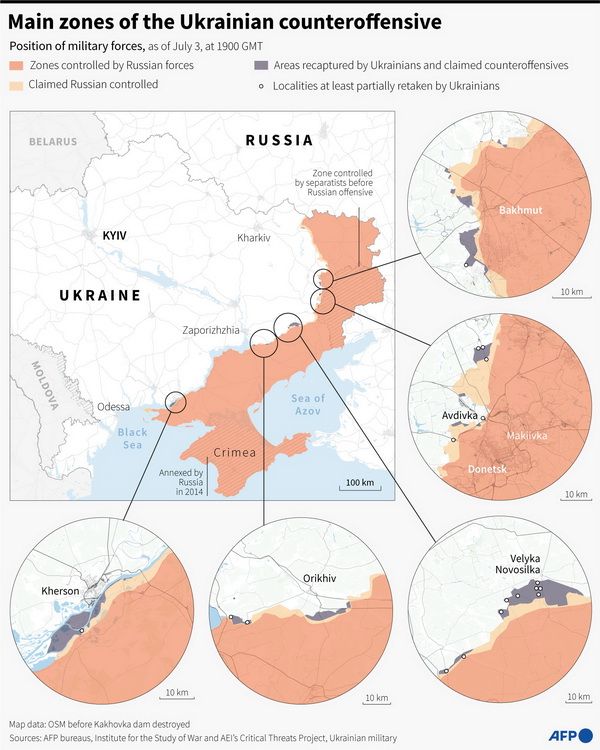 Main Zones Of The Ukrainian Counteroffensive.
Source: Barron’s
For example, in the Bakhmut direction, Ukrainian troops continue to advance in the north and south of the city in order to encircle it. Separate fighting is also taking place in the southwestern part of the city of Bakhmut, which remains under the control of Ukrainian units, and in the north of the city, where Russian troops have been forced to leave forward positions.
As of early July 2023, Bakhmut is half surrounded by Ukrainian troops and largely under their fire control. In turn, Russia is trying to keep the city, which is not so much militarily as politically important for it. As part of such efforts, the intensity of missile and artillery shelling of the positions of Ukrainian units is increasing, as well as reserves and troops are being deployed from the rear and other directions.
In the Mariupol, Berdiansk and Melitopol directions, Ukrainian troops have partially broken through the first line of defense of the enemy, and in some cases — are breaking through the second. Besides, in the Kherson area, Ukrainian units have crossed the Dnipro River and created a bridgehead on its left bank. At this, the advance of Ukrainian troops at the edge of strikes aligns the front line, which should prevent the enemy’s flank attacks.
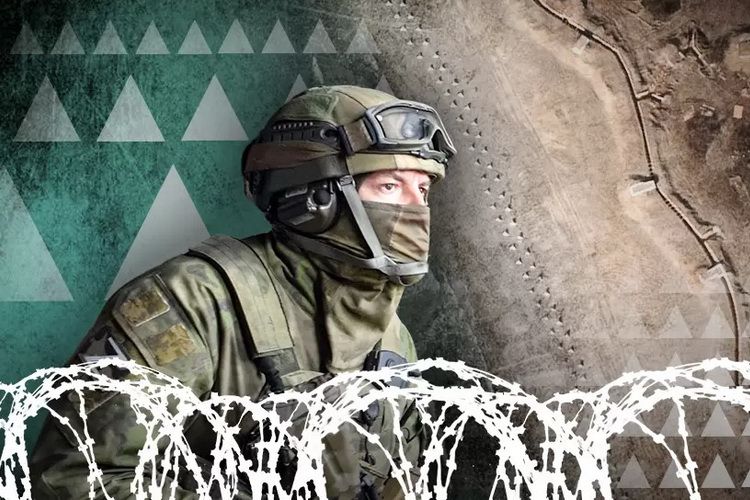 |
| Breaking through the enemy’s first (forward) line of defense has been and remains the most difficult task for Ukrainian troops |
Breaking through the enemy’s first (forward) line of defense has been and remains the most difficult task for Ukrainian troops due to its greatest power, which, in particular, includes anti-tank barriers and ditches, as well as solid minefields. There are also separate units of the enemy, in particular, ATGM teams, artillery fire spotters, scouts and sappers, who remotely restore minefields in case of their neutralization by Ukrainian troops and install new minefields in the directions of their movement. Besides, the first line of defense of the Russians is covered by barrel and rocket artillery, as well as aviation.
On the second (main) line there are equipped positions of the main part of the enemy forces, including infantry, tank and artillery units. Minefields are also laid in front of them, but not as dense as on the first line. It is on the second line that there is a direct clash between Ukrainian and Russian troops in close combat. Therefore, breaking through such lines is also quite difficult. Although, the battles on them are close to the usual practice of assaulting enemy positions.
The third (rear) line is designed to support the actions of Russian troops on the first and second lines and to cover the most important routes, transport and logistics hubs, key settlements and infrastructure facilities. Its main elements are fortified areas, positions of long-range artillery and tactical missile systems, field reserve camps, as well as fuel and ammunition depots. Based on the structure of the third line of defense, the most effective method of its breakthrough is to bypass and encircle fortified areas with their subsequent destruction by artillery. At the same time, this still complicates the offensive of Ukrainian troops and keeps centers of enemy resistance in their rear, which diverts part of the forces directly from the front and disrupts the logistics system of forwarded units.
Along with this, own defense systems have been built around each of the major cities in the occupied territories of southern Ukraine, namely Melitopol, Berdiansk and Mariupol. They consist of anti-tank barriers and ditches, strongholds of units of various levels and minefields. For the needs of the defense of these cities, their internal infrastructure is obviously being prepared: streets, intersections, individual buildings and quarters.
An important component of the Ukrainian counteroffensive is the protection of the left flank of the southern grouping of Ukrainian troops from enemy attacks from the occupied territories of the Donbas. This is the essence of the defensive actions of Ukrainian troops in the Marinka, Avdiivka, Lyman and Kupiansk directions, as well as in neighboring areas. For its part, Russia is still trying to achieve its goal of capturing the entire territory of Donetsk and Luhansk regions, and besides, to go to the rear of Ukrainian troops conducting an offensive in the south of our state, or at least to disperse our forces.
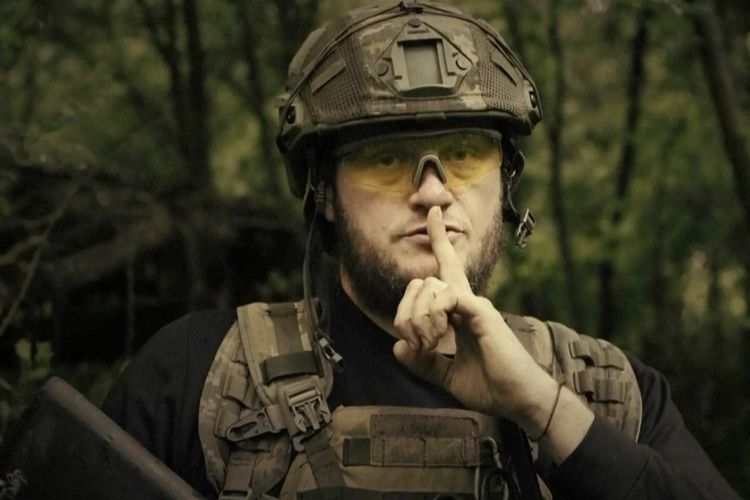 |
| The methods of action of the armed forces and other military formations of Russia and the Defense Forces of Ukraine are fundamentally different |
As before, the methods of action of the armed forces and other military formations of Russia and the Defense Forces of Ukraine are fundamentally different.
For example, Russia seeks to maintain its superiority over Ukraine in the number of personnel and military equipment, as well as a more powerful mobilization potential and defense industry. Proceeding from the above-mentioned, the Russian military command is trying to achieve success on the battlefield by conducting massive artillery fire, missile and bomb strikes on areas of concentration of Ukrainian units and massive, despite losses, use of manpower. In this way, Russia sometimes manages to push back Ukrainian troops or contain their counteroffensive. However, the losses of Russian troops still make themselves felt, especially after PMC “Wagner” left the front. Therefore, Russia is now forced to save its forces, at least of the regular army, and resort to covert mobilization.
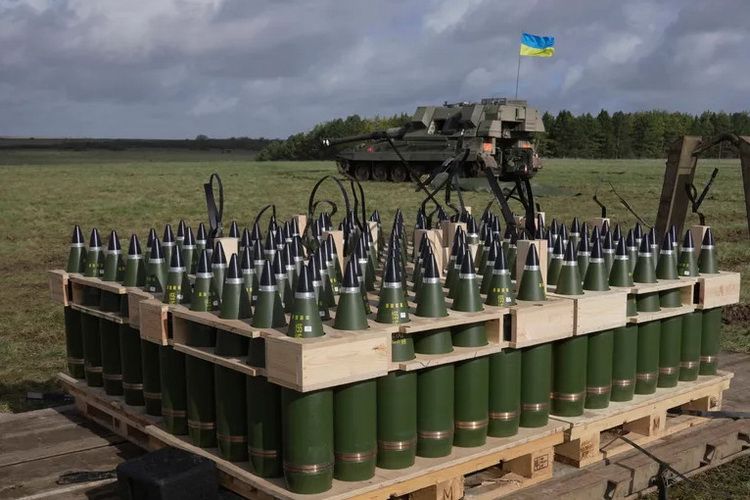 |
| Ukrainian troops make the most of their technical superiority over the Russian troops, which was achieved thanks to Western assistance |
Ukrainian troops make the most of their technical superiority over the Russian troops, which was achieved thanks to Western assistance. On this basis, Western offensive and defense tactics are also used, which involves the destruction of enemy strike weapons at the front and its critical objects in the rear by high-precision missile and artillery strikes while conducting targeted fire on the enemy’s combat formations. Only after the suppression of the enemy there are assaults on its positions by infantry units with the support of armored vehicles. If the enemy manages to maintain combat capability, the assaults are stopped, additional reconnaissance is carried out and targeted fire is opened to eliminate the remnants of enemy forces.
On the one hand, this allows Ukrainian troops to save personnel and equipment, but on the other — slows down the pace of their counteroffensive. However, as noted above, quite important successes have already been achieved. To them can be added the gradual establishment of parity between the Armed Forces of Ukraine and the Armed Forces of the Russian Federation in terms of artillery systems, which was the result of the purposeful actions of our defenders to destroy the enemy’s artillery. Unfortunately, the enemy still outnumbers us in aviation, which also slows down the successful advance of Ukrainian troops.
|
…Ukraine has indeed partially seized the initiative in the war… |
At the same time, the first results of the counteroffensive of Ukrainian troops already allow us to draw a number of military-political conclusions.
Firstly, Ukraine has indeed partially seized the initiative in the war. Now in most sectors of the front line, it is Ukraine who imposes her will on the enemy, forcing it to react. This applies even to those areas where the enemy continues to actively attack. Despite the superiority of the enemy in forces and means, Ukrainian troops not only repel all its attacks in these areas, but sometimes capture its positions.
|
…The successes of the Ukrainian troops testify to their ability to liberate our occupied territories… |
Secondly, the successes of the Ukrainian troops testify to their ability to liberate our occupied territories. In the near future, this will concern actions to clear the left-bank part of Kherson region and the south of Zaporizhzhia region from the enemy, along with access to the approaches to the Crimean Peninsula. Ukraine has the necessary resources to solve these tasks. Currently, only up to four brigades are involved in breaking through the enemy’s first and second lines of defense. About 25 more are in reserve and are likely to be deployed after Ukrainian troops enter the operational space.
|
…Military-technical assistance to Ukraine from its Western partners significantly increases the combat capabilities of Ukrainian troops… |
Thirdly, military-technical assistance to Ukraine from its Western partners significantly increases the combat capabilities of Ukrainian troops, as evidenced by the situation at the front. As we have already written, the decision on further such assistance and giving it new forms may be made during the NATO summit in July 2023.
The reality of such prospects was confirmed by the meeting of the leaders of the European Union at the end of June 2023, most of whom are also leaders of NATO member states. The participants of the EU summit stressed the full support of Ukraine, which meets the interests of European security, and expressed readiness to continue to provide it with political, economic, military, financial and humanitarian assistance for as long as it takes. In this regard, EU members have reached an agreement on the urgent supply of artillery ammunition and surface-to-surface missiles to Ukraine. Besides, they confirmed the firmness of the European Union’s intentions to exert pressure on Russia by strengthening sanctions against it.
|
…Putin not only failed to quickly defeat Ukraine, but is actually losing the war… |
Fourthly, the successes of Ukrainian troops at the front undermine the position of the Putin regime, which not only failed to quickly defeat Ukraine, but is actually losing the war, leading to a deadlock situation, which has increasingly negative consequences for Russia and its population. The catalyst for this process may be Russia’s loss of one or more relatively large cities that it captured in the south and east of Ukraine. Given the mentality of Russians, this will be a powerful moral blow for them, which will create a threat of new unrest and riots within the country with unpredictable consequences.
That is why Russia now seeks to end the war with Ukraine on favorable terms for itself. However, due to the intransigence of Ukraine, which agrees to negotiate with the enemy only after the withdrawal of its troops from all the occupied territories of our state, and the ineffectiveness of Russian pressure on it, the Russian Federation can cross all the still existing “red lines”.
For example, quite real is the threat of Russia’s blowing up the Zaporizhzhia NPP, including remotely. After the disaster, Russia could blame Ukraine and initiate a cessation of hostilities in order to allegedly focus its efforts on eliminating the consequences of the disaster. At this, Russia would hope that Ukraine would not abandon its initiative, as such an unyielding position would cause a negative reaction from the international community. Besides, Russia would thus be able to justify its decision to refuse to continue waging war before that part of Russian society that “dreams” of complete victory over Ukraine.
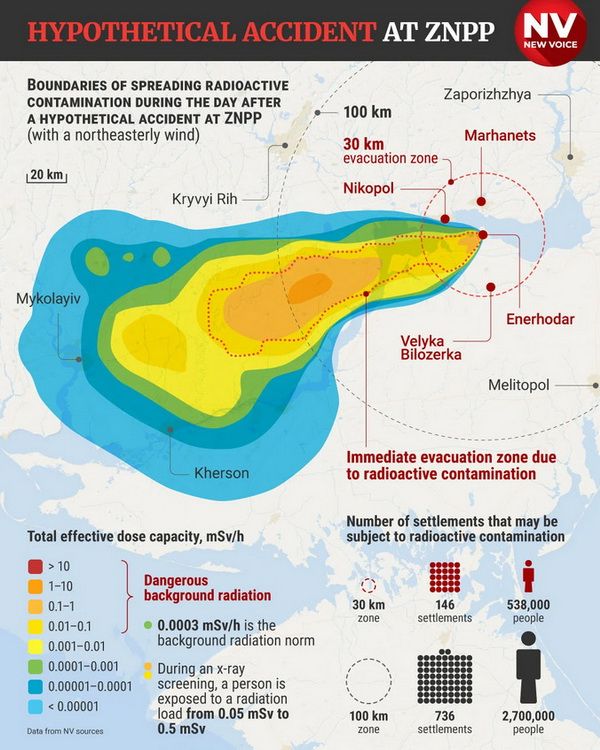 Zelenskyy says Russia could blow up Zaporizhzhya NPP remotely, even after its de-occupation.
Source: The New Voice of Ukraine
However, the threat of Russia’s terrorist attack at the Zaporizhzhia nuclear power plant does not mean that Ukraine should abandon its counteroffensive. Let’s hope that the prospect of a tough reaction from the West will stop the crazy intentions of the Russian Federation.


