
 Ivan Sichen
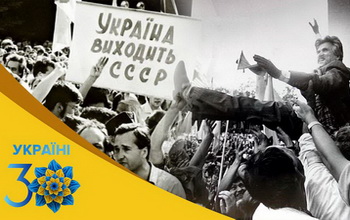
In August of 2021 Ukraine celebrated the 30th anniversary of its independence. This year also marks the 30th anniversary of the collapse of the Soviet Union — in fact the “reincarnation” of the Russian Empire, which was forcibly created by Moscow in 1922. As expected, Russia did not congratulate Ukraine on this date, but just resorted to new military provocations near the eastern border of our state and in its occupied and annexed territories. Moreover, in the year of the thirtieth anniversary of the self-destruction of the Soviet Union, the Putin regime intensified its efforts to restore it in a new form. However, it will not be able to intimidate us and force us to retreat. We have already built our independent state and will never give up on it.
|
…The Putin regime will not be able to intimidate us and force us to retreat. We have already built our independent state and will never give up on it… |
Thirty years of a new independent Ukraine: is it much or little? A historical moment and a whole decisive epoch in the development of the Ukrainian society. We will not talk much about the success Ukraine has achieved during this time and the losses it has suffered. They are well known, and are widely covered by the media at this important time for our state.
Let’s say just a few words on this topic. Over the past thirty years, the main achievements of Ukraine have been as follows:
- building a real democratic state system with free elections of leaders at all levels and their accountability to the public;
- ensuring free and independent media environment as the “fourth” estate in the country;
- creation of a new Ukrainian economy with the achievement of positive dynamics in its development; getting rid of Ukraine’s trade and economic dependence on Russia; For example, our country is one of the five main suppliers of food to the countries of the European Union;
- preservation and development of high technologies in Ukraine, as a result of which it is in fact the only European country that can produce its own passenger and military transport aircrafts, space rockets, engines and high-precision weapons;
- revival of the Armed Forces, which have become one of the most powerful in Europe and allow to deter Russia’s aggression;
- active development of cooperation with the European Union and NATO (including the signing of an Association Agreement with the EU and obtaining the status of NATO’s Enhanced Opportunities Partner), as well as Western and other countries.
Unfortunately, Ukraine has also faced a number of significant problems and threats to the country’s security and interests that complicate its development. The most difficult and dangerous of them are:
- Russia’s armed aggression against Ukraine, including the annexation of Crimea and the occupation of part of the Donbas, where the Russian-Ukrainian military confrontation continues. At this, Moscow retains and increases its capabilities to expand the scale of military invasion of our state;
- low (or no) national consciousness among Ukrainian citizens, which is used by Russia to wage a hybrid war against Ukraine and complicates the processes of its European and Euro-Atlantic integration;
- high level of corruption in the state authorities of Ukraine and low rates of reforms, which hinders the state and economic development of our country, and is another obstacle to its membership in NATO and the EU;
- lack of unanimous support for Ukraine from Western countries, which do not want to exacerbate their relations with Russia, and even more so — to enter into armed conflict with it. As a result, they limit the level of military-technical cooperation with Ukraine. For the same reason, the United States and NATO are unlikely to provide direct military assistance to Ukraine in case of Russia’s open attack on it;
- threat of Ukraine’s losing its importance as a transit country for Russian gas to Europe after the commissioning of the Nord Stream 2 gas pipeline. This will inevitably be used by Russia for new “gas wars” against Ukraine.
|
…In the year of the thirtieth anniversary of the collapse of the USSR, Moscow has sharply intensified its actions to restore it in a new form… |
Despite all these problems, we are still moving forward and continue to strengthen Ukraine and its position in the world. And every year this process becomes more and more irreversible. Both our friends and the enemy understand this fact perfectly well. That is why: on the one hand, our Western partners are stepping up assistance to Ukraine, and Russia, on the contrary, is stepping up efforts to regain control over our country.
This year — the year of the thirtieth anniversary of the collapse of the USSR, Moscow has sharply intensified its actions to restore it in a new form. In particular, a manifestation of this was V. Putin’s program article “On the Historical Unity of Russians and Ukrainians”, which was published in July of 2021.
I have already mentioned it in my previous publications, but only in the part concerning V. Putin’s vision of Ukraine’s economic problems. Given the topic of today’s article, I would like to draw attention to its other theses, which, in fact, are the ideological justification for Russia’s aggression against our state. They are well known, but I will remind you of them again. So, according to V. Putin:
- “Russians and Ukrainians are one people — descendants of ancient Rus; they were separated only by the Tatar-Mongol invasion and the actions of Lithuania, Poland and Austria-Hungary, which captured part of the historical territories of the ancient Rus”;
- “After all those events, Moscow became the only center of liberation and consolidation of ancient lands, including the territory of the present-day Ukraine; and therefore has a legal right to them”;
- “Ukrainians, as inhabitants of the outskirts of Russia, have always served Russia; for this, Russia provided them with its own territories, which make up the majority of modern Ukraine, including its left-bank and southern parts”;
- “It was Russia that contributed to Ukraine’s economic development and its transformation from a backward agricultural region into one of the industrial centers; first of all, this concerns the Donbas”;
- “Attempts to create an independent Ukraine after the revolution in Russia in 1917 were groundless and were provoked by Poland, Germany, Ukrainian nationalists and other Russian enemies; as a result, such attempts ended in the expected failure”;
- “The emergence of the present independent Ukraine also had no objective grounds and was the result of the mistakes of the Soviet leadership during the signing of the Union Treaty, which allowed the possibility of withdrawal of Soviet republics from the USSR”;
- “Ukraine’s independence is of no use to it and only undermines its economy and leads to a decline in living standards without any prospects for resolving the problems; and only Russia has always supported Ukraine, from providing it with financial and economic assistance in the 1990s (including through gas supplies at reduced prices), to assistance in resolving the conflict in the Donbas”.
From this, he draws several strategic conclusions which are hidden in nature, but fully show what V. Putin thinks about Ukraine and what he intends in relation to our state. They are quite clear and indicate the invariability of his position on Ukraine. For example, according to the Kremlin leader:
- “Ukrainians as such do not exist, they are just a kind of Russians like other ethnic groups of the Russian people”;
- “Ukraine has no historical right to independence, it is an artificial state entity and an anti-Russian project of the West”;
- “The only option for the positive development of Ukraine (including the revival of the Ukrainian economy, improving the well-being of the population and ensuring the security of the country) is to build allied relations with Russia”;
- “The majority of the population of Ukraine understands the need for this and would like to improve relations with Russia; however, the Ukrainian leadership prevents this and, in fact, pursues an anti-people policy”;
- “This fact, as well as the fact that Ukraine received most of its territories from Russia, gives Moscow the right to interfere in Ukrainian internal affairs, as well as to regain the lost Russian lands”.
|
…Russia has long developed and is implementing a comprehensive program of action to establish control over the post-Soviet space… |
We will not even talk about all the nonsense of this delusion. But it is already being used by the Russian authorities and various political forces as a guide to practical action. In particular, this applies to Moscow’s measures to demonstrate force near the border of Ukraine and in its annexed and occupied territories, which have gained special momentum since the beginning of this year. Moreover, the management of the Russian company Gazprom has already stated that it has no plans to continue the transit of gas through Ukraine’s territory.
However, this is not the whole story. Russia has long developed and is implementing a comprehensive program of action to establish control over the post-Soviet space. The only difference is that while before, Moscow somehow disguised its intentions under various integration projects, now it speaks about this directly and openly.
For example, back in June of 2021, during the IX Moscow Conference on International Security, V. Putin stressed Russia’s “responsibility” for the situation in its neighboring countries. By this, he actually recognized Moscow’s interference in internal affairs of the countries of the former USSR, and reserved to it such a “right”. And in August of 2021 a number of Russian politicians, from the ruling United Russia party, communists and nationalists fully disclosed the above-mentioned Moscow’s plans, along with their comments and additional suggestions.
Again, in one article, it is impossible to retell all their veriest nonsense connected with their “phantom pain” of the loss of Ukraine and Russia’s other capturings. Therefore, I will still confine myself to the main theses of the neo-imperial conceptions of our Russian opponents. Despite the rather inadequate content of most of these ideas, we will try to retell them at least in general form.
So, here is what V. Putin’s “any and all” acolytes recommend to him:
- to continue the protection of the Russian-speaking population, which is “severely oppressed” in the countries of the former USSR. First of all, Ukraine and the armed conflict in Donbas are mentioned in this regard, which are the most painful problems for Moscow;
- to pay greater attention to the issues of Russia’s economic development, which should increase its attractiveness for the former Soviet republics as an “economic flagship in the post-Soviet space”. At this, special emphasis is placed on the need to preserve and strengthen the economic dependence of the post-Soviet countries on the Russian Federation;
- to intensify measures of informational influence on the countries of the former USSR. The main directions of such influence should be persuading the political elite and the population of those countries about the benefits of integration with Russia, which would create favorable conditions for improving their economies, as well as provide protection from stronger neighboring states and other security threats. Besides, a separate direction of information work should be to discredit the ideas of independence of post-Soviet countries and their rapprochement with the West and other adversaries and rivals of Russia, as well as to undermine the authority of national leaders;
- to expand the Russian lobby in the countries of the former Soviet Union by facilitating coming to power of pro-Russian forces, to spread the ideas of the restoration of the Soviet Union, and to provide stronger support to various pro-Russian and anti-national forces.
According to the authors of this concept, the organization and coordination of these activities should be done at the level of Russia’s top leadership with the involvement of relevant governmental and non-governmental organizations and the media. At this, Russian embassies in the countries of the former USSR should become “Moscow’s forward headquarters” on their territories.
In principle, there is nothing new here. All these measures have been implemented by Moscow since 1992. However, so far without tangible results, except for Russia’s creation of the Collective Security Treaty Organization and the Eurasian Economic Union. But even they remain mostly formal, not real effective organizations. By the way, it was Russia’s inability to establish control over Ukraine by political, economic and other hybrid methods that prompted Moscow to launch an armed attack on our state in 2014.
Despite this, Russian supporters of the restoration of the USSR, or the construction of some new form of it, are for some reason fully convinced of the possibility of achieving their goal. According to them, the majority of the population of the former USSR supports the idea, “which will continue to lead to the destruction of the borders of the former Soviet republics, as it happened in 2008 and 2014”.
|
…The time of the Russian imperialists has passed and will not return… |
However, the time of the Russian imperialists has passed and will not return. Evidence of this was the failure of Russia’s attempt to destroy Ukraine in 2014, which, according to the Putin regime, was to be the last year of independence of our state. It didn’t work out and it will never work out. And we will celebrate with you the fiftieth and all other Independence Days of Ukraine as an integral part of the Western world.
Happy Independence Day, Ukraine! Glory to the Heroes and death to the enemies!


