
 A Training Course at the Kyiv-Mohyla Academy
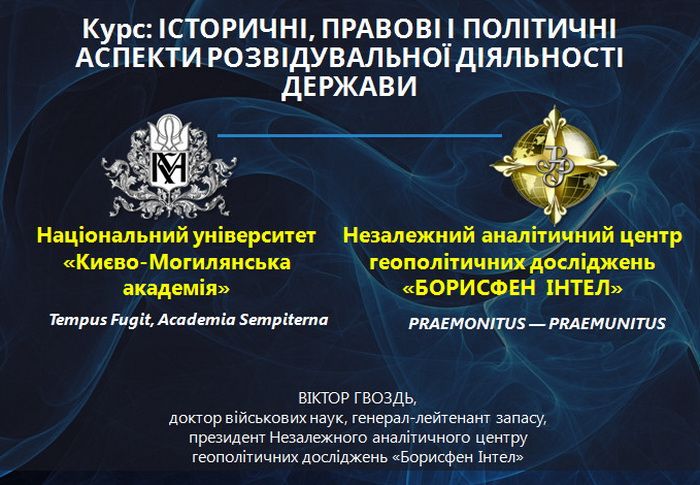
In the winter semester of this year, students of the “Kyiv-Mohyla Academy” National University had the opportunity to learn the course “Historical, Legal and Political Aspects of the State’s Intelligence Activity”. It had been studied for the fifth time in the group of optional subjects, and it should be noted that the student community’s interest to it is not declining. The author of the course, President of the Independent Analytical Center for Geopolitical Studies “Borysfen Intel”, Doctor of Military Sciences, Lieutenant General of the Reserve Victor Hvozd, proposed it in 2016, and since then he has been constantly expanding the topic. Which, by the way, is quite logical and understandable, because in the world, intelligence is only gaining momentum: there are new forms and methods of its conduct in countries, especially advanced ones, improving its legal framework, with private companies often resorting to it, because their scientific and practical production is also interesting for competitors.
This time more than eighty students wanted to take the course: 31 — from the “Faculty of Law”, 53 — from the “Faculty of Social Sciences and Social Technologies”, different in specialty, such as “Law”, “Political Science”, “Philology”, “International Relations”, “History and Archeology”, “Management”, etc.
 Training under the quarantine was remote, using the corporate e-learning platform DistEdu (Moodle) for classes and control activities.
It is clear that the content of the lectures was given remotely. And this has its “nuances”, which should be taken into consideration, because important is personal communication with the teacher, when a theoretical aspect raises questions and needs to be discussed further.
Students also received materials on eight topics of the course in the form of lectures and presentations, including interactive, a large number of additional materials in the audio and video format. Students passed control tests on each topic, and at the end of the course prepared essays, where they considered a large number of issues: from the biblical roots of intelligence to the peculiarities of organization and conduct of intelligence in the postmodern world.
To see how successful the course was — just look at the results of the final test, which they performed with an average score of 9.62 (out of 10 maximum). As well as the quality of the essay prepared, many of which (38 people — in fact half of those who took the course) were awarded the maximum score — 35-40 points out of 40 maximum.
Today it is appropriate to get acquainted with the opinions of the participants of such training to make sure that they are interested in intelligence activities not as ordinary citizens, but as future professionals of different specialties who will work for the benefit of their state in different institutions.
The Students’ Comments:
— Lectures are quite relevant. Conducted in an unusual way, a lot of useful examples filled with interesting content.
— The topics are very interesting, especially regarding the connection between diplomacy and intelligence. Presentations and interactive presentations make understanding of the materials much more interesting. Videos are also very interesting.
— As for the themes — the selection of topics is balanced, they are interesting, well-structured and quite clearly presented. At the library, I also took a monograph for the duration of the course — it made learning much easier and clearer.
— I especially want to point out the interest of the teachers themselves in the course, who followed its passage throughout the time and reminded of its importance (sometimes, in my opinion, excessively). One can see at once that this course is important for teachers and they are willing to share their information.
— We had the opportunity, even in the absence of live communication, to quickly resolve problems or get help from teachers.
— I for one (like many of my colleagues), lacked live communication with teachers. Most students enrolled in this course, relied on the feedback of senior colleagues, who spoke especially warmly about the lectures. We fully understand the complexity and peculiarities of remote learning, but we would be very happy to have the opportunity to communicate with the author of the course, even in the format of 1–2 conferences after the holidays (I’m sure my classmates will support me).
— We are missing live communication.


