
 Partner Countries in the Alliance’s Operational and Strategic Plans. Part 2
Victor Hvozd
Doctor of Military Sciences
Part 1
Less known is military and military-technical cooperation between the United States/NATO and Finland and Sweden. So let’s look at them more closely.
Thus, in 2014, in addition to joining Finland and Sweden to the Enhanced Opportunities Partnership with NATO, the Host Nations Support agreements were signed. It gives the Alliance the right to conduct exercises in these countries and send NATO troops to respond to crises there. Later these accords were supplemented by a number of other agreements. In May 2018, a Trilateral Statement of Intent was signed to deepen military cooperation between the United States, Finland and Sweden. Among other things, the document provides for the intelligence exchange, increasing the interoperability of the armed forces, conducting joint exercises, improving the capabilities of joint operations, strengthening cooperation in the sphere of weapons development and military research. In June of that year, Finland and Sweden signed another agreement on their armies’ participation in the United Kingdom-led Joint Expeditionary Force.
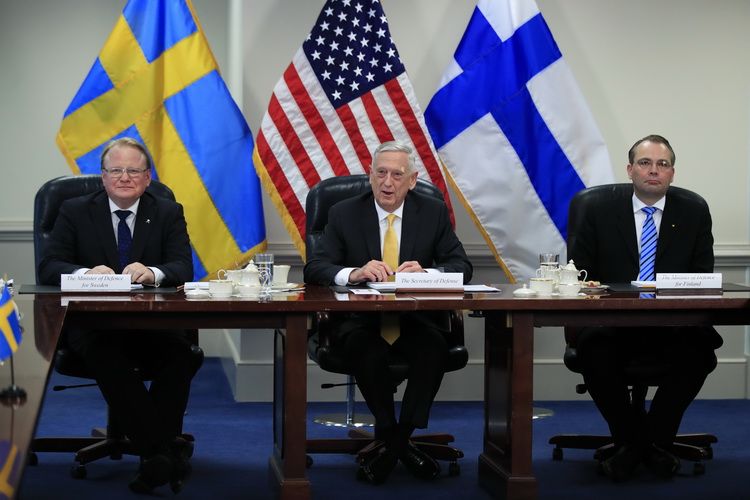 |
| The defence ministers of the United States, Finland and Sweden during a trilateral meeting, May 2018 |
Quite illustrative is the Joint Statement of Intent signed in September 2020 between Norway, as a NATO member, and Finland and Sweden on deepening military cooperation. It provides for synchronizing military plans of the three countries and their coordination with NATO plans, as well as to conduct joint exercises. The agreement was signed at the Norwegian military base Porsangmoen, 200 km from the border with Russia. At this, such a step was defined as “a clear signal” to Moscow about the inadmissibility of aggressive actions in the region.
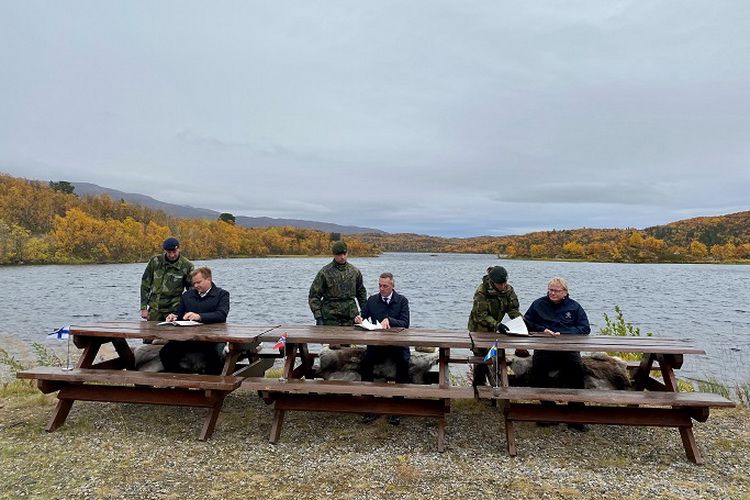 |
| The signing of the Joint Statement of Intent by the defence ministers of Finland, Norway and Sweden, September 2020 |
As part of the practical implementation of these agreements, forces of NATO and individual Allies have been given greater access to the naval and air bases of Finland and Sweden. Besides, Finnish and Swedish troops have been systematically involved in NATO’s multinational military exercises in the Baltic and Arctic regions, including the Arctic Challenge Exercise, Baltops and Trident Juncture. At the same time, NATO troops are participating in exercises of the national armed forces of Finland and Sweden. The exercises address issues related to the confrontation between Russia and NATO in these areas.
We should also point out the deepening of military-technical cooperation between the United States/NATO and Finland and Sweden. In particular, in 2020, the US State Department approved a sale package for Finland for 64 fifth-generation F-35 fighters, 58 F/A-18E and F/A-18F fighters, and 14 electronic warfare aircrafts, Also, in 2021 Finland’s defense budget is planned to increase by 54 %. In turn, Sweden intends to increase its military spending by 40 % by 2025.
Given these circumstances, Western experts point out the fact that Ukraine, Georgia, Finland and Sweden have actually been included in NATO’s operational and strategic plans. At this, despite the fact that they do not fall under Article 5 of the North Atlantic Treaty on collective security, the North Atlantic Alliance, in fact, assumes responsibility for their protection from external aggression.
 |
| NATO members and dates of accession |
In general, these processes can be compared to the next stage of NATO enlargement, which significantly changes the situation in the European theater of operations. Thus, the accession to NATO of the countries of Central and Eastern Europe and the Baltic states in 1999–2004 has already led to the direct confronting of Russia and the Alliance in the Baltic and Black Sea regions. However, at that time NATO troops reached only the borders of Poland (near the Kaliningrad region of Russia) and Lithuania, Latvia and Estonia.
|
…Due to the new forms of cooperation with partner countries, the North Atlantic Alliance, in fact, reaches Ukraine’s and Finland’s borders with Russia… |
Since 2014, this situation has acquired a fundamentally new character. In particular, due to the launch of NATO’s qualitatively new forms of cooperation with partner countries, the North Atlantic Alliance, in fact, reaches Ukraine’s and Finland’s borders with Russia — with a length of 2295 and 1272 km, respectively. Moreover, NATO is coming ever closer to Russia’s strategically important political, economic and military centers.
To date, this has forced Russia to deploy additional troops in the Baltic and Black Sea regions, including the 1st Tank Army and the 20th Combined Arms Army of the Western Military District, the 8th Combined Arms Army of the Southern Military District, as well as the 11th Army Corps of Coastal Troops of the Baltic Fleet, the 22nd Army Corps of the Black Sea Fleet and the 14th Army Corps of the Northern Fleet of the Russian Armed Forces.
At the same time, the border between Russia and Finland remains virtually uncovered. In particular, the 6th Combined Arms Army (HQ — St. Petersburg) of the Western Military District, which has only two motorized infantry brigades near Vyborg and Luha, has been deployed in this direction. Two more motorized infantry brigades from the 14th Army Corps of Coastal Troops of the Northern Fleet are located near the cities of Alakurtti and Pechenga west of the Kola Peninsula. Between the 6th Combined Arms Army and the 14th Army Corps of the Russian Armed Forces on the section of the Russian-Finnish border about a thousand kilometers long there are only Russian border troops.
|
…In general, these circumstances contribute to the strengthening of NATO in the European theater of operations and are additional factors holding back Russia’s expansion in the Black Sea, Baltic and Arctic regions… |
Given Finland’s actual moving towards NATO, this situation requires Russia to build up its troops deployment on the Finnish direction as well. According to the Russian side, at least one more combined arms army consisting of 3–4 motorized infantry brigades should be deployed there. However, today Russia cannot do this due to the aggravation of the country’s economic problems, which are forcing it to reduce military spending.
In general, these circumstances contribute to the strengthening of NATO in the European theater of operations and are additional factors holding back Russia’s expansion in the Black Sea, Baltic and Arctic regions. At the same time, they are pushing Moscow to seek certain compromises with the West, on the settlement of the situation around Ukraine included. In turn, this creates more favorable conditions for Ukraine to defend its interests before Russia, as well as to speed up the process of Euro-Atlantic integration of our country.


