
 Partner Countries in the Alliance’s Operational and Strategic Plans. Part 1
Victor Hvozd
Doctor of Military Sciences
June 2020, NATO leaders decided to develop a Concept for Deterrence and Defence of the Euro-Atlantic Area. The document should be a development of the new NATO Military Strategy, adopted at the Alliance’s summit in December 2019, and will focus on countering major threats to Euro-Atlantic security, primarily from Russia, Islamic extremism and China. With this in mind, the Concept will specify NATO’s actions to deter adversaries and repulse possible aggression in all domains, including in land and naval theaters of war, as well as in the air, space, cyber and information spaces. Besides, it takes into consideration new methods of hybrid warfare and various new technologies. Special attention is paid to deepening NATO’s interaction with the European Union’s military structures, as well as with non-Alliance partner countries.
Thus, according to Western experts, in case of an armed conflict (war) between Russia and NATO, it will be important to support the actions of the Alliance by countries such as Ukraine, Georgia, Finland and Sweden. According to military analysts, this will allow NATO to significantly improve its operational and strategic posture in the European theater of operations. First of all, this applies to Ukraine, which is one of the determining factors in the balance of forces between NATO and Russia. In particular, Ukraine acts as a buffer between Russia and NATO member states in Central and Eastern Europe and the Black Sea region. Besides, Ukraine draws off part of the troops of the Western Military District (the 20th Combined Arms Army), as well as most of the forces of the Southern Military District (the 8th and 49th Armies) and the Black Sea Fleet of the Russian Armed Forces. As a result, in case of a military conflict with NATO, Russia would not be able to redeploy them to other areas, including the Baltic region.
Similarly, Georgia is NATO’s bridgehead in the Caucasus and the buffer zone between Russia and Turkey. At the same time, like Ukraine, Georgia makes Russia keep the relevant forces of the Southern Military District (the 58th Combined Arms Army) and the Russian Black Sea Fleet against it, and thus they cannot be used against other Russian adversaries.
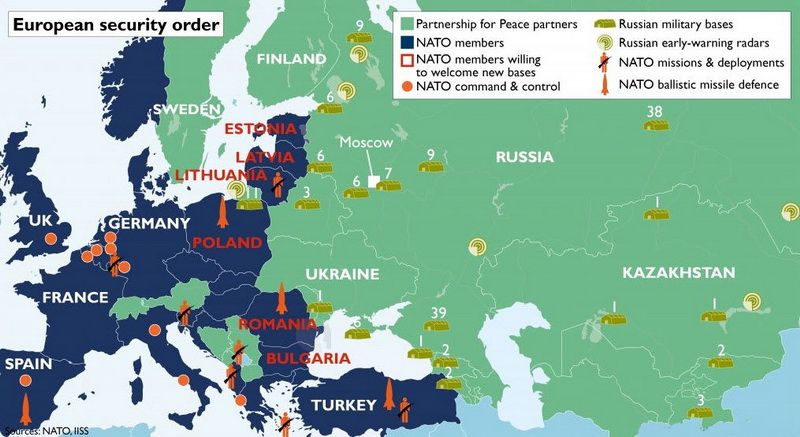 |
| European security order |
In turn, NATO’s interest in Finland is determined by its geographical location in the north-eastern part of the Baltic region and in the immediate vicinity of the strategic transport corridor St. Petersburg — Murmansk. Based on this, if necessary, Finland can block both the exit from the Gulf of Finland and the only way to provide Russian troops on the Kola Peninsula (including bases of nuclear submarines of the Northern Fleet). In addition, there is a direct threat to the city of St. Petersburg.
In the same way, Sweden has full control of the north-western part of the Baltic region, including the island of Gotland, which allows it to block navigation in the Baltic waters. At the same time, with the participation of Finland and Sweden, the actions of the Russian Baltic Fleet may be blocked.
|
…Ukraine and Georgia are already under attack by Russia, while Finland and Sweden do not rule out the possibility of such scenario… |
In this context, Ukraine, Georgia, Finland and Sweden have their own problems with Russia, which creates the basis for their siding with the North Atlantic Alliance. For example, Ukraine and Georgia are already under attack by Russia, while Finland and Sweden do not rule out the possibility of such scenario. The increase of threats of Russian aggression against Finland and Sweden was recognized by special services of those countries in early 2010‘s. Such conclusions were based on the facts of increasing Russian military activity in the Baltic and Arctic regions, including rehearsing use of the nuclear weapon. According to NATO leaders, Russia tested simulated nuclear attack on Sweden in the spring of 2013.
Fundamental changes in the attitude of Finland and Sweden to Russia took place in 2014, which was a consequence of the events around Ukraine, which fully confirmed the aggressive nature of Moscow’s policy. It was during this period that the question of the possibility of their joining NATO was raised in Finland and Sweden. In particular, the Finnish government’s report on the country’s foreign and security policy for 2016 pointed out the possibility of Finland’s possible NATO membership. During the same period, Sweden adopted a new National Security Strategy, which identifies Russia as the main threat to Swedish security.
According to NATO experts, all this determines the coincidence of the interests of Kyiv, Tbilisi, Helsinki and Stockholm with Brussels in the confrontation with Moscow. Thus, strengthening Ukraine’s, Georgia’s, Finland’s and Sweden’s ties with NATO contributes to their security and is a deterrent to Russia. In turn, as said above, the Alliance is interested in deepening cooperation with these countries from the operational and strategic point of view.
|
…NATO uses adaptive forms of integration of partner countries, which provide the cooperation on the level of official NATO members without their formal membership in the Alliance… |
NATO leaders also take into consideration the de facto impossibility of a quick Euro-Atlantic integration of Ukraine, Georgia, Finland and Sweden, as well as other partner countries. As we know, the reasons for this are internal problems in Ukraine and Georgia (including armed conflicts on their territory), as well as the presence in Finland and Sweden of strong political forces that oppose their NATO membership. In view of this, the North Atlantic Alliance uses adaptive forms of integration of partner countries, which provide for bringing cooperation with them to the level of official NATO members without their formal membership in the Alliance.
Thus, in 2014, the Enhanced Opportunities Partnership (EOP) was launched, which aims to strengthen the interoperability of the troops of the EOP member countries with the Alliance’s troops. Georgia, Finland, Sweden, Australia and Jordan joined the EOP in 2014, and Ukraine — in 2020. NATO leaders have intensified cooperation with them at the bilateral level as well.
Forms of cooperation between NATO and Ukraine and Georgia are well known and do not require in-depth consideration. Basically, the cooperation of the parties is organized within the framework of Annual National Programs, which include a wide range of activities in various spheres. Besides, since 2014, NATO leaders have adopted a number of additional plans and programs for cooperation with Ukraine and Georgia, and assisting them in strengthening their defense in confrontation with Russia. In particular, in 2014, the Welsh Summit of the Alliance decided to establish six trust funds and several other financial programs in spheres critical for Ukraine for a total of 21.6 million Euros. And in 2016, during the Warsaw Summit, NATO leaders endorsed a Comprehensive Assistance Package for Ukraine.
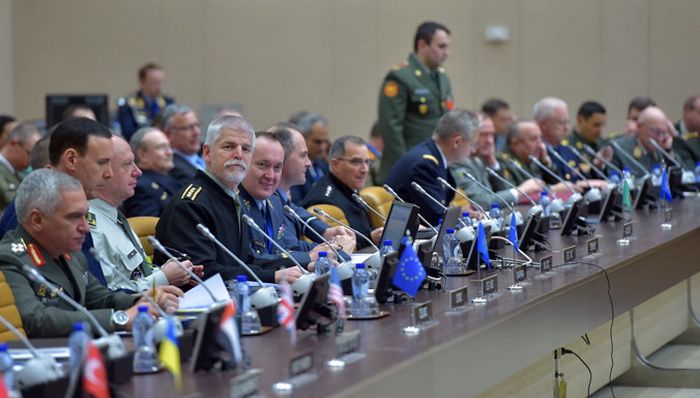 |
| In 2016, during the Warsaw Summit, NATO leaders endorsed a Comprehensive Assistance Package for Ukraine |
Some NATO member states also provide assistance to Ukraine. Thus, in 2014–2020, the United States allocated more than 1.6 billion US dollars to strengthen the defense sphere of our state. These funds are used to supply Ukraine with various types of weapons and military equipment, including modern FGM-148 Javelin anti-tank missiles, counter-battery radars, patrol boats, military vehicles, communication and night vision equipment, bulletproof vests, etc. The issue of transferring MANPADS to Ukraine is also being considered. In addition, with the help of the United States, Ukraine’s military infrastructure is being developed and modernized.
An important donor to Ukraine in the military sphere is the United Kingdom, which has been determined by NATO as responsible for deterring Russia in the Black Sea region. In October 2020, an agreement was reached to provide the UK’s loan of 1.25 billion pounds for the restoration and development of the Ukrainian Navy. These funds will be used for the production and purchase of naval vessels, as well as the construction of two naval bases in Ukraine in the Black and Azov Seas.
In turn, the NATO-Georgia Substantial NATO Package (SNGP) was adopted in 2014, which includes measures to help Georgia’s Euro-Atlantic integration. According to the plan, a Joint Multinational NATO-Georgia Brigade was formed. In addition, a NATO Training Center has been set up at Georgia’s Vaziani base (20 km from Tbilisi). It is also planned to deploy a large military logistic center of the Alliance, capable of accepting all types of military transport aircrafts. Apart from the Vaziani base, there are two other NATO facilities in Georgia, namely the Mountain Training School at Sachkhera and the Joint Training and Evaluation Centre at Krtsanisi.
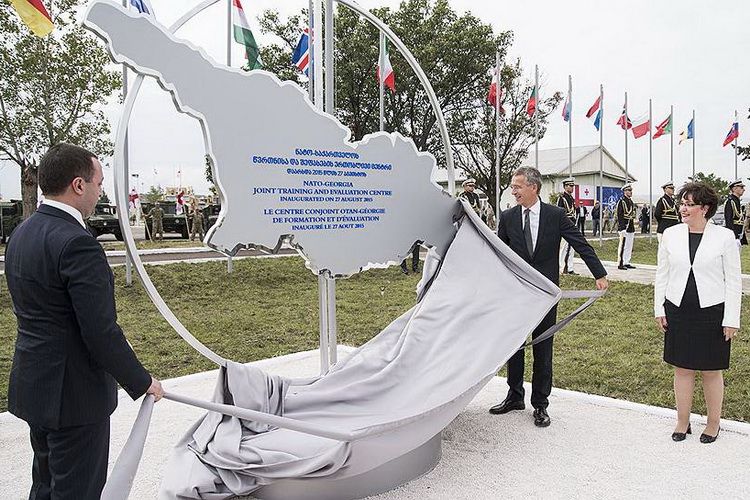 |
| The opening of the Joint Training and Evaluation Centre at the Krtsanisi, Georgia, August 2015 |
At the same time, the US and NATO military commands intensified joint military exercises with Ukraine and Georgia, rehearsing joint counteraction to Russia’s possible aggression. The main such exercises in the US/NATO-Ukraine format were Sea Breeze, Joint Effort and Rapid Trident. Similar exercises in the US/NATO-Georgia format are Agile Spirit and Noble Partner.
In 2019, in the airspace of Ukraine there begun systematic flights of US Air Force strategic bombers simulating strikes on Russian military facilities in the occupied Crimea and North Caucasus.
Part 2


