
 Russia will be forced to resume the Grain Deal. And not on the Kremlin’s terms at all
Ivan Sichen
Another crime of the Putin regime during the war against Ukraine is Moscow’s withdrawal from the so-called Grain Deal. Moreover, Russia has inflicted a number of blows on grain reserves and port infrastructure of our state. At the same time, it openly threatens to destroy cargo ships if they go to Ukrainian ports without proper approval. The purpose of such steps of the Kremlin is quite clear, in particular: to inflict maximum damage on Ukraine; to force the West to lift sanctions imposed on Russian food exports; to oust our state from the international grain market as one of the main competitors of the Russian Federation.
At this, the leadership of the Russian Federation is not at all worried that the implementation of these plans creates the threat of a food crisis in Asia and Africa, which could lead to the death of millions of people from starvation. After all, when did such things hold Moscow back?
However, the “boomerang always returns”, which is shown by the deep crisis in which the grain sector of Russian agriculture found itself.
|
…In 2023, the agricultural industry of Russia increasingly found itself in a deep crisis, first of all its grain sector… |
A year ago, Moscow boasted of a record grain harvest in Russia’s history. And agriculture was called the “locomotive of Russia’s economy”, which will help it cope with the negative consequences of Western sanctions. However, already in 2023, the agricultural industry of the Russian Federation increasingly found itself in a deep crisis, first of all its grain sector.
On the one hand, the reasons were a significant drop in grain prices due to the surplus of grain in the country, and on the other hand, an increase in the cost of agricultural machinery, fertilizers, fuel, transportation, rental of warehouses and export duties. Most of these factors arose as a result of Russia’s full-scale attack on Ukraine, as well as foreign sanctions imposed against the Russian Federation. Besides, an additional “disaster” for the Russian Federation was the high level of harvest of its own grain and the theft of grain from the occupied territories of Ukraine. Because of this, Russian farmers are already considering reducing wheat crops or even abandoning it due to its unprofitability. And this already creates the basis for the collapse of the grain segment of Russia’s agricultural sector, which will negatively affect its food industry, agricultural machinery and Russian exports. Let us analyze these problems in more detail.
To begin with, according to the Ministry of Agriculture of the Russian Federation, 157 million tons of grain were harvested in the country in 2022, which is 30 million tons more than in the previous year. The wheat harvest was also a record — 104 million tons. Of those, about 10 % were grain grown on the territory of the “DPR/LPR”, as well as a grain that were stored in the occupied part of Zaporizhzhia and Kherson regions, and were “taken under control”, but in fact — stolen by Russia.
At the same time, foreign sanctions against Russia imposed for its attack on Ukraine, in particular, the disconnection of Rosselkhozbank from the SWIFT system, have complicated the export of Russian grain. At the same time, the main consumers of Russian grain in Europe — Greece and Italy — decided to single-handedly reduce its imports by 40–50 %. Russia is trying to compensate for its losses by increasing grain supplies to Türkiye, Egypt, Saudi Arabia, Bangladesh, Kazakhstan and other countries, but still cannot cope with this problem. As a result, there is a surplus of grain in the Russian Federation, which objectively led to a drop in prices for it almost twice — from 23 thousand rubles per ton at the end of 2021 to 13 thousand rubles in 2022. At this, the cost of producing one ton of grain is 10.5–11 thousand rubles (depending on the region and technology), and its transportation to storages is on average 1.4 thousand rubles. That is, for one ton of grain, the farmer gets an income of not more than 600 rubles.
The same applies to other agricultural crops. In 2021, a ton of rapeseed cost 47 thousand rubles, while in 2022 — only 25 thousand rubles. Last year, sunflower seeds cost 35 thousand rubles per ton, while this year it costs already 20 thousand rubles per ton.
In the occupied territories of Ukraine, the situation with prices is even worse. Despite the fact that Russia calls them “its own”, local farmers are openly discriminated. They are forced to sell wheat at 5.5–6 thousand rubles per ton, while the cost of its transportation to Russia is 8–11 thousand rubles.
And that’s not all. As you know, Russia’s war against Ukraine has led to a shortage of funds in the Russian budget. In this regard, the Russian government has increased export duties on grain to about 3 thousand rubles per ton. This amount ranges from a quarter to a third of the revenue (not income) of farmers.
|
…All these circumstances significantly hamper the development of the grain sector of agriculture in Russia… |
All these circumstances significantly hamper the development of the grain sector of agriculture in Russia, not allowing to maintain it in proper condition. This is simply impossible to be achieved without upgrading machinery, including tractors, combines, trucks, seeders, trailers, farm equipment, etc. And farmers do not have the necessary funds for this. Moreover, since the beginning of 2022, agricultural machinery in Russia has risen in price by 30–40 %, and in some cases by 100 %, which is again a consequence of the introduction of foreign sanctions against the Russian Federation.
In particular, before the war, the share of Western components and materials in the products of the Rostov plant Rosselmash was up to 40 %, including engines, gearboxes, reduction units, plastic elements and even paint. Currently, the company is forced to buy them from China or try to get them through third countries, which complicates and makes logistics chains more expensive. And in the case of China, it also worsens the quality of the equipment.
Previously, the farmers resolved the problem of lack of funds with the help of state programs for the provision of financial assistance, the transfer of equipment on lease, as well as compensation to factories for discounts in prices for their products. Now such programs are closed or funded in critically insufficient amounts. An example of this is the federal “Program 1432”, according to which farmers bought domestic equipment with discounts. In 2023, it was cut from 8 to 2 billion rubles.
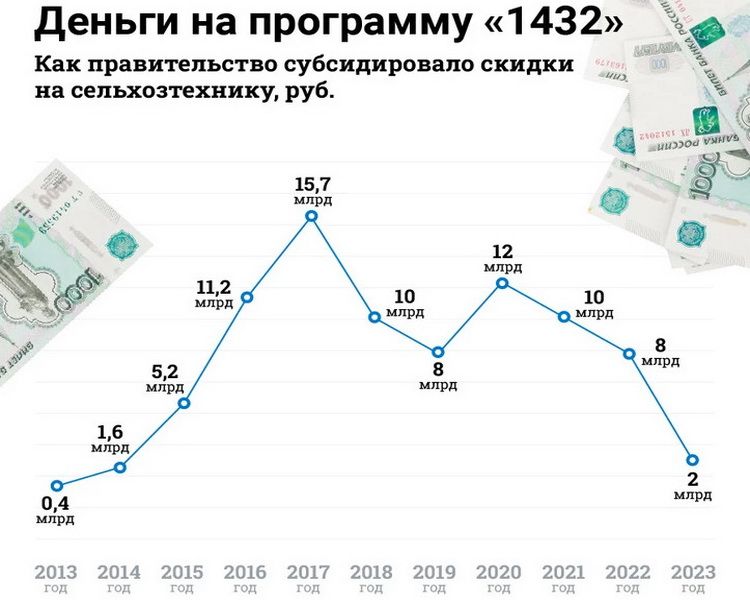
Therefore, at present, in order to purchase the same equipment, the farmer needs to sell two to three times more grain than last year. But, again, this is practically impossible, especially due to great yield losses due to the obsolescence of a significant part of agricultural machinery. In particular, in Rostov region, more than half of the combines have been in operation for more than ten years, as a result of which about 700 thousand tons of grain are lost in the region annually.
These circumstances have already critically reduced the profitability of grain production in Russia. Under such conditions, farmers try to minimize their costs by pursuing a policy of total savings. They save on everything. People do not buy new machinery and equipment, use the cheapest, and therefore lower-quality fertilizers, hire workers with low qualifications, reduce the amount of capital investments. The norm is the use of various illegal schemes of economic activity and buying the fuel stolen from the army.
However, according to the same farmers, the consequence of such acts is the degradation of agriculture, a decrease in its competitive capabilities in world markets, as well as a weakening of resistance to the negative impact of natural phenomena such as drought or excessive rainstorms. And those who violate the law are threatened with administrative or criminal liability.
Therefore, many farmers prefer to reduce the volume of grain sowing or even give up growing grain completely. And this is already happening in reality. In 2023, Russia is expected to drop grain harvest to 140 million tons, including wheat — to 89 million tons. It is likely that this trend will be observed in the coming years, which will cause the danger of a shortage of grain and a decrease in demand for labor, agricultural machinery and fertilizers. And with that, there will be a shortage of food along with an increase in prices for it, unemployment will increase and incomes of the machine-building and chemical industries of the Russian Federation will decrease.
|
…One of the main goals of Russia’s refusal to extend the Grain Deal is to force the West to lift the sanctions imposed on Russian grain exports… |
According to prudent Russian experts, it is possible to get out of this range of problems of the grain sector of the country only by stopping the war against Ukraine, restoring positive relations with it and the civilized world, as well as returning to normal market relations. However, Moscow, according to its habit, acts quite differently, namely, blackmails its opponents and uses military force against them.
As noted above, one of the main goals of Russia’s refusal to extend the Grain Deal is to force the West to lift the sanctions imposed on Russian grain exports. According to the Kremlin’s calculations, Western countries and international organizations will be forced to do this under the threat of hunger riots in Asia and Africa, which could lead to another wave of refugees to Europe and the United States. In this way, Moscow hopes to cope with the problems associated with surplus grain and receive revenues from its sale.
Besides, Russia is trying to remove Ukraine from the world grain market as its powerful competitor and inflict maximum losses on it, including preventing the use of Ukrainian ports. It is for this purpose that systematic strikes are being carried out on Ukraine’s granaries and port infrastructure.
Finally, the Kremlin also pursues its geopolitical goals of strengthening Russia’s position in the Black Sea region and demonstrating its control over it. Thus, by blocking Ukrainian ports and creating obstacles to navigation in the Black Sea with the use of military force, Moscow is trying to prove to the West and the countries of the region its “dominance” within the Black Sea borders, as well as the firmness of its position in realizing Russian interests. Moreover, Russia hints to the United States and NATO that it will not stop even in the face of an armed conflict with them.
In this context, quite illustrative is V. Putin’s refusal to discuss the Grain Deal with President of Türkiye R. Erdogan, who was one of its initiators and guarantors. On the one hand, the Russian dictator again seeks to somehow demonstrate his contempt for the West, including Turkey, which is a NATO member, and on the other — he is simply afraid of Ankara with its powerful potential, which is in no way inferior to Russia’s.
|
…Russia is actually more interested in the Grain Deal than Ukraine… |
Such a position could cost Russia dearly, as the RF is actually more interested in the Grain Deal than Ukraine. Our state, together with its partners, has already established a land route for transporting grain to foreign markets, although it is less powerful and ergonomic than the sea route.
But Russia cannot resume grain exports in sufficient volumes, which not only further complicates the problems of its agriculture, but leads to the loss of its foreign markets. This was clearly shown by the Russia-Africa Summit, where the leaders of African countries rejected the Russian proposal to provide them with 60,000 thousand tons of grain for free. This showed their interest in stable markets, rather than one-time, albeit free, supply.
|
…Step by step the Russian economy is being driven into a state of deep crisis, in which the grain sector of its agriculture has already found itself… |
At the same time, relations between Russia and the West are getting worse, and anti-Russian sanctions are being strengthened. Moscow can do nothing about this, which is why step by step the Russian economy is being driven into a state of deep crisis, in which the grain sector of its agriculture has already found itself. One way or another, but Russia will be forced to resume the Grain Deal. And not on the Kremlin’s terms at all.
In conclusion, I would like to quote the opinion of Russian farmers about what is happening in their country now. They say they are just desperate. The years 2022 and 2023 were their worst years in the last thirty years. It seems that the authorities in the Kremlin are deliberately destroying Russia’s agriculture…


