
 Ivan Sichen
The summer of 2021 became one of the richest in various world-class political events that directly concerned the national interests of Ukraine. In July 2021 we have summarized the main of such events that took place in the first half of this summer. I would like to continue this practice and assess the significant political events that took place in the second half of the summer – the beginning of September 2021. Especially since they were no less important for Ukraine.
The main ones were President of Ukraine V. Zelenskyi’s meeting with the President of the USA J. Biden, which was preceded by the visits of the Federal Chancellor of Germany A. Merkel to Washington, Moscow and Kyiv. Against the background of these events, there was another complication of the situation in the world, which was also directly related to our state. In general, these circumstances create a number of positive and negative consequences for Ukraine, which require special attention.
 |
 |
 |
 |
| The summer of 2021 became one of the richest in various world-class political events | |||
In general, the main political events that took place in the world in August and early September 2021 have already been widely covered by the media. However, as in June–July 2021, their assessments are different (including completely opposite) depending on the views and goals of certain politicians, experts and the media. In view of the above, I would like to look again at the mentioned events through the prism of Ukraine’s interests.
First of all, we need to clarify and specify a number of new military-political and economic factors that have emerged recently and led to changes in the world situation. In particular, such factors are:
- a certain deterioration in the international prestige of the United States after the withdrawal of American troops from Afghanistan, which allowed the Taliban to seize power there. This fact has caused concern among US allies and partners about the firmness of Washington’s position in fulfilling its obligations to them as well;
- intensifying Moscow’s efforts to regain control of the post-Soviet space. As noted in my previous publications, V. Putin’s article “On the Historical Unity of Russians and Ukrainians” became a programmatic and guiding document for such actions by Russia. In addition, during the final stage of Russia and Belarus’ joint SCPE “West-2021”, there was another intensification of Russian military activity in the North-Western (Baltic) and South-Western (Black Sea and Ukrainian) directions;
- worsening of the situation on the European energy market due to miscalculations by EU countries, which delayed the filling of European gas storage facilities because of excess gas last year. Against this background, Russia and its European partners have actually completed the construction of the Nord Stream 2 gas pipeline;
- the approach of parliamentary elections in Germany, which could lead to changes in the balance of political forces in Germany as the most powerful country in the European Union. In turn, this may have a negative impact on the unity of positions of EU members on the main issues of the organization, including its policy towards Russia and Ukraine.
Based on the content of these processes and trends, their main initiators or “sources” were the United States, Russia and Germany, which pursue their own interests or find themselves in certain circumstances, including with negative consequences for them.
For example, the main purpose of Washington‘s decision to withdraw US troops from Afghanistan was to free up efforts and resources to strengthen its capabilities to deter Russia and China in more important areas, namely in Europe and the Asia-Pacific region, respectively. At this, Washington is in no way going to change its policy toward American allies and partners in these and other regions.
In turn, Moscow continues to work to restore Russia’s role as a “great world power” by gaining control of the post-Soviet territories and undermining the West’s positions. Today, Moscow is using Biden’s readiness for dialogue with Russia, which was expressed by him during a meeting with V. Putin in June 2021 (which the Kremlin sees as a manifestation of “Washington’s willingness to make concessions”). Besides, favorable factors for Russia are the growing world oil and gas prices, as well as the practical completion of the Nord Stream 2 gas pipeline.
Berlin is pursuing its own goals, trying to create the conditions for a democratic and controlled transformation of power in Germany, to strengthen the stability of the country’s energy needs, and to prevent weakening of transatlantic ties and growing threats to Europe’s security from the East. These issues become especially relevant in the context of A. Merkel’s departure from the post of Federal Chancellor of Germany.
|
…Ukraine plays an important role in the balance of power in Europe… |
And, as before, the United States, Russia and Germany associate the implementation of these plans with Ukraine, which plays an important role in the balance of power in Europe. The topic of the role and place of Ukraine in the system of geopolitical interests of the West and Russia has been repeatedly raised on our website. Therefore, let’s just say that the peculiarities of the current situation in the world, which were discussed above, as well as the results of Merkel’s visits and the results of US-Ukrainian talks at the highest level, not only confirmed the conclusions, but also allowed to supplement and clarify them. In particular, in this regard, the following main aspects can be pointed out:
|
…The main efforts and resources of the United States are reoriented to deter major adversaries, primarily Russia and China… |
1. The United States continues to pursue a policy of maintaining American dominance in the world, giving it a more practical meaning. For example, in the interests of achieving this goal, the main efforts and resources of the United States are reoriented from less important areas to deter major adversaries, primarily Russia and China.
As noted above, these were the goals of the US leadership’s decision to withdraw US troops from Afghanistan. Moreover, as a result of this step, the United States created additional problems for Moscow due to the growing threats of the expansion of Islamic extremism to Central Asia, and through it — to Russia.
2. As part of the practical implementation of this policy, Washington attaches great importance to strengthening relations and deepening cooperation with its allies and partners in Europe, which strengthens the USA’s capabilities in the confrontation with Russia.
This is especially true of Germany, as one of the leading countries in NATO and the EU. In particular, during the meeting of J. Biden and A. Merkel in July 2021, the so-called Washington Declaration was signed, which provides for strengthening the allied relations between the two countries on the basis of strategic partnership. The Declaration expresses the intention to jointly oppose the attempts of individual states to divide the world into spheres of influence, to ensure the security and freedom of Europe, to protect the rights of all countries to freely choose their future. At this, NATO is called the “cornerstone” of European security.
|
| The meeting of the Federal Chancellor of Germany A. Merkel and the US President J. Biden in Washington, July 16, 2021 |
In addition, the United States continues to increase its military presence in Europe. In this regard, the most revealing are the plans to return the US medium-range missiles to Europe. According to such plans, in November 2021 in Germany, the deployment of a unit of the US Armed Forces equipped with LRHW hypersonic missiles with a range of about 3,000 km should begin.
3. Among European countries that are not members of NATO and the EU, Ukraine is currently the USA’s main partner. The reason for this is Ukraine’s pro-Western course, its steadfast stance on deterring Russia’s aggression, and our country’s having a significant territory and demographic, economic, and military potential, making it the West’s “outpost” in deterring Moscow’s expansion.
With this in mind, the United States is pursuing a consistent policy of supporting Ukraine and has in fact brought relations with it to the level of a strategic partnership. Actually, this nature of relations between the parties was established during the US-Ukraine Summit in the United States and in the Joint Statement on the US-Ukraine Strategic Partnership. This was evidenced by the agreement to resume the work of the US-Ukraine Strategic Partnership Commission. The first of the practical results of its work should be the adoption of a new Charter on the main directions of cooperation between the parties to meet 21st century challenges.
|
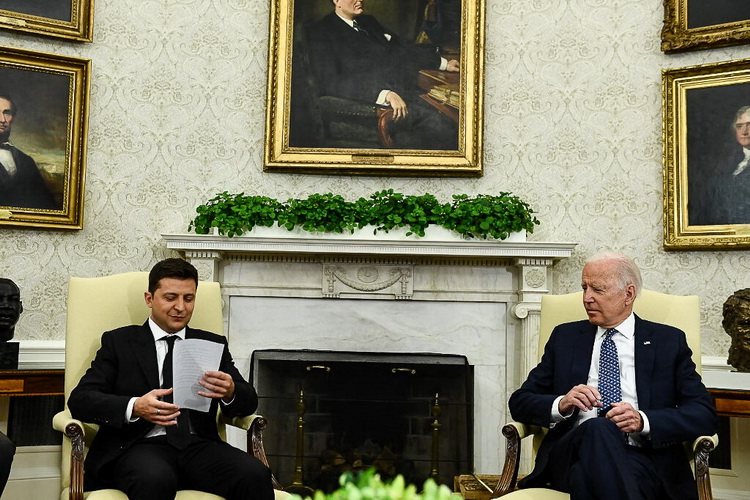
| The meeting of V. Zelenskyi with J. Biden in Washington, September 1, 2021 |
Also of fundamental importance during the visit of the President of Ukraine V. Zelenskyi to the United States were: the US-Ukraine Strategic Defense Framework; Research, Development, Test, and Evaluation Agreement for military-technical cooperation; Strategic Energy and Climate Dialogue; Memorandum of Understanding between the Ministry of Economy of Ukraine and the Export-Import Bank of the United States; Memorandum on the construction of five nuclear power units in Ukraine; Space Situational Awareness MOU for information sharing on space objects; Bilateral Cyber Dialogue.
The content of these documents is well known and does not need further detail. I can just add that they became official and documentary confirmation of statements of J. Biden and other representatives of his administration concerning:
- the support by the USA of independence, sovereignty and territorial integrity of Ukraine, and also processes of its European and Euro-Atlantic integration;
- Washington’s readiness to continue to assist Ukraine in countering Russian aggression and strengthening Ukraine’s economy and defense capabilities;
- the USA’s being able to contain Moscow’s new attempts to exert energy pressure on Ukraine.
|
…The USA will not go to direct military conflict with Russia in case of its attack on Ukraine… |
However, a number of other issues important for Ukraine remain unresolved, in particular, the direct involvement of the United States in resolving the conflict in the Donbas (including within the “Normandy” group), as well as providing firm guarantees for continued transit of Russian gas through the Ukrainian GTS after the start of the Nord Stream 2 gas pipeline. Besides, it is quite obvious that the United States will not go to direct military conflict with Russia in case of its attack on Ukraine.
This once again confirms a certain “doubleness” of the US position on Ukraine. Thus, based on its own interests, the United States supports Ukraine, but limits such support to a certain framework.
|
…European NATO and EU countries support Ukraine, however, like the USA, within certain limits, avoiding excessive aggravation of relations with Russia… |
4. Ukraine remains important for the European NATO and EU countries, which also consider it a deterrent to Russia. In view of this, they support Ukraine, however, like the United States, within certain limits, avoiding excessive aggravation of relations with Russia.
The main advocate of European interests in relation to Ukraine is in fact Germany. In particular, during their meeting in July 2021, A. Merkel and J. Biden discussed the issues of coordination of American and European (German) policy to support Ukraine in its confrontation with Russia. At this, special attention was paid to determining the possibilities of guaranteeing the continuation of the Russian gas transit through Ukraine after the commissioning of the Nord Stream 2 gas pipeline.
The problem of continuing the gas transit through Ukraine was also raised by A. Merkel during her talks with V. Putin in Moscow. She also tried to agree with V. Putin the resumption of work of the “Normandy” group, including at the highest level. However, these negotiations did not yield any real results.
|
| The Federal Chancellor of Germany A. Merkel visited Moscow on August 20, 2021 |
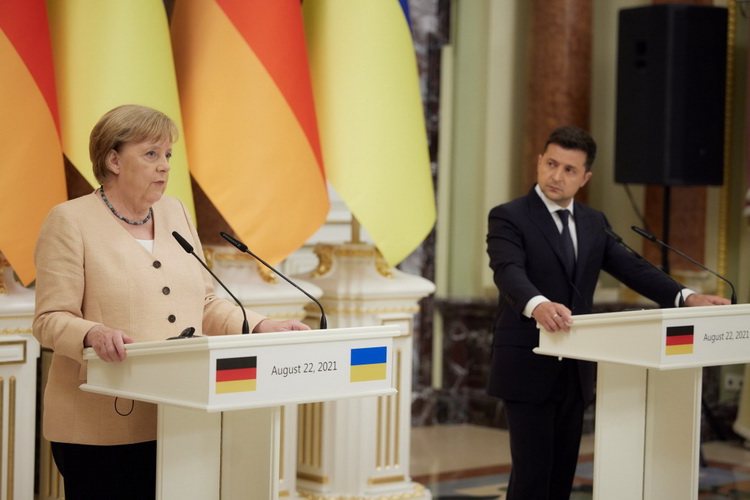
With this in mind, during her visit to Kyiv in August 2021, A. Merkel only stated the intentions of the USA and Germany to protect Ukraine’s interests in the situation with the Nord Stream 2 gas pipeline.
|
| The Federal Chancellor of Germany A. Merkel with the President of Ukraine V. Zelenskyi in Kyiv, August 22, 2021 |
|
…We should expect Russia’s significantly increasing pressure on Ukraine in the near future… |
5. Based on the peculiarities of the current situation in the world, we should expect Russia’s significantly increasing pressure on Ukraine in the near future, first of all, regarding Kyiv’s agreeing to the Russian scenario of “settlement” of the conflict in the Donbas.
As before, the main forms of such pressure will be the intensification of armed provocations on the front line, as well as the increase in the level of Russian military activity near the Ukrainian border (in particular, under the guise of conducting the “West-2021” exercise). In addition, Russia may launch another round of “gas wars” against Ukraine.
At the same time, Moscow will increase pressure on European NATO and EU countries to persuade them to change their policy toward Russia and Ukraine. In fact, Moscow is already doing so by blackmailing the EU over gas supplies to the European market. At this, Russia demands from Germany and France, as members of the “Normandy” group, to influence Ukraine in order to force it to fulfill Russia’s conditions for resolving the Donbas problem.
However, so far such efforts by Russia have not been successful. The positions of Western countries and international organizations on supporting Ukraine and putting pressure on Russia through sanctions remain unchanged. Moreover, in connection with Moscow’s above-mentioned actions in the energy sector, the EU countries have intensified steps to replace Russian pipeline gas with liquefied gas from the United States and other countries.
Despite this, Ukraine must prepare for the worst: from complete cessation of Moscow’s gas transit through Ukrainian territory to the possibility of a full-scale military invasion of Moscow into our state. This is the main conclusion of my article.


