
Analytical center “Borysfen Intel” monitors and analyzes V. Putin and his environment’s attempts to find compensatory measures for easing the EU and the USA’s sanctions (see.: “Lifesavers of the Putin regime”, August 11; “The Russian background for the EU, USA and Ukraine’s sanctions”, 19 September; “Consequences of the sanctions for Russia and Putin’s regime”, November 5), and “geographical peculiarities” (within the EU, in Central and Eastern Europe, in the Black Sea region, etc.) of these attempts of the aggressor state, called to save the Russian economy from degradation, and the regime of the aggressor state — from a social explosion (Putin’s political epic fail is a separate theme). It’s time to consider other vectors of the Kremlin’s “substitution therapy”, in particular — the Asian vector.
 |
|
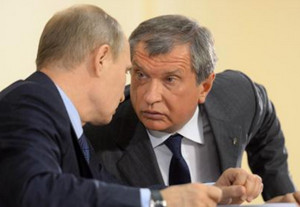
Sechin proposed Putin the “plan of attack” on the West http://mstrok.ru/ |
Insiders from Moscow report that the Russian leader is well aware of how futile (from the point of view of economy) his measures against sanctions are. Therefore, he holds “consultations” with all heads states and governments, ready to financial injections and “trading” with Russia. Even the dismissal of the editor of “Kommersant”, who has made public I. Sechin — V. Putin’s secret anti-sanctions plans, is another confirmation of fears of the “master of the Kremlin and Russia” before the unity of the international community.
Therefore the aggressive “Valdai-Sochi” speech, historical reminiscences before Russian historians and geographers and provocative behavior of the president of the Russian Federation at the APEC summit (Asia-Pacific Economic Cooperation) in Beijing, which were supposed to calm the average Russian patriot, in fact, is a hidden signal of his readiness to exchange the Ukrainian issue for Russia’s image-building concessions. This exchange has already taken place in history when the Russian Federation had agreed to unlock the eastward expansion of NATO in exchange for membership in the “Group of Eight” (G8).
However, during such “negotiations” V. Putin will not stop searching for individual countries and spheres that could become donors for the Russian economy in the short and medium term. The “Turn to the East” which we forecasted in previous publications about the plans of the Russian leader, has got its further development during his and Russian government’s officials’ voyages over the past six months. And in this context we mean, first of all, Asia and the Pacific Region (the BRICS, SCO, APEC and ASEM summits), Central Asia, South Caucasus and the “Caspian Five” as a kind of counterforts for the Russian Federation and Eurasian Economic Union being created by the Kremlin.
 |
|
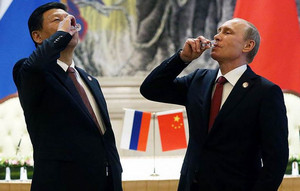
Russian President Vladimir Putin and Chinese President Xi Jinping raised his glass for the signing of the historic gas contract.
“Gazprom” will supply to China 38 billion cubic meters of gas worth 400 billion US dollars over 30 years http://www.ruscur.ru/ |
Since May of this year the Russian President has met three times with President Xi Jinping (the official visit, at the BRICS and APEC summits), thanks to which fact a number of documents have been signed (memoranda, framework and technical agreements, contracts between business entities) on cooperation in the energy sector, banking and investment activities with the “key Russian partner in the Asia-Pacific region”. It is clear that Putin had to make concessions to the Chinese side, regarding the western directions of supplies of Russian gas and its prices, but the Kremlin propaganda will still assign them to the list of “profitable”. The objective reality is that, in terms of closing western capital markets for the sake of the ostentatious progress in negotiations on additional gas supplies to China via the western route, “Gazprom” refused to take the advance in the amount of 25 billion US dollars for the construction of the gas pipeline “The Power of Siberia”, and the declared by it priority of the Chinese direction will harm other projects — the South Stream pipeline and LNG plants.
 |
|
Analysts of “Foreign Policy” magazine believe that Russia and China have made a huge step towards the strengthening of its economic and political ties. Photo http://www.foreignpolicy.com/ |
At the same time, analysts of the Foreign Policy magazine (founded by the creator of the theory of the “clash of civilizations” Samuel Huntington) believe that Russia and China have made a huge step towards strengthening of their economic and political ties, having concluded the 400-billion agreement on the supply of energy resources, showing the change of the balance of forces in Asia. According to them, it is a kind of marriage of convenience: Russia needs to break out of the isolation in which (not without the help of the West) it has been since the annexation of the Crimea, and China needs a reliable and affordable energy sources. Besides, the option with the supply of gas through pipelines from Russia also coincides with Moscow’s desire to prevent export of US liquefied natural gas to Asia, and with Beijing’s wish to reduce its dependence on the vulnerable from the naval forces of the US oil and gas supplies by sea.
Signing of a new large contract with Moscow will enable to ease tension in Russian-Chinese relations, caused China’s penetration into Central Asia, inclusive with existing power contracts and willingness to invest 40 billion US dollars into the transport infrastructure of Central Asian states as the basis of a new economic project called “Silk Road”, because Russia has long been considered the region its fiefdom.
One should not forget about Vladimir Putin’s visit to Mongolia, the Russian-Chinese-Mongolian agreements at the highest level and the beginning of tripartite talks on transit corridors, in which the Mongolian side will advance a proposal for a gas pipeline to China via the western route not through the Altai mountains, but though the Mongolian steppes.
In general, contrary to Putin’s associates’ expectations, the “Ukrainian crisis” and the Kremlin’s “anti-sanctions search” provide real benefits to China in the Russian energy and in Central Asian directions, leaving China the right to refuse from unfavorable international and bilateral projects (like it happened recently with the Moscow Likhachev Plant).
Apart from APR, the Kremlin strategists’ attention is focused also on traditional areas of its strategic interest, such as the South Caucasus. The Kremlin’s policy in the Caucasus is directed to the use of internal risks to strengthen the stability of the ruling elites in the countries of the region and their business interests in order to get political and economic dividends from profitable for Putin rapprochement with President of Azerbaijan, Armenia’s accession to the EEU and split of the Georgian establishment into pro-European and pro-Russian groups.
In particular, Azerbaijan‘s reserved reaction to the events in Ukraine is connected not only with the political factor of possible deterioration of relations with Russia, and the Kremlin’s abilities to escalate the situation around Nagornyi Karabakh conflict, but also with I. Aliev’s desire not to prevent in such a way realization of large-scale energy projects, to protect large Azerbaijani business related to Russia from possible negative effects of anti-Russian sanctions, to maintain the existing conditions of Azerbaijani migrant workers’ stay in Russia (3 million people).
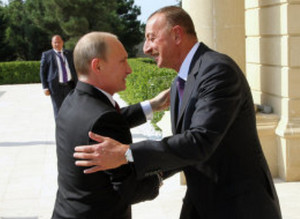 |
| One can state the intensification of contacts between Russia and Azerbaijan on different levels. Photo http://www.newsazerbaijan.ru/ |
There is a need to state intensification since June this year of political contacts at the presidential (Aliyev twice visited the Russian Federation, where he met with Putin in Sochi and Astrakhan at the Caspian Summit), governmental, parliamentary and ministerial (Ministry of Foreign Affairs, Ministry of Defense) levels. As a result, Moscow has supported Azerbaijan’s proposal to establish a bilateral high-level group to address issues of expansion of cooperation in the energy sector. The parties agreed on a program of cooperation in military and military-technical spheres for 2015-2016, reached an agreement to increase Azerbaijan’s supply of food to the Russian Federation in connection with the restriction of Russian imports of agricultural and food industry products from the EU. The program provides, inter alia, for creation in various regions of Russia (Moscow region included) of modern logistics distribution centers for Azerbaijani fruit and vegetables, as well as joint ventures in the agro-industrial sector. It is clear that cheap cheese is only in a mousetrap: in exchange for Armenia’s getting out (under pressure from Moscow) of seven occupied Azerbaijani districts, they will demand Azerbaijan’s integration into the Eurasian Economic Union.
 |
| Georgia is inclined to expand trade and economic cooperation with Russia due to the strong pressure from the B. Ivanishvili. Photo http://www.vestikavkaza.ru/ |
Despite Georgia‘s President G. Margvelashvili and Parliament’ positions of open support of the Ukrainian government and harsh condemnation of Russia’s aggression in Ukraine, Prime Minister I. Garibashvili is inclined to expand trade and economic cooperation with Russia due to the strong pressure from the B. Ivanishvili and businessmen of Georgian origin in the Russian Federation. In the same context, should be considered the government’s refusal to support Georgia’s sanctions against the Russian Federation under the pretext that Georgia allegedly has adopted a much more strict sanctions, having severed diplomatic relations with Russia.
In Armenia, the Kremlin counts on the failure of President S. Sargsyan. In the current domestic conditions, he will not be able to solve the question of succession and to prolong his power after 2018 (in the medium term it can lead to a loss of confidence even among the closest associates and representatives of local and foreign Armenian oligarchy). The Kremlin also relies on Armenia’s complete economic dependence on Russia.
 |
|
The Kremlin relies on Armenia’s complete economic dependence on Russia. Trade turnover between Russia and Armenia. Infographic http://inpress.ua/ |
By the end of 2013, Armenia’s trade turnover with the countries of CU/ EEA countries amounted to 1.39 billion US dollars, of which the Russian Federation accounted for 1.34 billion US dollars (96.5 %). Russia is the largest investor into the Armenian economy (42 % of all foreign investments) with a focus on energy projects for the construction of new units at the Armenian NPP, Hrazdan and Yerevan TPP (capacity of 100, 440 and 200 MW, respectively) and for the construction of hydroelectric power plants. 100 % of the company-monopolist’ stocks in transportation, storage and sale of natural gas of the CJSC “Gazprom Armenia” belong to the Russian “Gazprom”. At this, by the time of formal accession to the EEU, Armenia, within the framework of a bilateral agreement with the Russian Federation, received tangible discounts on supplies of Russian gas and oil. Transmission and distribution of electricity in the country is provided exclusively by CJSC “Electric Networks of Armenia” — the 100 % subsidiary of Russia’s OJSC “Inter RAOUES”.
Moreover, the share of the Russian Federation in the structure of the population’s remittances from abroad, which generates up to 15 % of GDP and 60 % of budget revenues, is over 85 %. Armenia has been included in the list of the RF’s key partners to replace the banned for import into the Russian territory fruits, vegetables and food from Western countries.
Therefore, in exchange for ephemeral advantages of Armenia’s membership in the EEU (including the country’s being “represented” in the Board of the Eurasian Economic Commission by as many as three members, who will have one vote without assigning any spheres of activity to them) the official Moscow will demand S. Sargsyan’s unconditional “obedience”, Yerevan’s being ready for geopolitical bargaining of territories and preserving Russia’s presence in the country.
To summarize all the above-said, according to economic calculations, (Chinese, Caucasian, Caspian, Central Asian) “Putin therapy’s” disastrous geopolitical and regional consequences for Russian citizens are obvious. Instead, they will have the right to be proud of achievements of their favorite president and of waving the imperial flag on a part of the post-Soviet territories. Besides, the Russian Orthodox Church has joined the process of saving Russian economy, recommending its congregation not to believe foreign forecasts, but to create their own criteria of the Russian economy on the basis of ethical rules and the system of orthodox banking!
In such a situation, according to well versed in Russian reality Gleb Pavlovsky, relevant would be isolationism, allowing “to shift from the Ukrainian constitution to domestic issues, to mind Russia’s own business and to try and get out from under the sanctions.” We do hope that the owners of state and church macroholdings Vladimir Putin and Vladimir Gundyayev know best how to rescue the “top-down economy”.

