
Part 1: Features of the global world processes in 2014.
1.1 Main trends in the development of the geopolitical situation in the world
The main trend of development of the geopolitical situation in the world in recent years — formation of a multi-polar model of the world order with two global centers of power (the USA and China) — remained in 2014, but 2014 returned to the world stage war as an instrument of not only solving political and economic problems, but of revision of state borders. At this, the war returned in forms and methods to which international security system was not ready to react quickly. The world was shocked by the new challenges, to which it cannot respond, and it will have to move to a new, more complex world “architecture” of international relations.
Change of the Ukrainian government in February 2014 as a result of the “Revolution of Dignity” pushed Russia to military aggression in order to renew Russian control over Ukraine within the framework of the strategic plans of Moscow on the revival of the Russian Federation as “a great world power”. At this, provision was made for, first of all, “returning” the Crimea to Russia, and then actual liquidation of Ukraine as a unified state through its division, creation of the so-called “Novorossia” (“New Russia”) on the basis of eastern and southern Ukrainian regions. This plan was based on the Kremlin’s ideology of “Russian world” and “protection of Russian compatriots in Ukraine from Ukrainian nationalists and fascists.”
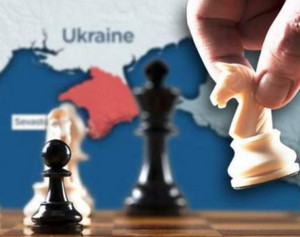 In the course of implementation of these plans, Russia used new methods of so-called “Hybrid wars”, which in the circumstances of Ukraine’s state of shock at that moment (absence of president, full parliament and government, demoralization of security forces), as well as a the West’s being completely at a loss, allowed the Kremlin to annex the Crimea, to provoke an armed conflict in the east of Ukraine and to create self-proclaimed republics in Donetsk and Luhansk regions.
|
|
 World was not ready to respond to new challenges
By its actions, Russia has violated the most important norm of international law — the principle of non-use of force or threat of force in international relations enshrined in the UN Charter and the Declaration on Principles of International Law of 1970, which prohibits occupation of the territory of a foreign state. Besides, Russia has violated the signed by it in the same 1994 Budapest Memorandum on Security Assurances in connection with Ukraine’s accession to the Treaty on the Non-Proliferation of Nuclear Weapons. The signatories of the Memorandum (Russia, the USA and the UK) then took the obligation to respect independence, sovereignty and existing borders of Ukraine.
The basic institutions of international governance — the United Nations and the Security Council failed to respond to new challenges, European security system was not ready to guarantee stability on the continent. In other words, the whole world was not ready to respond to new challenges, and now has to re-build the rules and mechanisms of protection that would make the world’s top players follow them.
 In 2014, the United States and China, along with the ongoing political and economic rivalries, had been seeking ways to distribute global spheres of influence in the world and opportunities for joint solutions to the most important issues of the world and regional security, as well as to deepen cooperation in the trade and economic sphere.
In US-China relations there remain essential contradictions concerning the influence of the parties, especially in the Asia-Pacific Region (APR), approaches to resolving conflicts in the Middle East, as well as access to markets and resources in Africa and Latin America. China was quite “outraged” by the so-called “America’s reorientation towards Asia”, deployment of 60 % of naval forces of the USA in the Pacific Ocean included. At this, China has few military allies in the region, while the USA has a military cooperation pact with Japan and South Korea, and they maintain close relations with a number of countries in Southeast Asia.
At the same time, at the Summit of the Asia-Pacific Economic Cooperation (APEC) in November 2014, China proposed the idea of the so-called “Asia-Pacific Dream” — a program based on the feeling of a shared destiny of the countries of the region and aimed at mutually beneficial cooperation. This, above all, includes creation of a free trade zone in the Asia-Pacific region, the process of which was launched at the Summit by adoption of the relevant roadmap. China also offered its vision of Asian security. At the Conference on Interaction and Confidence Building Measures (CICA) in Asia (May 2014, Beijing) Chinese President Xi Jinping stressed China’s willingness to actively promote the concept of common, comprehensive, sustainable and based on cooperation security in Asia. For Beijing, this will help to deepen and expand its international influence in the region.
|
|
It is worth noting that in November 2014, during US President Barack Obama’s official visit to China, the USA and China’s leaders took an unprecedented step in normalization of bilateral relations in the Asia-Pacific region. During the talks, they signed a number of agreements in the sphere of military security, allowing the USA and the PRC in the future to avoid “misunderstandings” between the armed forces in the region, to strengthen mutual trust and to build “a new type of military relations” between the states. Taking into consideration the difficult situation in the Asia-Pacific region which had developed against the background of territorial disputes between China and the USA’s strategic allies (in particular, the disputed status of Senkaku and Spratly Islands), the agreements between Beijing and Washington may be the beginning of stabilization of the situation in the region. In particular, according to the signed documents, the parties have to inform each other of military trainings and other planned in the Pacific major military events. In the trade and economic sphere the USA and China signed agreements aimed, in particular, at reducing tariffs on a number of technology products and the fight against global warming.
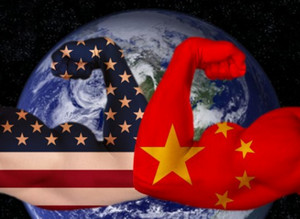 At the same time, both the USA and PRC have sought to maximize the effective implementation of their own national interests. Along with the aggravation of competition in the Asia-Pacific region, 2014 preserved the trend of large-scale political and economic confrontation between the USA and China in other regions of the world. First of all, in Europe, which has become, along with APR, Central Asia, Africa and Latin America, a new object for influence over which are competing the USA and China. The United States activated measures to create a free trade area with the European Union (although seven rounds of negotiations held in the past 1.5 years, had not produced results) and was building up the US military presence in Central and Eastern Europe (including the deployment of elements of the system ABM US/NATO, placing the US Air Force units in Poland and the Baltic States).
China was intensifying its credit, investment, trade and economic activities in the European countries that are involved in the new Chinese program for the construction of the so-called “Economic Belt of the Silk Road” (which is supposed to help establish a new level of China’s relations with Central Asia, the Caspian and Black Sea regions and Europe). In March 2014 the leader of the PRC Xi Jinping made his first official visit to Europe, visiting the Netherlands, France, Germany and Belgium. Apart from Ministers of the State, the delegation included also about two hundred representatives of Chinese business. Chinese investments into the European economy in the last year exceeded 140 billion US dollars, while the volume of bilateral trade of the sides made more than 550 billion US dollars, having made Europe China’s 2nd largest trade partner.
The development of military-political and security processes in the world are significantly affected by the aggravated character of the relationship between the USA/NATO/EU on the one hand, and Russia, which owns one of the largest military potentials, on the other, as well as by the economic crisis in Russia reinforced by the introduction of Western sanctions and drop in world oil prices.
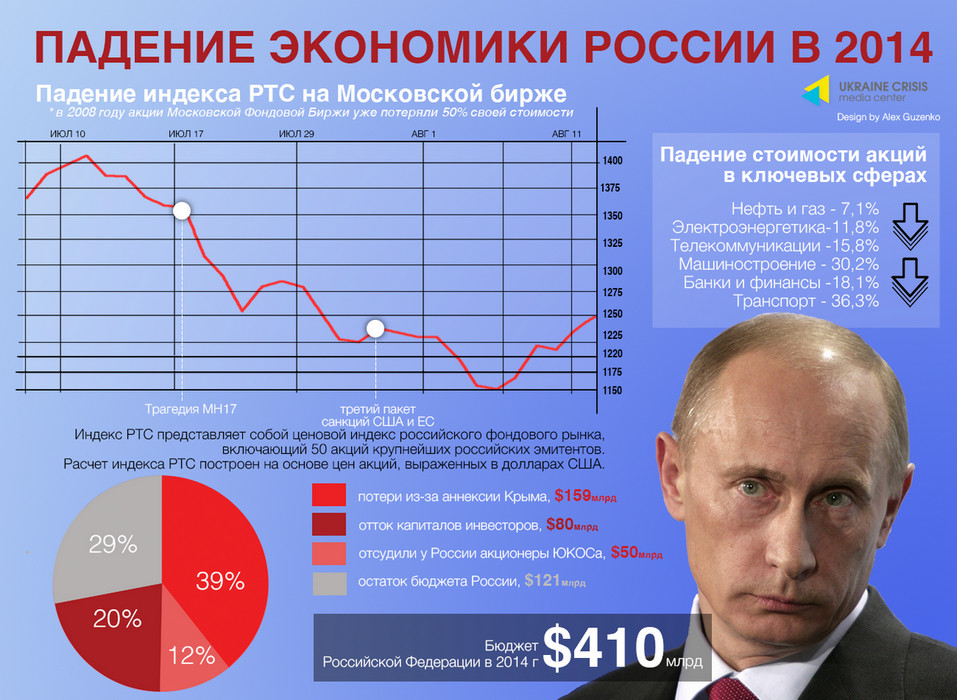
Russia is going through the most difficult since the Soviet Union’s collapse and sharp period in terms of relations with the West. The annexation of the Crimea and the military aggression against Ukraine became a catalyst for the destructive processes in relations between Russia and the West. The USA and EU’s sanctions, the pressure of Western countries and international organizations, the fall in world oil prices significantly affect the Russian economy. Even representatives of the Government of the Russian Federation and V. Putin’s close circle have to admit this. Last year, Russia lost at least 40 billion US dollars due to geopolitical sanctions, and another up to 100 billion US dollars due to the fall in world oil prices. Besides, at the end of the year, the outflow of capital from Russia amounted to at least 150 billion US dollars. Moreover, economic problems are already observed not only at the macroeconomic level, but also in the real life of the population: the collapse of the Russian ruble, business interruption, mass layoffs, rising inflation, delayed payment of wages, cuts in social spending and funding programs for the development of the Russian economy. But, at the same time Russian military costs actually remain unchanged. How well Russia (whose economy is largely dependent on oil and gas exports) can withstand the West’s pressure is a question. It is well known that the Soviet Union in the struggle for global influence lost mainly in the economic rivalry.
Trying to discredit Ukraine, Russia has resorted to aggressive media campaign. It tries to cast Ukraine as a “fascist” and “non-viable” state, from which “it is necessary to protect the Russian-speaking population”. At this, the Russian Federation categorically refuses to recognize itself as party to the conflict and, despite obvious facts, denies the presence of its troops on Ukrainian territory.
Besides, Moscow is trying to split the relations between the USA and the EU, as well as to oppose the interests of individual member states of the European Union on the issue of their relationship with the Russian Federation and applying of sanctions against it. For this purpose, is used some European countries’ economic dependence on Russia, as well as is in progress consistent work through diplomatic channels and through the channels of Russian special services.
Meanwhile, the international community does not believe that Moscow “is not involved in the events in Ukraine”. Thus, the G-20 Summit in Australia in November 2014 confirmed the international isolation of V. Putin and the “Group of 20’s” leaders’ personal distrust of him.
|
|
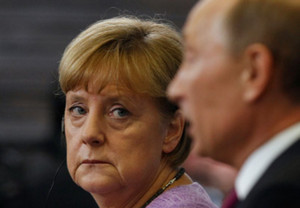
Once the closest partner of Russia in the EU — Germany has ceased to consider Russia as a partner. Over the past year, Russia, according to Berlin, has turned from a difficult partner into an enemy. A. Merkel, despite her frequent conversations with Vladimir Putin (from the beginning of the Ukrainian crisis, she has talked with the Russian president about 35 times on the phone), also does not know how far he is ready to go in the conflict with the West.
No less important factor for Russia is the very sensitive weakening of its international positions. Russia has actually been isolated diplomatically, as the annexation of the Crimea was recognized only by Cuba, Nicaragua, Syria and Venezuela. The Russian diplomacy got another very serious “impact” when it became clear that Cuba and the United States decided to restore diplomatic relations. As it turned out, the negotiations had been on in secrecy for more than six months under the mediation of the Pope, and Cuban partners did not feel the need to inform Moscow about it. And this, after most of Havana’s debts (accumulated since the Soviet times) having been written off. It was not just diplomatic, but also an image-building embarrassment.
The Parliamentary Assembly of the Council of Europe adopted a resolution strongly condemning the Russian military aggression against Ukraine and the annexation of the Crimea. In view of these developments, it was decided to deprive the Russian delegation of voting rights, to prohibit the Russians occupy senior positions in PACE and participate in the observer missions of PACE until the end of the year.
|
|
So, the year of 2014 for Russia went down in history as the beginning of a new “cold war”. The West’s cautious position on the war between Russia and Georgia, and on the civil war in Syria, has given rise to Russia’s belief in itself. Enriched over the last 15 years by incomes from the sale of oil and gas, Russia has not reconciled with the West’s ignoring its global political ambitions. That is why in the Ukrainian issue the Russian Federation does not deviate from its positions.
Last year, the development of relations between Russia and the PRC was given priority by the leaderships of the two countries. They were characterized by further deepening in political, military and economic issues. The strategic nature of the relationship (especially for Russia) is clearly indicated by high-level contacts — last year the leaders of the countries, V. Putin and Xi Jinping, had met five times. At the same time, is expanding cooperation between China and Russia within the framework of international organizations (in the first place — the United Nations, BRICS, APEC and SCO) on political, economic and security issues. Is being activated the parties’ cooperation in military issues, including joint anti-terrorist and peace-keeping trainings.
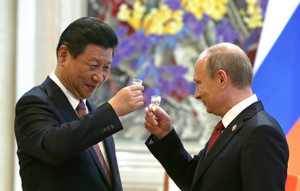 Both countries are seriously concerned about the expansion of the USA’s military influence in the world. They cannot help being concerned about the US Navy’s being near the Chinese coast and NATO’s troops — at the Russian border. Therefore, it is clear that both Russia and China are unhappy with the USA’s not allowing them to completely dominate in their own regions. Neither country accepts the current USA’s foreign policy and the idea of a unipolar world, which makes them spend huge sums on defense. At this, China is not willing to give up the position of the main economic partner of the United States.
|
|
However, Russia has become economically much weaker than China. Its economy is not in the best condition, and relations with the United States over the past year have so much deteriorated that, unlike China, it can no longer rely on the partnership with Washington. As a result of the negotiations in May 2014, Russia had agreed to supply gas to China at a price, not profitable for Moscow. Besides, China now demands from Russia to sell it high-tech weapons, which earlier it refused to sell. Moreover, Russia continues to have serious concerns about the future consequences of China’s economic development. The Russian Far East is rich in natural resources, population density in the region is very low, and large areas there were populated by the Chinese in the XIX century.
Therefore, in the bilateral relations Russia is concerned about the increasing influence of China and strengthening of the PRC’s positions in the Far East and East Siberian regions of the Russian Federation. Besides, leading Chinese economists have warned their exporters directly that trade with their Russian counterparts is fraught with great challenges due to lack of necessary resources in Russia and the possible collapse of the banking system. Even if this does not happen, a serious political component can be seen here.
Important roles (though not as active as before) in global geopolitical processes were played also by other large regional centers — India, Brazil, Argentina, South Africa, Iran and Turkey.
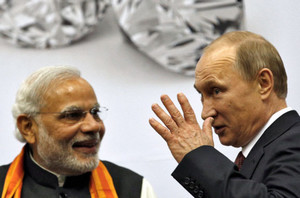 During the past year the leadership of India, further developing relations with the USA, EU and Russia in the economic and military-technical spheres, was trying to achieve military parity with China, as well as to counter threats from Pakistan. A momentous event was the signing of major contracts in the field of arms and energy by the Prime Minister of India N. Modi, and Russian President V. Putin in December 2014, which indicates special relations between the two countries. In turn, US President Barack Obama begins 2015 with his official visit to India.
As for the activity in the international arena of other countries of the BRICS group — Brazil and South Africa — it was relatively low. They mainly focused on solving their internal problems related to the slowdown in the Brazilian economy and internal conflicts in South Africa.
Actions and position of each of the above-mentioned countries were determining the nature and direction of leading international organizations, as well as the impact on the development of the situation in key regions of the world.
1.2 Features of activity of leading international organizations
Special influence on the development of the geopolitical situation in the world, including on Ukraine’s national interests, was made by the work of leading international organizations of global and regional levels.
United Nations
 During the past year the United Nations, within the framework of the 68th and the beginning of the 69th Session of the General Assembly continued to work on solving global problems and some important issues related to strengthening security in the world and some regions, ensuring the development of the world economy, human rights, overcoming poverty, combating transnational crime, prevent the spread of infectious diseases, and so on.
At the same time, the United Nations’ activity has confirmed the low effectiveness of the Organization in resolving international conflicts in cases of fundamental disagreements of interests of the world’s leading countries. Evidence of this was the failure of the UN to stop the annexation of the Crimea and the Russian military aggression against Ukraine. Despite the active discussion of the Ukrainian question (more than 20 meetings were held), the UN Security Council failed to adopt a clear resolution on the Russian Federation’s actions against Ukraine and confined itself to general statements. At the same time, UN Secretary General Ban Ki-moon stressed that the conflict in Ukraine had worsened the security and stability in Europe and revived the ghosts of the “cold war”.
Taking into consideration the inefficiency of the UN Security Council, a number of countries have taken initiatives to reform it through the expansion of the permanent membership of the Council (including the inclusion of Brazil, India, Germany and Japan into it), as well as abolition of the veto when considering most important issues that are at the intersection of the interests of the world’s leading centers of power.
The “Group of Twenty” (G-20)
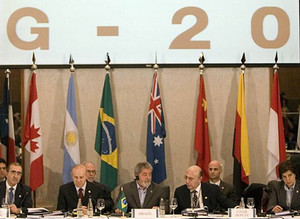 In 2014 G-20 continued to focus mainly on ensuring the stable development of the global financial system and economy in the situation of geopolitical and economic instability. In particular, within the framework of the Group had been reached agreements to harmonize financial and economic policies of the leading countries of the world, elimination of trade barriers between them and formation of more transparent public and private sectors, as well as increasing the volume of trade and investments, strengthening competition. The Group also approved an Anti-Corruption Action Plan for 2015-2016.
At the same time, most of the leaders of the “Big Twenty” demonstrated unity of positions to condemn Russia’s military aggression against Ukraine. A clear indication of this was the outright obstruction of Russian President Vladimir Putin during the G-20 Summit in Brisbane in November 2014. At the same time Western leaders directly accused the head of the Russian state of the illegal annexation of the Crimea, provoking an armed conflict in the east of Ukraine and the military invasion of our country. This position of the G-20 leaders made Putin leave the Summit early.
The “Group of Seven” (G-7)
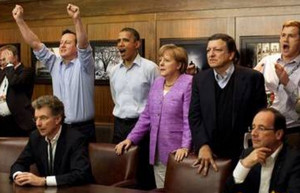 In connection with the occupation of the Crimea, participants of the “G-8” in March 2014 suspended cooperation with Russia in the format of the “G-8” and canceled the summit of the “Big Eight”, which was to be held in Sochi. Instead, in June, a meeting was held in the format of G-7 in Brussels. Besides, Russia was not invited to the meeting of members of the “Big Seven” held at the Forum on Nuclear Safety in The Hague in March 2014.
During the year, the leaders of the G-7 had been serving as one of the main instruments of international pressure on the Russian Federation in connection with the aggression against Ukraine. However, the G-7’s activity continued to jointly address the issues of the world economy, deepen trade and economic relations between the parties, as well as to create new jobs.
The European Union
 The past year was marked by the May elections to the European Parliament, which resulted in the EPP and Progressive Alliance of Socialists and Democrats’ retaining their leading positions (together 412 deputies). In the autumn the newly elected President of the European Council Donald Tusk and the new composition of the European Commission, headed by J.-C. Juncker began their work.
The situation in Ukraine had a decisive influence on the activities of the European Union in 2014. Thus, the EU took an active part in solving the internal political conflict in Ukraine during the “Revolution of dignity”, and then — in containing the Russian military aggression against Ukraine. In this regard, the European Union (together with the USA) was the initiator and conductor of the policy of sanctions against Russia, as well as of support for Ukraine.
In particular, in the context of the EU “Eastern Partnership” initiative, very important were the signed in June Agreements on Association and on creation of the Free Trade Area with Ukraine, Moldova and Georgia. At the same time, the EU has stepped up its support of Ukraine also in many other spheres, including resolving the conflict between Russia and Ukraine in the gas sphere, provision of financial assistance to Ukraine (1.6 billion Euros), reducing duties on Ukrainian goods that are exported to European countries, as well as helping to reform Ukrainian law enforcement agencies (within the framework of the EU Advisory Mission in Ukraine — EUAM Ukraine).
The so-called “Marshall Plan for Ukraine” is being developed. According to it, the country can be allocated up to 30 billion Euros until 2020. In this context, a positive factor for Ukraine was D. Tusk’s being elected President of the European Council, as he is a staunch supporter of Ukraine’s European choice.
NATO and the EU’s policy towards Ukraine and Russia, has been supported by the majority of European countries. The active position on this issue is occupied by Germany, France, Great Britain, Poland and Lithuania. However, a number of countries, including Italy, Hungary, Bulgaria, Slovakia, as well as some political and business circles of the EU, show a more cautious attitude to measures of pressure on Russia, because of their economic and energy dependence on Russia. Besides, a negative factor for Ukraine is the activation of the Hungarian, Romanian and Ruthenian movements of nationalist orientation, which is used by Russia to provoke tensions in western and south-western regions of Ukraine.
In response to the intensification of Russia’s aggressive actions, the EU leadership has stepped up measures to enhance the security of Europe in the military and energy spheres. Thus, within the framework of implementation of the EU Joint Security and Defence Policy, decisions were taken to deepen cooperation between the EU and NATO on countering military threats to the European region. Besides, a new Capability Development Plan of the European Union for the period 2015-2018, has been adopted. In order to strengthen European energy security, the EU leadership has focused on speeding up the process of creating the “Southern Energy Corridor” (includes a system of gas pipelines from the Caspian and Middle East regions to Europe bypassing Russia), construction of terminals for liquefied natural gas, increasing the volume of countries’ own gas production, transition to the use of alternative energy sources, as well as uniting energy networks of European countries. The European Commission has effectively blocked Russia’s plans to expand the capacity of the pipeline “North Stream”, as well as the process of construction of the gas pipeline “South Stream” (which made Moscow abandon plans to implement it).
Greater attention was paid to solving financial and economic problems of the European Union and ensuring its sustainable development. In particular, in November 2014 the European Commission published a new Investment Program, which provides for a steady growth of the European economy, creation of 1.3 million new jobs, as well as accumulation on the accounts of joint European funds of more than 300 billion US dollars within the next two years.
Implementation of other EU programs continued, including the “Black Sea Synergy”, “EU Danube Strategy”, “Euro-Mediterranean Partnership” and “EU Strategy for the Baltic Sea Region”. During the year, it was decided to grant Albania candidate status for EU membership, negotiations began to grant similar status to Serbia, and was initialed a Stabilization and Association agreement between the EU and Kosovo.
NATO
 In view of the increasing aggressiveness of Russia’s foreign policy and growth in the level of military threats on its part, last year there started the process of transformation of NATO in order to bring the activities of the Alliance in accordance with the terms of the new international confrontation.
In particular, in May 2014 the North Atlantic Council adopted an Action Plan to strengthen the defense capabilities of NATO in the East, and during the NATO Summit in September in Wales was adopted comprehensive plan for reforming NATO. These plans provide for increasing activities of operational and combat training of the Joint Armed Forces of the North Atlantic Alliance in the East; strengthening the military presence of NATO forces in the countries of Central and Eastern Europe and the Baltic States, including continued to deploy elements of a missile defense system the US/NATO; increase responsiveness to military security threats to the Alliance.
As part of practical implementation of these plans, were initiated activities to create within the structure of the NATO Response Force of the Joint Operations Unit of Ultra-Rapid-Reaction Force; deployment of a battalion tactical group as part of units of member countries (on a rotating basis) in Poland and the Baltic States; increasing the number of fighters as part of NATO’s mission to protect the airspace of Lithuania, Latvia and Estonia; deployment of mobile missile systems in Poland and Romania; activation of NATO military trainings in the Baltic region; deployment of the network of advanced logistics points of the Alliance troops in Germany, Italy and Norway.
Besides, NATO continued its active cooperation with partner-countries, including Ukraine, Moldova and Georgia. At this, leadership of the Alliance confirms its compliance with the policy of openness of NATO, as well as providing assistance to Ukraine. In particular, are being realized the programs to create four trust funds aimed at reforming the security sector of Ukraine, especially in the spheres of logistics, management, cyber security and medical support.
In the past year NATO operations in Kosovo and Afghanistan continued. Despite the persistence of some problems in the relationship between the Albanian and Serb populations of Kosovo, NATO’s efforts in cooperation with the EU made it possible to stabilize the situation in northern areas of the province, which allowed to continue the process of reducing the KFOR peacekeeping force. In turn, in connection with the withdrawal of most of the International Security Assistance Force in Afghanistan (ISAF), from 1 January 2015 in the country began its work a new NATO mission — Resolute Support Mission/RSM), which provides for assistance in the development of Afghan security forces.
BRICS
 At the summit of the BRICS countries (Brazil, Russia, India, China, South Africa) in July 2014 in the Brazilian city of Fortaleza were signed the Treaty for the Establishment of a BRICS Contingent Reserve Arrangement (the original 100 billion US dollars), Agreement on Cooperation in the innovation sphere, as well as on creation of BRICS Development Bank (declared capital of 100 billion US dollars, the initial subscribed capital — 50 billion US dollars). Also, the Russian side presented a draft Strategy for multilateral economic cooperation of BRICS and the Roadmap for investment cooperation including 37 projects in various spheres.
In the face of the deteriorating geopolitical confrontation between Russia and the West over the Russian-Ukrainian conflict, the Russian side had been actively trying to use the BRICS group as a counterweight to the USA and EU, as well as a means of avoiding international isolation of Russia and diversifying its economic and trade ties. Active Moscow’s actions were aimed at consolidating the position and potential of the BRICS, creation of alternative to Western mechanisms to support sustainable economic development of members of the Association and oriented to cooperation with it partners from among developing countries.
At the same time, Russia has not been able to fully realize its intentions within the framework of the Organization because of the disagreement between Russia’s interests and those of other members of the Organization, as well as their unwillingness to spoil relations with the USA and the EU because of the Russian Federation and the general negative trends in economic development of BRICS.
The Shanghai Cooperation Organization (SCO)
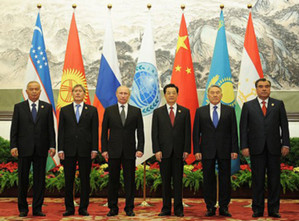 A characteristic feature of the work of the SCO in 2014 was the intensification of Russia’s actions to support and promote its own interests in the face of the deteriorating relations with the USA, NATO and the EU. Thus, on the initiative of Moscow during the last SCO summit in September 2014, was signed the so-called “Dushanbe Declaration”, which provided a positive assessment of the work of the contact group in the format “Ukraine-RF-OSCE”, as well the Russian Federation’s President’s initiatives on “resolving the situation around Ukraine”.
At the same time, to retain and strengthen its control over the transport links between the countries of the Asia-Pacific and South-East Asia and the European Region, as well as to “compensate” for the failure of the implementation of China’s infrastructure projects in the Crimea, the Russian side made a proposal to create a joint transport system of SCO. It is supposed to unite the Russian Trans-Siberian and Baikal-Amur Mainlines with transport communications, which are being built by China as part of its concept of the so-called “New Silk Road”.
For its part, China has continued to use the format of cooperation within the SCO to strengthen its own economic presence in the member countries of the Organization. In particular, the PRC’s President Xi Jinping expressed his willingness to provide the SCO member states with loans worth 5 billion US dollars for the implementation of joint infrastructure projects.
Besides, special attention was paid to the security of the SCO member countries in the face of increasing threat of Islamic extremism from Afghanistan. Thus, during the meeting of the Council of Defense Ministers of the SCO Member States in April 2014, in Tajikistan were reached agreements on establishing a joint anti-terrorism center, as well as on organizing special buffer zones in the border areas with Afghanistan to prevent infiltration of terrorists and Islamic extremists from Afghanistan’s territory.
APEC
 At the summit of the Asia-Pacific Economic Cooperation (APEC) in November 2014 in Beijing, the leaders of the member states discussed joint economic activities in the region for the period up to 2025. In the resulting documents were reflected questions of innovative progress, structural reforms and economic growth, combating corruption in the economic sphere, fighting the “epidemic of the century” — the Ebola virus. Also was adopted the Beijing road map to help the movement to the Asia-Pacific free trade zone (from 2020). APEC leaders expressed their commitment to accelerate economic reforms and innovations, strengthen coordination of macroeconomic policy, as well as to explore new spheres of growth in order to strengthen the role of APR as an engine of economic development of the world.
To be continued…

