
LAST WEEK’S KEY FACTORS AND MAIN TRENDS
IN THE DEVELOPMENT OF THE SITUATION AROUND UKRAINE
(April 17–23, 2017)
I. Major-Profile Events in the Development of the Situation around Ukraine
April 19 2017, the UN International Court of Justice approved the intermediate decision on the use of temporary measures against Russia on Ukraine’s claim of Russia’s violation of human rights in the Crimea, and financial support for terrorists in Donbas. According to this decision, the court ordered the Russian Federation’s leadership to refrain from maintaining or imposing limitations on the ability of the Crimean Tatar community to conserve its representative institutions, including the Mejlis, and to ensure the availability of education in the Ukrainian language in the Crimea. Besides, the Court demanded from Russia and Ukraine to refrain from any actions that might aggravate or continue the dispute in the Court or to make it more difficult to resolve.
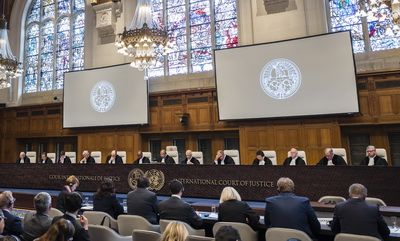 Besides, the UN International Court of Justice declared its jurisdiction over Ukraine’s lawsuit regarding Russia’s violation of the Convention for the Suppression of the Financing of Terrorism. Thus, the said case was officially taken into consideration by the Court, which created the legal preconditions for proper investigation. However, because of “…the absence at this stage of conclusive evidence of the Russian Federation’s supporting terrorists”, the Court denied temporary measures against Russia in this sphere.
In general, the intermediate decision of the International Court of Justice is positive for Ukraine because it recognizes the claims of our country to Russia or takes them into consideration. This puts Russia into a very complex situation with the Mejlis of the Crimean Tatars. Thus, on the one hand, the resumption of the Majlis’ activity would allow the Crimean Tatars to continue their struggle against V. Putin’s regime in Crimea, on the other — maintaining the ban on the work of the Medjlis would mean Russia’s not fulfilling the decision of the International Court with appropriate moral and legal consequences. The Court also called on Russia to implement the Minsk Agreements, which actually means the recognition of Moscow as party to the conflict, and not a “mediator in the negotiations”, as the Kremlin claims.
The position of the UN International Court of Justice has shown the need for Ukraine’s more thorough preparation of the evidence of Russia’s involvement in provoking and supporting the armed conflict in Donbas. The above-mentioned lays a special responsibility on the relevant departments and agencies (including security services) of Ukraine, which should get such evidence.
At the same time, of great importance for the interests of Ukraine is the situation inside Russia, which has a direct impact on the ability of the Kremlin’s actions against our State. Thus, the situation in Russia in general was characterized by the head of the Russian government D. Medvedev in his speech before the Deputies of the RF State Duma on 19 April, 2017.
As you would expect, in his speech Medvedev emphasized “…the RF Government’s success in solving economic and social problems of the country”, including “…restoration of the positive dynamics of economic growth”, “increasing salaries and pensions”, “improving the quality of health care”, and “increasing the birth rate in the country”.
|
Consolidated index of regional economic activity |
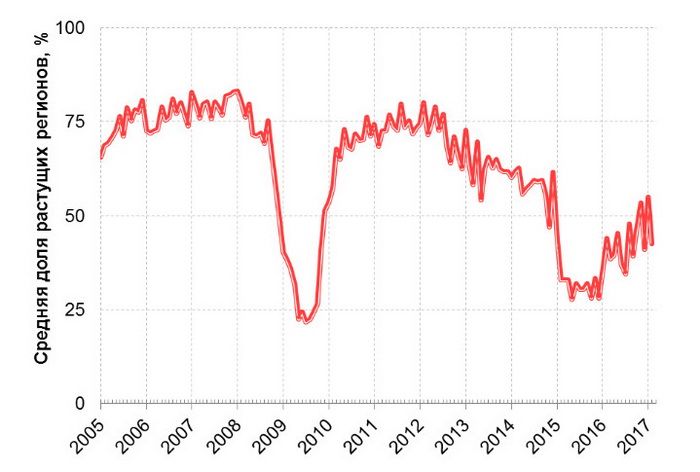
However, as always, he actually ignored the official data of the RF statistical bodies and the assessments by independent Russian and foreign experts, which are completely different in nature and content. Thus, according to the Russian Foreign Economic Bank, since the beginning of this year, GDP in Russia has fallen by 0.4 %. This negative trend prevailed in most major branches of the Russian Federation’s economy and in Russian regions.
Thus, according to recent assessments by experts of the Higher School of Economics of the Russian Federation, after a brief period of a certain slowdown in the economic decline, the country appeared on the brink of a new stagnation. During the first 3 months of 2017 in 46 of the 82 Russian regions, where they conducted the study, there was further decrease in economic activity, in the 22 — it remained at the same level, and only in 14 — there was some growth. At this, regions with positive dynamics formed no more than 6 % of Russia’s GDP, practically no effect on the overall economic situation in the country.
All this leads to further growth of socio-economic and political tensions in Russia, which in fact was recognized by D. Medvedev. For example, commenting on the upcoming presidential elections in Russia (planned for March 2018), he pointed out the “seriousness of the political struggle that is taking place in Russia”, and urged the Russian society “to prevent the escalation of this struggle into a war”.
The evidence of the relevance of this issue is the continuation of protests in Russia, which continue across the country. This, first of all, refers to the strike of truckers who have actually moved to the methods of Ukrainian “Maidans” in terms of organization of permanent camps in the areas of most important roads in Russia. As a result of the truckers’ strike, there are disruptions of supplies of food and essential commodities in more than 30 regions of Russia.
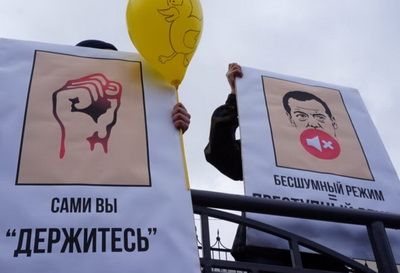 The range of the opposition’s methods of actions of the opposition is becoming wider. In particular, the leader of the “Progress Party” and founder of the “Fund to Fight Corruption” A. Navalny has launched a campaign for collecting one million signatures of Russian citizens for their support to him as a candidate for President of the Russian Federation (as of today, there are already more than 300 thousand signatures, which is the minimum level for registration at the CEC). The action is used as a means of propaganda, for recruiting volunteers and expanding the geography of supporters.
Besides, measures are being taken to involve more young people in opposition activity. In particular, the party “Yabloko” (leader — G. Yavlinsky) has created a youth faction, which already operates in more than ten regions. The faction’s main slogans include: abolition of compulsory military service in Russia; release of political prisoners and cessation of the RF’s interference with Ukraine’s internal affairs.
Given the dangers of the events for the Putin regime, the RF government is increasing pressure on the opposition. All in all, as of today, more than 600 criminal cases have been opened against participants in demonstrations and meetings of 26 March, 2017. The total amount of fines for “disorderly behaviour” is about 3 million rubles. At the same time, there are new arrests of participants of the protests taking place on weekends. In particular, April 16 2017, hundreds of people were detained in Moscow, St. Petersburg, Sochi, Tyumen and other cities of the Russian Federation.
Besides, the Russian leadership continues to intensify measures to control the situation in the regions by carrying out personnel changes in the governing bodies of local authorities. In particular, in April 2017, the leaders of Mordovia and Mari El Republic were replaced.
The Kremlin pays special attention to improving power capacity to counteract the opposition’s actions. In particular, it has planned to equip combat and special vehicles of the Federal Service of the National Guard troops of the Russian Federation (“Rosgvardia”) with 81 mm cannons. Analysis of the “Rosgvardia”’s application for public procurement shows that the new weapons are planned to be installed on RHM-BB, URAL-BB, “Tornado”, “Patrol-SN” SPM-3 “Medved”. Multishot 81 mm gun will have two blocks of barrels of six barrels in each. It will be installed on the platform with horizontal and vertical guidance. It is expected that this sample of a gun will be developed by the end of November 2018. The contract will be about 10.5 million rubles.
II. Russia’s Military Aggression against Ukraine
2.1. The East of Ukraine (the ATO Zone)
In the situation developing around Russia, the Russian leadership continues to conduct double policy towards both, Ukraine and its western partners. On the one hand, Moscow has shown a willingness for a peaceful solution to the conflict in the Donbas and the continuation of negotiations in the “Normandy” format, on the other — in every way it is delaying the process of real settlement of the situation in the East of Ukraine. Evidence of this is the telephone conversations of the leaders of the “Normandy Four” (April 18, 2017) which ended in a declaration of Putin’s “peaceful” intentions, without taking any concrete commitments.
Similarly, Moscow demonstrates that it has no obligations regarding the self-proclaimed republics in the Donbas, which were created by Russia and are used by it to put pressure on Ukraine. Evidence of this is the actual economy stop in the “DPR” and “LPR” after the “nationalization” of Ukrainian enterprises carried out on their territory at the Kremlin’s prompt.
However, after a reduction in the intensity of fighting in the Donbas during the Easter holidays, the Russian-terrorist forces have again intensified shelling of the ATO forces’ positions and peaceful settlements to about 50 per day.
2.2. The Crimean Peninsula
One of the main directions of the Kremlin’s policy regarding the Crimea is trying to prove the “international recognition of the Peninsula’s belonging to Russia” as well as attracting foreign investments into the Crimean economy, despite Western sanctions. Thus, within the framework of implementation of these intentions, last week the Crimea hosted the so-called Third Yalta International Economic Forum.
According to the statements of the Crimean occupying authorities, the event was attended by about 1.5 thousand politicians and representatives of various businesses, including more than 200 entrepreneurs from 50 countries (which allegedly is by 1/3 more than last year). At this, among the “most representative delegations” as always are mentioned Russia’s “friends” in Europe, namely Italy, which sent to the forum “50 politicians, bureaucrats and businessmen”.
Besides, “businessmen and politicians” from Brazil, Britain, Germany, Germany, Greece, Israel, Cyprus, Austria, China, Korea, Latvia, Mongolia, New Zealand, Poland, Palestine, USA, Turkey, Finland, Switzerland, Japan and other countries are said to have participated in the forum. Accordingly, hopes are being expressed for “possibility of signing contracts worth over 100 billion rubles”.
The peculiarity of the Forum is the event’s being held against the background of the decision of the UN International Court, which actually recognizes Russia’s violation of human rights in the Crimea.
2.3. Other Aspects of the Russian Federation’s Actions against Ukraine and the West
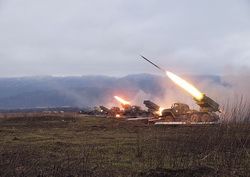
In the situation of Russia’s continuing military aggression against Ukraine and growing confrontation between Russia and the West, the focus of operational and combat training of the Russian Armed Forces is mastering different scenarios of military conflicts with Ukraine and the United States and NATO.
 |
 |
 |
 |
||
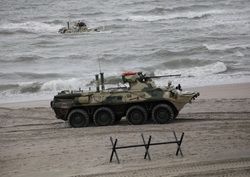
Such a scenario was the basis of the combat trainings that were conducted during the final inspection of the Western and Southern Military Districts of the RF Armed Forces for the winter trainings in March–April 2017. In particular, within the framework of the above-mentioned events, they were mastering preparing and conducting offensive operations on the Baltic direction, and defensive (deterrent) operations on the Ukrainian and the Black Sea directions.
Based on the content and direction of the events of the trainings of the RF Armed Forces, the plan of an offensive operation on the Baltic direction provided for a strike from Belarus along the southern border of Lithuania towards the Kaliningrad region of Russia to create the so-called Suwalki corridor. In particular, this task was mastered in the course of a joint tactical training of Battalion Tactical Groups of the 106th Airborne Division of the RF Armed Forces (HQ in Tula) and 103rd Separate Airborne Brigade of the Belarusian Special Operations Forces in Vitebsk region of Belarus. They also were mastering reconnaissance and search operations to determine the main routes to bring main forces, capture and retain the forward areas.
At the same time, a series of trainings of the Baltic Fleet of the RF on mastering sea-born landing of the forces of the 336th Marine Brigade (Baltiysk, Kaliningrad region), as well as missile and bomb strikes on the enemy’s targets by missile ships, submarines and naval aviation. Besides, some elements of an offensive operation on the Baltic direction were mastered during the trainings of the units of the 1st Tank Army (HQ in Bakovka, Moscow region) and of the 6th Army of the Air Force and Air Defense (HQ in St. Petersburg) of the Aerospace Forces (VKS) of Russia.
In turn, the scenario of a defensive operation in the Black Sea region provided for holding off the enemy’s attacks on the Crimea with the use of sea and airborne forces and subversive groups. Therefore, the tasks were as follows: creating rapid reaction forces groups to strengthen the Armed Forces of Russia in the Crimea; anti-airborne defense in cooperation with the Black Sea Fleet; destruction of the enemy deep in the Crimea with the support of tactical and army aviation; antisabotage actions and taking control of important facilities.
These tasks were mastered during joint trainings in the Crimea in late March 2017 with participation of Battalion Tactical Groups of the 7th Air Assault Division (Novorossiysk), 56th (Kamyshin) and 11th (Ulan-Ude) Air Assault Brigades. Besides, against the single operational background in April 2017 in the Crimean Peninsula were conducted trainings of the 126th Separate Brigade of the RF Black Sea Fleet. At the same time, some elements of a defense operation were mastered during the training of ship-based forces and naval aviation of the Black Sea Fleet and units of the 49th and 58th Combined Arms Armies of the Southern Military District, the 4th Army of the Air Forces and Air Defense Forces of the VKS of the RF Armed Forces.
Along with this, during the tactical trainings of the 20th Combined Arms Army of the Western Military District of the RF Armed Forces and designated forces of the 4th and 6th Armies of the Air Force and Air Defense Force of the VKS of the RF were fulfilled the tasks of deterring Ukraine and putting pressure on it.
The final test of the Western and Southern Military Districts of the RF Armed Forces, and units of other types of troops deployed in their territory, was a key element in the preparation of the “West-2017” SCPE (scheduled for September 2017) and showed possible scenarios of Russia’s combat actions against Ukraine and its western partners.
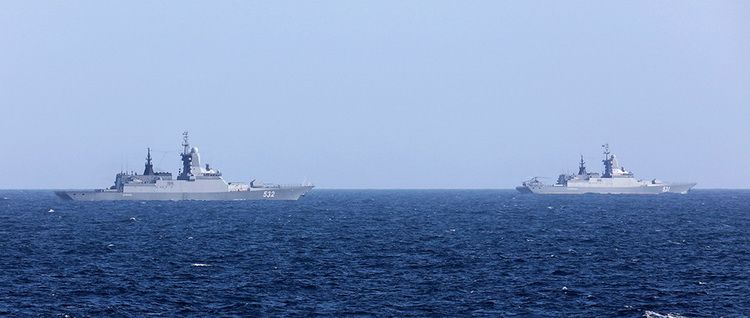
Meanwhile, Russia continues demonstrating power in the Mediterranean region. Thus, to strengthen the ship group of the RF Navy in the Mediterranean Sea, corvettes “Soobrazitelny” and “Boiky” were sent to the coasts of Syria from the Baltic Fleet.
III. Ukraine, International Organizations and Leading Western Countries
Intensification of Russia’s military activity on the European direction causes an adequate reaction of the USA and NATO, conducting symmetrical military measures to improve the security of Europe. Ukraine’s Western partners also increase pressure on Russia in other spheres, and continue to support our State.
3.1. International Organizations
 NATO. As part of implementation of decisions of the Warsaw Summit of the North-Atlantic Alliance (July 2016) on strengthening NATO’s military presence in Central and Eastern Europe and in the Baltic States, by mid-April this year was actually completed the deployment of NATO’s multinational battle groups in Poland, Lithuania, Latvia and Estonia.
Last week , military trainings of the Allied Forces “Summer Shield” began in Lithuania, in the course of which is being mastered a scenario of a possible armed conflict with Russia in the Baltic region. At this, it is a scenario of counteracting of Russia’s methods of a “hybrid war” which was used by it in the Crimea and Donbas.
About 1.2 thousand military servicemen from the USA, Canada, UK, Germany, Luxembourg, Latvia, Lithuania, Estonia, Romania, Bulgaria, Slovakia and neutral Sweden are taking part in the training. Besides, in the training are involved multi-purpose aircrafts Eurofighter of Germany’s Air Force (Amari Air Base, 335 kilometers from St. Petersburg) and F-16 of the Air Force of the Netherlands (Siauliai Air Base) that fulfill the task of controlling the airspace over the Baltic region.
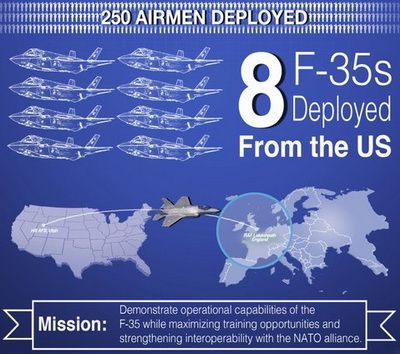
Along with this, there continue the measures to improve the combat potential of the US Command in Europe (which is the main component of NATO Forces in Europe). In particular, in April 2017, first six (out of eight) modern multifunctional fighters of the fifth generation F-35 of the US Air Force were deployed at the Lakenheath airbase in the UK.
3.2. Leading Western Countries
The USA. US President D. Trump continues the policy of severe pressure on all potential adversaries of the United States, threatening their security. Thus, April 18 2017, D. Trump instructed the National Security Council to analyze the compliance with US interests of the so-called Nuclear Deal signed with Iran (includes partial lifting of sanctions against Iran in connection with its implementation of the requirements of the UN Security Council and the IAEA on the Iranian nuclear program). Besides, the US President suspects that Iran supports international terrorism. A confirmation of the USA’s position against Iran was the introduction of additional sanctions against a number of individuals and organizations involved in the implementation of Tehran’s plans to create new ballistic missiles.
At the same time, within the framework of fulfillment of his election campaign promises, D. Trump has signed a decree providing for introduction of more stringent conditions for issuing US work visas for highly skilled professionals. It also includes strengthening the protection of the US market for a number of groups of goods. In consultation with President D. Trump, the US Treasury Department declined the request of the company “ExxonMobil” to grant it a permission to resume cooperation with the Russian company “Rosneft” (in particular, the development of the Black Sea shelf).
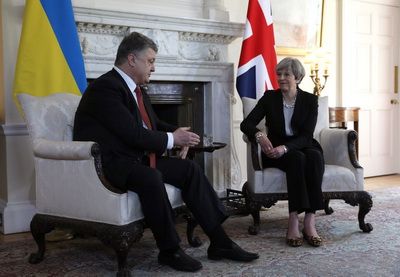 The United Kingdom. The leadership of the UK shows support for Ukraine and readiness to continue pressure on Russia until the latter’s full implementation of the Minsk Agreements and returning the Crimea to Ukraine. This position was confirmed by the British Prime Minister T. May during her meeting with President of Ukraine P. Poroshenko on 18 April 2017 in London.
Against this background rather ambiguous looks the situation around the UK’s plans to leave the European Union. Thus, due to sharp disagreements on the issue in the Parliament of the country, at T. May’s initiative, for June 8 this year have been scheduled early parliamentary elections. According to some experts’ estimates, the elections may lead to changes in the composition of the Parliament and UK Government, and to raise the issue of another referendum on membership in the EU.
IV. Other Important Trends and Developments that Will Have an Impact on Ukraine’s National Interests
Russia — post-Soviet territories. Current developments in the post-Soviet territories confirming the actual failure of the policy of Moscow to promote the ideas of the “Russian world” in the countries of the former Soviet Union. Thus, according to a European research organization Euromonitor International, from 1994 to 2016 the share of Russian-speaking population in Kazakhstan fell from 33 % to 20 %, in Estonia — from 40 % to 33 %, in Latvia — from 29 % to 23 %, in Georgia — to 1,1 %. A significant decrease in the number of Russian-speakers is also observed in Ukraine. In fact, Russification continues only in Belarus, where the number of Russian-speaking citizens has increased from 50 % to 71 %.
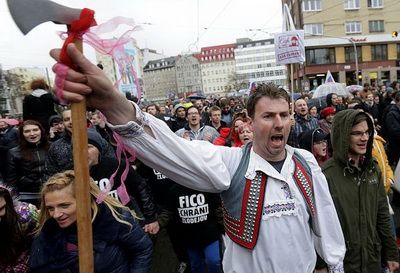 Slovakia. A characteristic feature of the situation in Slovakia is the growing criticism of the population against the Slovak government led by Robert Fico. Last week in Bratislava and other cities of Slovakia there were mass protests against corruption in Slovakia’s government. The protesters demanded resignation of Interior Minister Robert Kalinak, police chief Tibor Gaspar and other officials that create obstacles in investigating high-profile corruption scandals in the country. The protesters have been supported by President of Slovakia Andrej Kiska.
In fact, the situation in Slovakia is similar to the events in Romania earlier this year. So, the protests in Slovakia may be a reflection of the dramatic struggle between pro-Western political forces supporting Andrej Kiska and SMER-SD (“Direction — Social Democracy”) Party, led by Robert Fico, who is for restoration of ties with Russia.
V. Major Trends in the Development of the Situation around Ukraine in the Future
5.1. Key Events and Trends that Will Be Most Important for Ukraine
At the moment the main limiting factor for further expansion of Russia’s military aggression against Ukraine is the actions of the USA leading the policy of putting pressure on Putin’s regime and supporting our State. Moreover, after the election of D. Trump the US President, the issue of constraining Russia has acquired new significance as a key element of Washington’s strategy to improve the US’s leading role in the world.
Evidence of this is the firmness of the USA’s intention to maintain sanctions against Russia over the Ukrainian issue, the US Congress’ demonstrating a sharply negative reaction to Moscow’s interference with presidential elections in the US and the continued USA’s active cooperation with NATO in Europe (including in terms of increasing the US military presence in Central and Eastern Europe and in the Baltic States).
Besides, new evidence of Washington’s strategy include statements by D. Trump about the need to strengthen the nuclear capabilities of the US Armed Forces, as well as the missile strike on the Syrian Air Force base, the strike of the super-powerful bomb in the area of concentration of terrorists in Afghanistan, and the demonstration of military force to North Korea.
All this is being done to demonstrate the determination and steadfastness of the position of the US leadership in the implementation of the concept of “America above all!”, despite the resistance of any opponents, including Russia. At this, by distracting Russia’s attention from Ukraine, the United States nullifies all its efforts. Thus, in addition to the costs of continuing its armed aggression against Ukraine (including the build-up of the grouping of forces on the border with Ukraine, the support to the “DPR” and “LPR” and the integration of the Crimea into the Russian Federation), Russia is forced to spend considerable funds to prepare a possible adequate response to the USA.
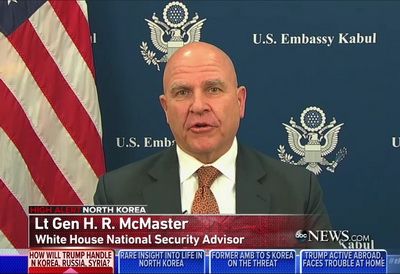 Taking into consideration the strategic nature of these Washington’s goals, we can expect further continuation of its policy of pressure on Russia, which will get intensified as the problems in US-Russian relations worsen. According to the US National Security Adviser G. McMaster, the United States must take a tougher position against Russia over its armed aggression against Ukraine, subversive actions in Europe, and support for the Assad regime in Syria. The USA will strengthen its pressure on Russia’s allies and partners, first of all Syria, Iran and North Korea. It is also possible that the USA will provide active support to the Russian opposition forces, which will help expand the scale of protest actions in the Russian Federation. By this, the United States is consistently “driving” Russia into a “dead end” of critical external and internal problems with the ultimate goal of changing power in Russia, or at least its policy.
5.2. Prospects for the Development of Events in the Conflict Zones in Ukraine
In the near future, the beginning of consideration by the International Court of Justice of the essence of Ukraine’s claim against Russia may become an additional factor of influence on the development of the situation in the conflict zone in the Donbas. The terms of the Court’s considering this issue are planned to be determined in May. Therefore, Russia will make every effort to ensure that Ukraine could not prove the fact of Moscow’s support for the “DPR” and “LPR”. In particular, in this regard, V. Putin’s regime will be forced to strengthen the secrecy of supplying arms and ammunition to the self-proclaimed republics, as well as of Russian citizens’ participation in the fighting in the East of Ukraine. Accordingly, this may lead to a certain reduction in the level of armed confrontation in the Donbas.
However, Russia will by no means go to a peaceful settlement of the situation on the basis of the Minsk Agreements, and will continue its provocations in the conflict zone. At the same time, it will keep a powerful grouping of its troops on the border with Ukraine, capable of acting on the side of the “DPR” and “LPR” at any time. Such “scenarios” are worked out during the trainings of the Western and Southern Military Districts of the RF Armed Forces. Besides, in order to increase its capabilities, the Kremlin continues to deploy new formations and groups of forces on the Ukrainian direction, in particular, the 8th Combined Arms Army in the Southern Military District (in Rostov Region).
5.3. Other Important Events that Will Influence Ukraine’s Interests and Security
For Ukraine in the development of the process of its European integration, it will be very important to complete the simplification of the visa regime with EU. April 26 2017, the Committee of Permanent Representatives of the EU must approve the decision of the European Parliament on this issue, adopted on 6 March 2017. The issue of simplifying the visa regime with Ukraine will be submitted for approval by the Council of the EU on 11 May 2017, and before May 18 a relevant document is expected to be signed.
Later, on 23 May 2017, the Senate (Upper House) of the Netherlands’ Parliament plans to consider ratifying the Association Agreement between Ukraine and the European Union. The positive decision of the Netherlands senators will in fact mark the end of the process of adoption of the said agreement and activate measures for its practical implementation.

