
 Will Lukashenko Enter the War?
Ivan Sichen
One of the important aspects of Russia’s war against Ukraine was the information about Russian aircrafts firing missiles at several settlements in Belarus. The Belarusian Defense Ministry denied such reports, but the fact remains. The Putin regime is facing critical problems in Ukraine and urgently needs additional military resources. Due to their absence in Russia itself, it is trying hard to involve the Belarusian armed forces in the attack on Ukraine. Given the urgency of this issue for Ukraine, we would like to analyze – whether Russia has a chance to implement these plans, and whether the Belarusian army will be able to play a significant role in hostilities on Ukrainian territory.
To begin with, let’s look at what the armed forces of Belarus are. Today the country’s ground forces include four separate mechanized brigades (6th, 11th, 19th, 120th), two artillery brigades (111th, 231st), one reactive artillery brigade (336th), one missile brigade (465th). In addition, the Belarusian army consists of one air assault and one airborne (according to another classification – mobile) brigades (38th and 103rd), as well as one special forces brigade (5th). The total number of personnel of these units is more than 20 thousand.
Taking into account the bases/warehouses of military equipment, the Belarusian army is armed with: more than 500 T-72 and T-73B3 tanks; about 1,600 different types of armored fighting vehicles, including BMP-1, BMP-2, BRM-1K, BRDM-2 and MT-LB; 200 self-propelled artillery guns of 152 mm caliber, including self-propelled guns 2S3 “Akatsiya”, 2C5 “Giatsint-S” and 2SC19 “Msta-S”; 125 self-propelled artillery guns of 122 mm caliber 2S1 “Gvozdika”; 200 towed howitzers and artillery guns of 155 and 125 mm caliber, including D-30, 2A65 “Msta-B”, 2A36 “Giatsint-B”; 200 MLRS systems, including BM-21 “Grad”, BM-27 “Uragan”, BM-30 “Tornado” and “Polonez”; 36 tactical missile systems “Tochka-U”.
The Air Force of Belarus includes three air bases – the 61st fighter air base, the 50th mixed air base and the 116th assault air base. They are armed with: 39 MiG-29 fighter jets (a third of them have been upgraded to the level of MiG-29BM, which allows them to attack ground targets); from 4 to 8 Su-30SM fighter jets; from 20 to 30 Su-25 ground attack aircrafts; about 20 Yak-130 and L-39 training and combat aircrafts, which can also be used to strike ground targets.
Of course, these are quite powerful forces, and be their potential they are approximately equal to the Russian combined arms army. Moscow is counting on them to make progress in the war against Ukraine. Especially when Russia’s own military resources are virtually depleted.
It is known that Ukraine destroyed or disabled about a third of the forces and weapons of the Russian troops that invaded its territory. And those were the most capable units of the Russian army, which were the first to be thrown into battle. What else can be said here, when the Russian military command could not form more than one battalion tactical group from the brigades and regiments of the ground forces and airborne troops, as well as the marines.
Obviously, they selected the best, or something that could somehow fight. And now most of the Russian battalion tactical groups that took part in the fighting in Ukraine have suffered significant losses and need to be restored. And there is almost nothing to replenish them with.
Evidence of this is the conduct of covert mobilization in Russia, as well as the involvement in the war against Ukraine of mercenaries of private military companies, militants from the Middle East and even criminals who are in prison.
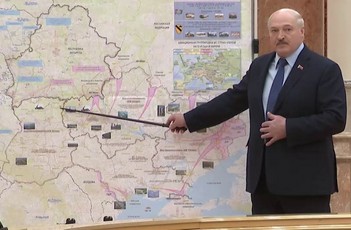
That is why Moscow desperately needs Belarus’ armed forces: at least – to compensate for its losses, and at most – to invade the western regions of Ukraine. Also, they can be involved in assisting the RF Armed Forces in carrying out several extremely important tasks, namely: isolating Ukraine from its Western partners by blocking transport communications on the Polish-Ukrainian border; shackling of Ukrainian reserves in the western part of the country; preventing the encirclement and destruction by the Ukrainian army of the Polissya group of Russian troops northwest of Kyiv.
However, the implementation of Moscow’s plans is faced with a number of complex problems, including those that have virtually no solution. The reason for this is not only the position of the dictator of Belarus Alexander Lukashenko, but also the state of the Belarusian army and its personnel. What are the difficulties and problems that do not yet allow Russia to achieve direct participation of the Belarusian armed forces in the war against Ukraine?
First, despite Lukashenko’s full subordination to Moscow for obvious reasons, he continues to play his own game and continues to try to “sit on two chairs at once”. Thus, on the one hand, Lukashenko is fulfilling his debts to Vladimir Putin (who actually retained his power in 2020) and allows Russian troops to act against Ukraine from Belarusian territory, and on the other – he refrains from sending the Belarusian army to the Ukrainian front.
And this is quite clear. Of course, Lukashenko could not deny Putin the question of providing his territory for the deployment of strike troops of the Russian army and prevent their attack on Ukraine. At this, he apparently trusted Putin’s assurances that the “special operation” in Ukraine would last no more than three days and would have no negative consequences for either the Russian Federation or Belarus.
However, everything went quite wrong. In fact, Moscow’s “special operation” in Ukraine proved to be a full-scale and protracted war against. As a result, both Russia and Belarus have come under strong Western sanctions with critical negative consequences. At this, there is a real threat of the fall of Putin’s regime, and with it – Lukashenko’s losing power. In addition, Russia’s mass war crimes in Ukraine have made Vladimir Putin a war criminal and opened up similar prospects for Alexander Lukashenko.
Under such circumstances, the entry of the Belarusian army into the war with Ukraine will further complicate the situation for the self-proclaimed “leader of the Belarusian nation”. Besides, he apparently still hopes to establish relations with the West in the future, as it happened in previous years.
Second, most Belarusian military do not want to fight on Russia’s side against Ukraine. In particular, this was shown by the results of an anonymous survey of personnel of the Armed Forces of Belarus, which was conducted on March 8, 2022. Also, servicemen of the 38th Air Assault Brigade of the Belarusian army, which was ordered to enter the territory of Ukraine in Chernihiv region, refused to do so. And that’s not all. According to a number of reports, representatives of the brigade have begun talks with the command of the Armed Forces of Ukraine on surrendering, or, in general, going over to the Ukrainian side.
In addition, the vast majority of Belarusian military not only have no real combat experience, but also peacekeeping experience either. As a result, the Belarusian army will inevitably suffer catastrophic losses if it is involved in hostilities on the territory of Ukraine. Moreover, such losses will be much greater than in the Russian army, which has been systematically involved in various armed conflicts since 1992. And this is not to mention the obsolescence of more than 90 % of Belarusian weapons.
It should also be noted that Belarus directly borders the NATO, which it considers its main adversary, and therefore is forced to protect Belarusian borders with Poland and Lithuania. This problem is especially relevant for Belarus in connection with the strengthening of the US/NATO military presence in those countries.
The call-up of reserve servicemen announced by Lukashenko will not improve the situation. It only caused panic in the country and mass attempts to leave for abroad by conscripts. By the way, Belarusian Interior Ministry’s employees and their families are trying to flee abroad.
According to experts, taking into account the above, even in case of a decision on direct entry into the war against Ukraine, the leadership of Belarus will be able to send to the front no more than two or three brigades and support units. At this, they will mainly operate in the second echelon of Russian troops and led by Russian officers who are already appointed to senior positions in the Belarusian army.
Third, the involvement of the Belarusian army in the war in Ukraine could be the catalyst for another wave of mass protests in Belarus against the Lukashenko regime. Moreover, the possibility of a local conflict in the Grodno region of the country, where a significant number of ethnic Poles live, is not ruled out. And no one in Belarus can guarantee that Poland will not intervene in such a conflict.
In 2020, the revolution in Belarus was suppressed by police and military forces, and the possibility of external intervention in the country (although it was not planned) was restrained by the Russian armed forces, which launched large-scale military demonstrations near Belarus. And now it will not be able to do so. Especially when the most capable Belarusian military units will be sent to Ukraine, and Russian troops are already involved in the fighting on Ukrainian territory.
All these are the factors that keep Lukashenko from directly interfering in the war in Ukraine on the side of Russia. However, Belarus is already involved in it. And Russian provocations against Belarus really make it a victim of aggression by Moscow. The continuation of such provocations and further intensification of the Kremlin’s pressure on the Lukashenko regime may indeed force it to make concessions to Russia on this issue.
However, we hope that he will still retain the remnants of common sense. If he does not, Alexander Lukashenko will soon lose not only his army but also his power.


