
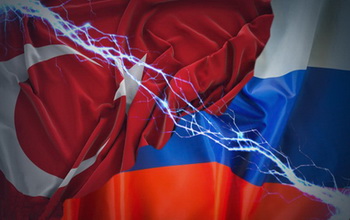
Which is the main and decisive factor in the development of bilateral relations — economy or politics?
Oleksiy Volovych
Ph.D. in History
In February – March 2020, Turkey and Russia narrowly missed direct armed clashes, which could have extremely negative consequences for both, their bilateral relations and the situation in the Middle East in general. Just in time, the Presidents of Turkey and Russia managed to negotiate a temporary truce. And all this happened against the background of the Turkish-Russian large-scale economic cooperation.
In this context, let’s try to answer some questions:
- To what extent can the interdependent trade and large-scale economic projects of the two countries prevent the breach of bilateral relations in case of an extreme sharpening of military and political disagreements between them?
- How do their political disagreements affect the economic cooperation?
- To what extent is Putin’s policy towards Turkey in accordance with the RF’s national interests?
- Which is the main and decisive factor in the development of such bilateral relations — economy or politics?
- Is there any prospect of the Turkish-Russian economic and political relations as long as R. Erdogan and V. Putin remain in power?
The economic “strategic partnership” of both countries is hybrid in nature, as it is quite dependent on the political component. Although Russian gas has been supplied by the Blue Stream since 2003, construction of the Turkish Stream gas pipeline was completed in January 2020, and Russian companies are constructing Akkuyu NPPs, and in October 2019 the Turkish Armed Forces received two S-400 air defense systems, nevertheless, the Kremlin’s strategists failed to make Turkey a full-fledged (more precisely, tolerant and compliant) strategic partner. Rather, on the contrary, as a result of such projects, Russia became dependent on Turkey.
The article is available in Ukrainian


