
 Ivan Sichen
Military and Political Expert
The full-scale war against Ukraine unleashed by Russia in February 2022 has been going on for more than two years. The consequences of such a criminal attack by the Russians are the suffering of the Ukrainian civilian population forced to leave their homes, destruction of infrastructure, and Russia’s occupation of Ukrainian territories. However, Russia failed to achieve its goal — to destroy Ukraine, and this is our main achievement.
After the dynamic changes at the front in 2022, the fighting actually became positional, characteristic of the First World War in Germany and France. But there are also some fundamental differences due to new technologies, first of all the use of precision missiles and UAVs, while outdated forms and methods of warfare are becoming a thing of the past.
Ukrainian and foreign media have repeatedly raised these issues. They were also analyzed in my previous articles. However, it is worthwhile to once again analyze what happened and draw the appropriate conclusions.
As already mentioned above, over the years of Russia’s war against Ukraine, which actually began in February 2014, we have suffered significant losses. The reasons for them are both objective and subjective, including as a result of our miscalculations at the state level. First of all, it should be noted that Moscow began preparations for war during the Yanukovych regime in Ukraine, when Russia’s proteges in the Ukrainian leadership consistently destroyed our Armed Forces and other security agencies. Moreover, in the turbulent days of the Revolution of Dignity, Moscow’s military preparations and claims became fully clear and beyond doubt.
At the end of 2013, a powerful group of forces was created in Russia’s Rostov region and the Krasnodar Territory to invade Crimea and the Donbas. In February-March 2014, additional Russian troops were deployed in Bryansk, Kursk, Belgorod, and Voronezh regions to put pressure on Ukraine and divert its attention from the main areas of Russian attack. Ukraine’s military intelligence informed the country’s leadership of the Russian Federation’s aggressive plans in advance. But the response was: “Don’t demonize Russia…” Most of these warnings were blocked at the level of the Main Directorate of Intelligence or Ministry of Defense, who either did not dare to disturb the leadership or held pro-Russian position and were Moscow’s agents. That is why Russia managed to seize Crimea and provoke an armed conflict in the Donbas.
If back in February 2014, we had started destroying the Russian invaders as we are doing now, we would have defended our territories. Especially with the help of the Crimean Tatars, who could have blocked the movement of enemy troops in Crimea, inflicted significant losses on them, destroyed collaborators and supported the Ukrainian Armed Forces. And in the Donbas, instead of wasting time and effort on the liberation of Sloviansk alone, it would have been more expedient to take control of Donetsk and Luhansk, where a large number of Russian troops had not yet been concentrated. And we should not have been afraid of blood then, because, as a result, it is now being shed in much larger volumes…
 Source: https://fakty.com.ua/
Similar problems remained after the change of power in Ukraine in February 2014. We must pay tribute to the new post-revolutionary leadership of our country, headed by Petro Poroshenko. In the circumstances of general chaos and a certain demoralization of the security forces, as well as continued aggression by the Russian Federation, which even then sought to enslave our lands, the new Ukrainian government managed to restore our Armed Forces, stabilize the situation and stop the attacker by conducting an Anti-Terrorist Operation. This came as a surprise to Moscow and thwarted its plans.
At the same time, the Ukrainian government again failed to pay attention to the intelligence warnings about the futility of hoping to reach any peace agreements with Russia, including within the framework of the so-called Normandy Group. In fact, the warnings about the Russian army’s preparations for an open invasion of Ukraine to “defend” the so-called DPR/LPR when they were on the verge of extinction as a result of the successful actions of the ATO forces were also ignored.
The consequence of indifference to the intelligence warnings was the encirclement of Ukrainian troops near Ilovaisk in late August 2014. And then, the Russian military command, which had guaranteed the Ukrainians a “humanitarian corridor”, ordered their execution. After that, Russia forced Ukraine to sign the openly unfavorable to our country Minsk Agreements. In the same way, in 2015, Moscow again forced Ukraine to sign the even more enslaving Minsk II Agreements.
But the Kremlin did not stop there. It began to put forward its own conditions for the implementation of the agreements, which provided for Ukraine’s recognition of the Russian-controlled “DPR/LPR”, where the Russian military presence in the form of the so-called 1st and 2nd Army Corps of the self-proclaimed “republics” would remain. In fact, as early as 2014, 1st and 2nd Army Corps were under the command of the territorial troops of the Southern Military District of the Russian Armed Forces, and then became part of the 8th Combined Arms Army, where they are now. In this way, Moscow tried to disintegrate Ukraine under the guise of its federalization, as well as to completely block the prospects of its accession to NATO and the EU. And the “DPR/LPR” were supposed to become a catalyst in the implementation of the Kremlin’s plans.
Of course, Ukraine could not agree to this, and therefore rejected Moscow’s claims. On the contrary, Ukraine intensified its cooperation with NATO and the European Union. In this sphere, the most important events were the adoption of NATO’s Comprehensive Assistance Package for Ukraine and the signing of the EU-Ukraine Association Agreement. At the same time, NATO, as a result of Moscow’s openly aggressive neo-imperialist policy, began to strengthen its forces in Central and Eastern Europe and the Baltic States.
In response, Russia stepped up preparations for a full-scale war with Ukraine. In particular, in 2015–2020, the 1st Tank Army, 20th and 8th Combined Arms Armies, as well as the 22nd Army Corps of the Coastal Troops of the Russian Black Sea Fleet were deployed near the Ukrainian border. At the same time, other formations and units of the Russian Armed Forces were being strengthened and rearmed.
At this, the scale of the information campaign to discredit Ukraine’s leadership and our country’s European and Euro-Atlantic course was significantly increased. Later, following the 2019 presidential election in Ukraine, other political forces came to power in our country, basing their election campaign on the idea of reconciliation with Russia. As part of demonstrative measures to put such plans into practice, a meeting of the Normandy Group was held at the end of 2019 with the participation of the leaders of Ukraine, Russia, Germany and France. It was decided on a ceasefire in the Donbas and withdrawal of troops of both sides from the line of contact. Ukraine fulfilled its obligations, including through the pressure exerted by the top state leadership on the commanders of those military units that did not want to leave their positions. Moreover, the Ukrainian fortifications were immediately occupied by Russians who were not going to fulfill the terms of the ceasefire, which was not foreseen in Ukraine by those who “saw peace in Putin’s eyes”. At the same time, they began to consider it unnecessary to strengthen Ukraine’s defense capabilities, since “the war was about to end”.
But then, it is fair to point out that Ukraine at least did not accept Russia’s binding conditions regarding the “DPR/LPR”, but continued to pursue a course of rapprochement with NATO and the EU. Therefore, Moscow began actively preparing for a full-scale war against Ukraine. After the 2020 crisis related to the COVID-19 pandemic, the Kremlin stopped hiding Russia’s military preparations, but rather openly declared them. This was quite understandable, as Russia’s economic problems began to once again undermine the authority of the Putin regime. That is why Putin used the traditional Russian method of diverting the population’s attention from internal problems by launching wars against other countries, and in this case, Putin’s schizophrenic desire to restore the former USSR was added to the mix.
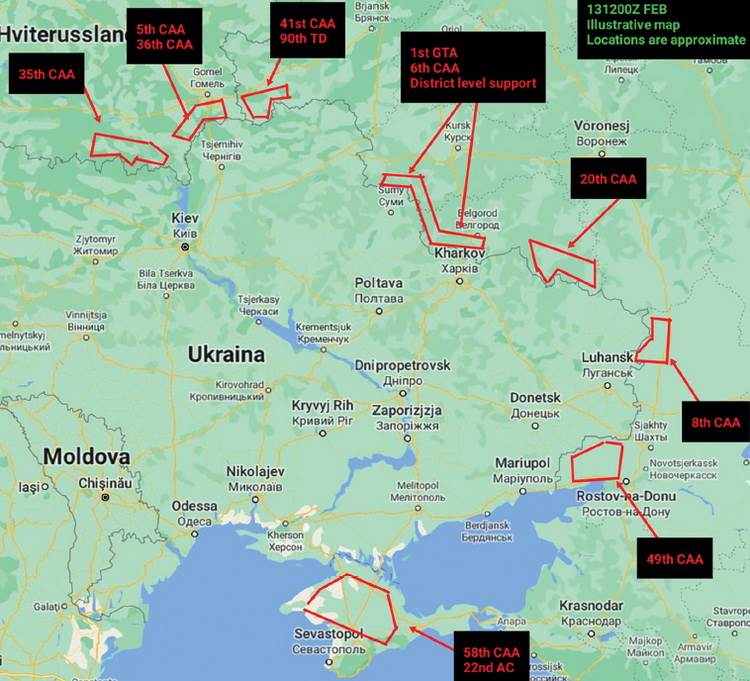 Russian troops near the borders of Ukraine.
Source: https://texty.org.ua/
In 2021, Russia conducted several military exercises, during which it deployed four groups of troops around Ukraine. The first was in Belarus, the second in Bryansk, Kursk, and Belgorod regions, the third in Rostov region and in the Krasnodar Territory, and the fourth in Crimea. Moscow’s deployment of forces was taking place in full view of the world. Its troops were being transferred from all over Russia, which could be observed from space and was confirmed by numerous videos of Russian military columns moving toward Ukraine.
The information about the inevitability of Russia’s attack and all the relevant details was repeatedly provided by Ukraine’s Military Intelligence and was also brought up by our partners, emphasizing how to respond. However, this was never done. Although some weapons from the United States and other NATO countries began to arrive in Ukraine. It was mainly small arms, as well as cannons, ammunition, portable anti-tank and anti-aircraft missile systems. At the outbreak of the war, those weapons, combined with the courage and resilience of Ukrainian defenders, played a decisive role in repulsing the Russian attack.
But for some reason, no one bothered to build fortifications on Ukraine’s borders with Russia and Belarus. It’s hard to tell whether it was possible to protect all of Ukraine’s borders at the time. But in the main directions of a possible and quite obvious offensive by the Russian Armed Forces, this would not have been a big problem. Only one highway leads from Belarus to Kyiv: through Chornobyl, Ivankiv, Borodianka, and Irpin. Defensive positions could have been built there, minefields could have been set up, and the only bridge across Prypiat could have been blown up. Moreover, due to the difficult forest and swampy terrain, the enemy would never have advanced there. And therefore, he would not have been near Kyiv almost on the very first day of the war… Then there were the tragic events in Bucha and Irpin, in other towns and cities to the north and west of Kyiv.
The same events, with even more negative consequences, happened in the South of Ukraine. There are only two roads leading from Crimea to the mainland of Ukraine on two isthmuses. A breakthrough of the enemy forces could have been blocked by creating two fortification lines and blowing up the bridges. If this had happened, the enemy would never have captured Melitopol, Berdiansk, and Kherson. And the tragedy of Mariupol would not have happened. And if some people had been fulfilling their duties thoroughly, there would not have been traitors like the current Russian “governor” of Kherson region, Vladimir Saldo, who handed it over to the aggressor.
However, the country did prepare for the war in a certain way, which made it possible to stop the enemy and prevent it from occupying the entire territory of Ukraine. The main role in this was played by the Armed Forces, the National Guard and the Territorial Defense, which defended Kyiv, Kharkiv, Sumy, Chernihiv and Mykolaiv. Our Special Operations Forces and the Defence Intelligence of Ukraine deserve special thanks. They fought near Kyiv and also blocked the logistics of Russian troops through the territory of Chernihiv and Sumy regions, thus stopping the Russian troops in the North of Ukraine, as their available reserves were designed for no more than a two-week offensive.
It was during that time that Russia hoped to capture Ukraine. And after Moscow failed to achieve that goal, it was forced to withdraw its troops, as it was unable to provide necessary logistics. Russia lost its offensive potential, which allowed Ukrainian defenders to liberate most of Kharkiv region, drive the enemy back from Mykolaiv, and then make it to leave Kherson. In this situation, Moscow was forced to suspend its offensive, switch to defense, and announce partial mobilization.
In fact, this was reminiscent of the Soviet attack on Finland in 1939, when Moscow underestimated its defense potential, hoping to capture the neighboring country in the same two weeks and turn it into another Soviet republic. The invaders were partially defeated, surrounded and captured. The USSR leadership drew the necessary conclusions and sent much larger forces against Finland, which managed to break through the defense system of the Mannerheim Line, seize the Karelian Isthmus and the city of Viipuri (Vyborg) along with the surrounding area. The United States and Europe actually refused to help Finland, forcing it to capitulate to Russia under the pretext of avoiding a major war on the European continent. By doing so, the West actually recognized the Molotov-Ribbentrop Pact on the division of Europe between Germany and the Soviet Union. But the World War began anyway, engulfing the entire Western world, including those countries that had betrayed Finland. Today, for some reason, the leaders of Hungary, Slovakia, and some politicians in Germany, the United States, and a number of other Western countries do not mention this tragedy.
The same events happened during the current Russian-Ukrainian war. Through partial mobilization, recruitment of contract soldiers, and the conversion of the Russian economy to a military-oriented economy, Russia built up its military potential. Thus, in the second half of 2022 and in 2023, about 500,000 people were drafted into the Russian army. This allowed Moscow to resume active offensives at the front, which were carried out by the so-called meat assaults using militants from various private military companies.
However, in 2023, the “successes” of the Russian Armed Forces were limited to the capture of the district center of Bakhmut and the village of Marinka on the outskirts of Donetsk at the cost of huge losses. Huge losses proved to be unbearable even for the Wagner PMC, which recruited its personnel from criminals in prisons and penal colonies. As a result, the company’s founder, Yevgeny Prigozhin, and his supporters rebelled in June 2023 and tried to march to Moscow with weapons and military equipment. The march was suppressed, Prigozhin died in a plane crash, and his fighters ended up in Belarus. Then they were recruited again, but this time to the penal battalions of the Russian Armed Forces, where they were successfully “utilized”.
In the fall of 2023, the Armed Forces of Ukraine launched a counteroffensive and liberated several villages south of Bakhmut. Besides, Ukrainian troops advanced 10–12 km from Orikhiv to Robotyno in the Melitopol direction and from Velyka Novosilka to Staromaiorske and Urozhaine in the Berdiansk direction. Several footholds were also taken on the left bank of the Dnipro River near Kherson.
However, the enemy’s capabilities to counter the Ukrainian counteroffensive were not properly taken into consideration. As a result, the Ukrainian counteroffensive did not produce the expected results and led to unjustified losses. And then someone began to make excuses that the enemy forces had been underestimated for some reason. As a result of such underestimates, for which someone must be held accountable, in early 2024 Russia seized the initiative along almost the entire front line. It managed to capture Avdiivka and several villages near it. At the same time, the enemy intensified its offensive in the Kupiansk, Avdiivka, Marinka, and Bakhmut directions, tried to eliminate our footholds near Kherson.
As usual, Moscow does not care about the losses of its troops and military equipment. Especially because of the presidential election in Russia, when Putin’s regime desperately needs at least some achievements on the front. And the fact that it is no longer possible to recruit human resources to the Russian army, and that industries are experiencing a shortage of workers, is of little concern at this stage. Russia is already saving military equipment, as there is a problem with its production. That is why Ukrainian positions are mostly attacked by infantry with minimal support with battle tanks, armored personnel carriers, or infantry fighting vehicles. Before the full-scale war, columns of Russian military equipment moved en masse toward the border with Ukraine. Soon, most of them were left on our roads and fields as scrap metal.
Moscow also failed to prevent the war from moving to Russian territory. The border areas of Bryansk, Kursk and Belgorod regions have actually turned into a war zone. The same is happening with the temporarily occupied territories of Ukraine. One third of the Russian Black Sea Fleet, including its flagship Moskva, three large landing ships and one submarine, has already been destroyed. The Headquarters of the Russian Black Sea Fleet in Sevastopol has been destroyed. Therefore, Russia was forced to abandon the blockade of Ukrainian ports, although it withdrew from the so-called Grain Deal, trying to provoke a food crisis in Africa and the Asia as a means of war against Ukraine and pressure on the West.
In 2023, our missiles and UAVs began attacking important targets deep inside Russia, as far as Moscow, Nizhny Novgorod, and St. Petersburg. The targets were political centers of criminal decision-making, military bases and enterprises, oil refineries and storage facilities. Ukrainian sabotage groups and Russian insurgents, which continue to be active throughout Russia, joined in. In June 2023, they seized part of Shebekino district of Belgorod region, in March 2024 — several settlements in Glushkovo district of Kursk region and in Graivoron district of Belgorod region.
However, the Russian Armed Forces’ offensive continues in all of the above-mentioned directions. Besides, the enemy Russia continues its air strikes on Ukraine, using ballistic and cruise missiles, unmanned aerial vehicles and guided aerial bombs. However, the destruction of fighter-bombers and long-range airborne early warning aircrafts A-50 by our air defense significantly reduces this possibility. Ukrainian troops are countering the Russian invasion, but sometimes they are forced to surrender some of their positions. The reason is quite obvious: there are delays in the EU and US decisions to provide financial and military assistance to Ukraine. First of all, because of their own political problems. In the European Union, the main ones are the position of the Hungarian leadership, which openly plays into Russia’s hands, and changes in the policy of the Slovak government, which has also sided with Moscow. And in the United States, the culprit is again the Republican Party led by Donald Trump, who is trying to win the 2024 presidential race.
However, some leaders have already begun to realize what is really happening and what it could lead to. Thus, on the second anniversary of the full-scale war, the leaders of most Western countries expressed their solidarity with Ukraine. They reaffirmed their support for Ukraine until our Victory! They also promised to do everything to bring to justice all those involved in the attack on Ukraine. It is known that the International Court of Justice in The Hague has already opened a criminal case against Vladimir Putin for the forced deportation of Ukrainian children, which has resulted in him hardly ever traveling abroad.
Support for Ukraine was also demonstrated during the World Economic Forum in Davos and the Munich Security Conference in January-February 2024. The emergence of a fundamentally new situation in the world, which is again divided into two antagonistic camps, was finally recognized there. Moreover, while during the last Cold War this division was somehow disguised as fundamental differences between communist and capitalist ideologies, now it has become an open struggle of totalitarianism with freedom and democracy.
So, what has Moscow achieved? From the early 1990s to 2007, Russia successfully integrated into the Western world. The Russian Federation together with NATO and the EU quite successfully implemented a wide range of different cooperation programs under the general slogan of creating a common economic and security space. The Russian Federation could have taken a decisive place there, including becoming a member of the North Atlantic Alliance and the European Union. But, thanks to Putin, it not only failed to do so, but, on the contrary, withdrew itself from the processes of world integration.
However, even after Moscow moved to confrontation with the West and launched its first attack on Ukraine in 2014, American and European companies still maintained close economic ties with Russia. In 2022, as part of the US and EU sanctions, those ties were largely curtailed. However, Russia managed to align itself with China, albeit at the cost of becoming completely dependent on it. Besides, Russia is being assisted by partners from among the pariah states. In particular, Iran supplies it with UAVs, and North Korea sends it artillery shells and missiles.
This is what Moscow is using to fight against Ukraine, since the “great world power” cannot produce weapons in the quantity needed for war on its own. Russia may still be able to produce two million artillery shells a year and several thousand short-range UAVs, but missiles are assembled only individually. Tanks, infantry fighting vehicles, armored personnel carriers, artillery, multiple launch rocket systems, aircrafts and helicopters are also individually assembled. Most of the military equipment delivered to the front in Ukraine is removed from long-term storage, repaired and modernized. But there is no longer enough of the military equipment in warehouses. That is why Russia is hardly using armored vehicles in battles, which are mostly fought by infantry.
So far, the aggressor country can still bypass Western sanctions and obtain foreign components for its own arms production. But the USA and the EU are imposing secondary sanctions against those American, European, Chinese and other companies that help Moscow.
It is quite obvious that the Russian Armed Forces will not be able to break through the front line and make a strategic breakthrough deep into Ukraine. Unlike in February-March 2022, this is virtually impossible. Even if the US Republican Party and Donald Trump personally continue to create obstacles to providing assistance to Ukraine.
Based on the analysis of the facts and trends just mentioned, several conclusions can be drawn.
Firstly, Moscow’s neo-imperial ambitions have significantly slowed down the processes of globalization and integration, and the world is again divided into two camps — supporters of democracy and supporters of totalitarianism. At the same time, Ukraine has become a determining factor and a hostage in the struggle between them. Further development of international relations will depend on who wins the struggle. If good wins, the world will return to peace and general cooperation. Under other circumstances, it will become a place of evil, wars and authoritarian regimes with a complete rejection of universal values and human rights.
Secondly, as part of this process, destruction of Ukraine has become Putin’s global idea and the main goal of his life. For this purpose, he is ready to put hundreds of thousands of his compatriots on the battlefield, to destroy the Russian army and his country’s economy, not to mention the Ukrainian citizens who die every day. And the majority of Russians, by the way, support such actions, because Moscow’s attack on Ukraine is aimed at “reviving Russia as a great world power”. The achievement of this goal is fully consistent with the Russian mentality, which is historically aggressive in nature. However, instead of a “great power” Russia has become an international pariah — just like Iran, Syria and North Korea. At the same time, it is becoming toxic even to China. The latter still supplies Russia with materials for the production of military equipment, but this is concealed because of the threat of Western sanctions.
Thirdly, today Russian society is seriously ill because of the Kremlin propaganda. How else can be interpreted the public calls spread by Russian television to kill Ukrainian children and create concentration camps? This disease can only be cured by Russia’s defeat on the front lines in Ukraine. Or the collapse of the Russian Federation, as happened to the former Soviet Union. While we and the entire civilized world are waiting for such defining events, Russia and the ideas of the “Russian world” will remain the greatest evil in modern history. Even greater than the evil of Hitler’s Germany. And Putin’s ruscism is the worst kind of chauvinism, fascism, Nazism, and racism. Russian propaganda could not conceal this fact and lost the information war. That is why it has abandoned its previous theses such as “liberation of Ukrainians from Nazis” and openly recognized its goals of occupying Ukraine.
Fourthly, after the dynamic changes at the front in 2022, the fighting has actually turned into a positional form characteristic of the First World War. Neither side is able to break through the fortified front line without suffering critical losses. Although Moscow is trying to do so, using the tactics of the Mongol-Tatars, from whom modern Russia is descended. It is conducting a massive and violent recruitment of its citizens and residents of the occupied territories, who are being forced to obtain Russian passports.
Fifthly, both Russia and Ukraine made significant mistakes in the preparations for the war and during it. Russia underestimate Ukraine’s capability of fighting the aggressor. We inadequately organized our defense on the eve of the war in 2022 and overestimated our ability to launch a second counteroffensive in 2023.
Sixthly, despite the alleged unity of the Western world, in reality it remains divided by many contradictions for internal and external reasons. At this, most of these contradictions have so far been quite successfully provoked by Russian special services. However, common threats are forcing Western countries to unite to confront Russia. Who would have ever thought that American and European guns, missiles, tanks, infantry fighting vehicles, armored personnel carriers, air defense systems, and even aircrafts would appear in Ukraine? And President of France Emmanuel Macron has already raised the issue of a possible deployment of military units of NATO member countries in Ukraine. Despite all the difficulties, Europe and the United States will not stop helping Ukraine.
Seventhly, the only way for Russia to defeat Ukraine is to sharply destabilize the situation in our country by organizing something similar to a “third Maidan”. There is indeed growing dissatisfaction in Ukrainian society with the decline in living standards and the lack of success at the front. However, based on previous experience, the reason for all our Maidans was the betrayal of the Ukrainian leadership in favor of Russia. Nothing else will make millions of our people take to the streets and squares. While criticism of the actions of the Ukrainian leadership, whatever it may be, will only be useful.
Eighthly, modern wars are taking on completely different forms than they once did. High-precision missile and artillery weapons, modern unmanned systems, and advanced air defense are beginning to play a major role, rather than classic armored vehicles or artillery. Although the traditional means of warfare still retain their importance. But at least they should be produced in sufficient quantities. At the moment, neither Russia nor Western countries can do this without putting of their economies on a war footing.
And finally, a general conclusion. One way or another, even at the cost of great sacrifices, Ukraine and world democracy will win. Because no one can stop the course of history and prevent the idea whose time has come. And peace with Russia will never be achieved. Any agreements with Moscow will be perceived by the latter as weakness and will be used for a new attack.
The full article you can read in the “BINTEL” Geopolitical Analytics Journal


