
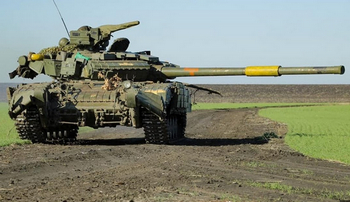
 Russia is a “colossus with feet of clay”
Ivan Sichen
Most experts believe that Russia has actually lost the second battle of the Donbas, namely, the winter-spring offensive, which was fundamental for it, failed. First of all, we mean Moscow’s attempts to seize the initiative at the front, morally compensate for its failures last year and seize all the territories of Donetsk and Luhansk regions. The Russian Armed Forces, together with the mercenaries of PMC “Wagner”, are still actively advancing, but it is obvious that they will not be able to achieve not only strategic, but operational-tactical goals of their offensive operation. Their successes are local. At this, the resources accumulated during partial mobilization last autumn have almost run out. And this allows us to draw a number of conclusions about Moscow’s military capabilities and possible changes in the strategy and tactics of its actions in the war against Ukraine, as well as about the impact of Russia’s next failures in the war on the political situation in that country.
The new Russian offensive in the Donbas began in mid-January 2023 and took place on almost the entire front line in the region. During the offensive, the main efforts were focused on the directions of the cities of Kupiansk, Lyman, Bakhmut, Avdiivka, Marinka and Vuhledar. The enemy’s greatest achievements were in the Bakhmut direction, where there was the most powerful units of its troops. However, even in Bakhmut, fighting is still taking place in the city center, with Ukrainian troops controlling 35 % to 40 % of its territory. In other areas, the enemy has achieved practically nothing, although it constantly sends military reinforcements there. In principle, the enemy still has the strength to capture Bakhmut and, possibly, a number of other cities in the Donbas, but those forces will no longer be enough for further advancement.
So, the situation of last summer is repeated, when the Russian invaders managed to take control of Mariupol, Sievierodonetsk and Lysychansk, but huge losses forced the enemy to take advantage of the operational pause. But Ukraine took advantage of this for the counteroffensive. In general, such events allow us to draw some conclusions of a military-political nature concerning the national interests and security of Ukraine.
|
…Russia is significantly losing its military potential… |
Firstly, Russia is significantly losing its military potential. For example, in the spring and summer of 2022, the Russian Armed Forces conducted active offensive operations almost along the entire front line — in the north, east and south of Ukraine. They tried to capture such large cities as Kyiv, Kharkiv, Mykolaiv.
Despite the fact that the Russian invaders were forced to leave the north and north-east of Ukraine, and were driven off from Mykolaiv, they managed to gain a foothold in the occupied territories of the Donbas and southern Ukraine. Moreover, as already noted, Russia captured Mariupol, Sievierodonetsk and Lysychansk. In fact, those are district centers, but important in terms of political and economic significance.
In the first quarter of 2023, Russians managed to conduct an offensive operation only in the Donbas. But even there they did not have significant achievements, which is quite understandable. Last year, Moscow mainly used against Ukraine a professional army armed with modern weapons and military equipment, and with a high level of motivation of the personnel. At least, in the sense of robbing our state. It is because of this that the enemy did achieve quite noticeable results.
Currently, the bulk of the Russian troops are mobilized reservists with low motivation and training. The same can be said about the mercenaries of PMC “Wagner”. Now, basically, these are prisoners brought from correctional colonies. They are used exclusively as “cannon fodder”. Those “professionals” who fought in Syria are not enough for the war in Ukraine. Moreover, most of them have already been liquidated by the defenders of our state. Ukraine is not Syria at all… No matter how hard Moscow seeks to use its “Syrian experience”, it will not succeed. Even with the help of the total destruction of cities, as Russian troops are now trying to do with Bakhmut.
Not to mention the destruction by Ukrainian troops of a significant part of modern military weapons of the Russian Armed Forces. Now such weapons are being replaced by obsolete weapons removed from long-term storages. And the stock of operational-tactical missiles of all types, spent to strike at Ukraine, in a short time is almost impossible to restore. As you can see, Russia has already significantly reduced the intensity of the use of even S-300 missiles against ground targets. SAMs are confidently destroyed by Ukrainian troops, and Russians do not have enough missiles even to fire at air targets.
|
…All such circumstances force Moscow to change its strategy and tactics in Ukraine, at least in the short term… |
Secondly, all such circumstances force Moscow to change its strategy and tactics in Ukraine, at least in the short term. For example, Russian troops are still advancing in the Donbas, but in general they are moving to strategic defense. This is confirmed by Russia’s construction of engineering barriers along the front line in southern Ukraine and partly in the Donbas, Crimea, as well as along the borders with Ukraine in Bryansk, Kursk and Belgorod regions of the Russian Federation. Such barriers consist of two or three rows of reinforced concrete pyramids (tetrahedra), anti-tank ditches, minefields, platoon strongholds with trenches, pillboxes and dugouts. Behind them there are artillery positions. According to the calculations of the Russian side, the system of engineering barriers, supported by troops, will deter the counteroffensive of the Armed Forces of Ukraine. In the main directions of offensive actions of the RF Armed Forces and PMC “Wagner” in the Donbas, there is no such system of barriers yet. But when the Russians finally lose their offensive potential, such barriers will definitely appear there.
At the same time, as compensation for the failure of the offensive, Russia may begin to more actively strike at the territory of Ukraine using tactical missiles, gliding aerial bombs, rocket and barrel artillery.
|
…Moscow will not give up its further offensive in Ukraine… |
Thirdly, despite the transition to strategic defense and the Russian Armed Forces’ problems with the personnel and weapons, Moscow will not give up its further offensive in Ukraine, creating appropriate conditions for this. Thus, under the guise of increasing the recruitment of contract soldiers, the next stage of mobilization in the Russian Federation has actually begun. By the end of 2023, it is planned to additionally recruit up to 400 thousand persons. In principle, this will allow Russia to resume active offensives in the Donbas and even expand their scale.
However, the problem for Moscow will remain the lack of uniforms, equipment and weapons for conscripts. Now the leadership of the Russian Federation is trying to cope with this by transferring the economy to military rails: to restore and modernize weapons and equipment located at long-term storages, as well as to attract volunteers to sew military uniforms and produce necessary gear.
However, another problem impossible for Russians to cope with is the shortage of labor in Russia as a result of mobilization. The problem arose in the autumn of 2022 and may now get especially aggravated. In addition, some of the people from the new mobilization are planned to be used not only for waging war against Ukraine, but also for the formation of a new division or army corps on the border with Finland after its accession to NATO.
|
…Prolongation of the war and Russia’s having no obvious successes at the front deepens the split in the Russian society… |
Fourthly, the prolongation of the war and Russia’s having no obvious successes at the front deepens the split in the Russian society and exacerbates contradictions in the ruling elite of the country, and also leads to a fall in the authority of the Putin regime. Moreover, neither Russian propaganda, nor repressions against those who oppose the war, nor announcements of new “decisive” offensives can stop this process.
For example, the spread of anti-war sentiments among the Russian population is quite obvious, as evidenced by the massive evasion of Russian citizens from conscription into the army, posts of people (mainly young people) on social networks and even open publications of local media. In particular, young people in the city of Bryansk and Bryansk region have already begun approving of Ukrainian UAV strikes on military commissariats and police stations. This demonstrates the attitude of young people to such institutions. The attitude to V. Putin himself is changing — from perceiving him as “the savior of the Russian nation” to placing on him responsibility for all today’s problems of the country.
Failures in Russia’s war against Ukraine cause growing discontent on the part of Russian chauvinists, who not only openly criticize the Kremlin for its inability to defeat Ukraine, but also began to unite in various types of socio-political organizations. An example of this was the initiative of the well-known FSB saboteur, the first “Minister of Defense of the DPR”, and now — Russian politician I. Girkin (Strelkov) to create the so-called Club of Angry Patriots. The Club issued a manifesto, accusing the Putin regime of Russia’s defeat at the front, which has a destructive effect on the situation throughout the country.
The problem with the rapid end of the war, and with the possibility of the West’s lifting sanctions against Russia with all the subsequent negative consequences for the Russian economy, directly affects the political and oligarchic circles of the ruling elite of the Russian Federation. As a result, it is divided into those who advocate continuing the war against Ukraine and those who support compromises with Ukraine and the West. According to a number of media reports, the latter are already trying to establish contacts with Kyiv on this issue.
Thus, Russia’s inability to achieve tangible successes at the front becomes the catalyst that undermines the unity of Russians and their cohesion around Putin’s regime (which until now was the basis of his power). This problem is especially exacerbated by misunderstandings between various state security agencies and military formations, in particular, between the Russian Ministry of Defense and PMC “Wagner”. And the “trigger” for an internal crisis in Russia can be a successful counteroffensive of Ukrainian troops, especially in case of liberation of important Ukrainian territories. First of all — restoration of Ukraine’s access to the Sea of Azov and destruction of the land corridor between Russia and Crimea. It was this corridor that became the main “achievement” of Putin’s war against our state.
|
…Resumption of negotiations with Ukraine is an urgent need for the Kremlin… |
Fifthly, in such a situation, the resumption of negotiations with Ukraine is an urgent need for the Kremlin. In this way, Putin’s regime hopes to prevent a counteroffensive of Ukrainian troops, to create the impression of Moscow’s readiness to end the war as a prerequisite for the West to lift part of sanctions against Russia, to gain time to replenish the Russian Armed Forces with personnel and weapons.
To this end, Russia constantly declares “readiness for dialogue” with Ukraine and its Western partners, however, as before, exclusively on its own terms. In addition, it is trying to pressure the West to force it to pressure Ukraine to agree to negotiations. The Kremlin is also trying to win over China, as one of the most influential players in the international arena, as well as its partners, in particular, from the BRICS. Formally, China supports Russia, advocates a peaceful solution to the “Ukrainian crisis”, as it calls the Russian-Ukrainian war. However, this is a well-known policy of Beijing, which always insists on the need to end wars and armed conflicts through political influence and avoids open support for one side or another.
Brazil is more open about Russian policy. This is most likely a consequence of its lack of awareness of Moscow’s real goals or even bribery of Brazilian politicians. Recently, Brazil appealed to Ukraine with a proposal to recognize the “Russian” status of Crimea, which allegedly would help end the war. Of course, this is a completely inadequate assessment of the situation, but Brazil imposes it on other countries, including China.
Ukraine rejects all such proposals. Because they do not meet its national interests and security at all. This position of Ukraine is fully supported by our partners.
And finally, the general conclusion: Russia is a “colossus with feet of clay” — a popular expression that characterizes something majestic in appearance, but in fact weak and incapable of existence in the modern world.
Therefore, we will definitely win.


