
 Strikes on Russia’s Airbases. Assessments and Conclusions
Ivan Sichen
In early December 2022, a rather resonant event occurred in the confrontation between Ukraine and the Russian invaders, which, in fact, opened a new page in the war. I mean the strikes of the Armed Forces of Ukraine on the bases of Russia’s strategic aviation in the depths of its territory. Thus, the ability of the Armed Forces of Ukraine to adequately respond to missile attacks on towns and other settlements of Ukraine, as well as on the Ukrainian critical energy infrastructure, has been demonstrated. As a result, Russian aviation has serious problems in carrying out terrorist attacks on our state, including from distant airfields. The ones that were considered to be out of reach of the Ukrainian weapons. Moreover, for the first time in history, objects of Russia’s nuclear triad, which is its main tool of deterring opponents, came under a direct strike. All this creates for the Russian Federation a number of negative consequences, both political and military. This directly affects not only the course of Putin’s war against Ukraine, but also Russia’s position in the world as a nuclear power. Therefore, the above-mentioned issue needs a separate analysis in order to make appropriate assessments and conclusions.
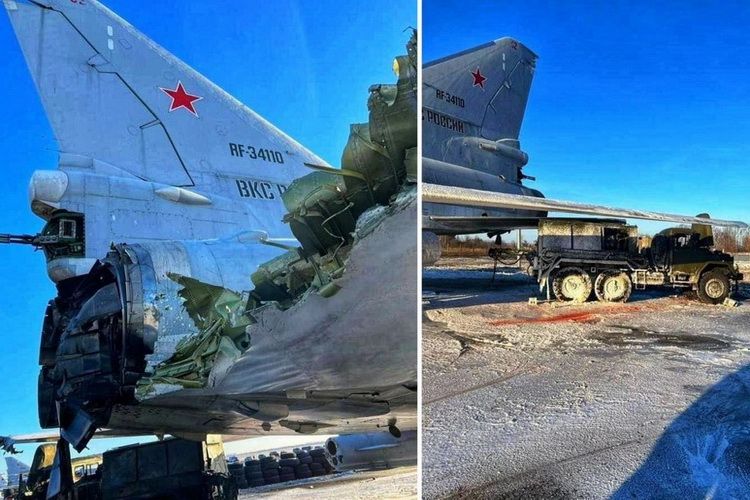
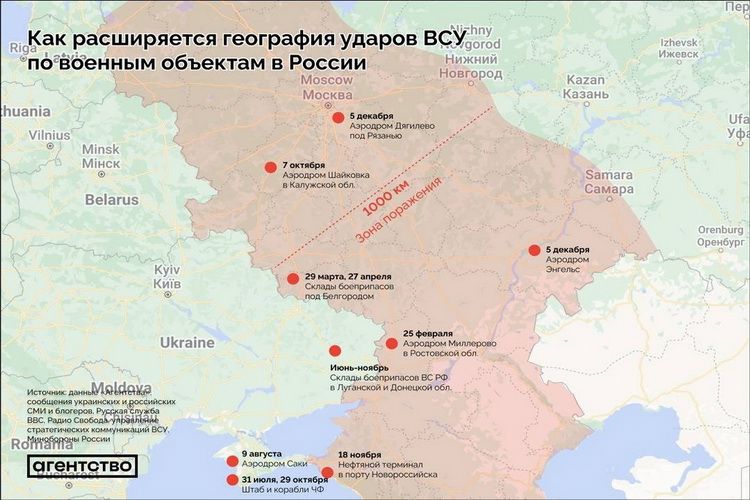
As is known, the first strike of the Armed Forces of Ukraine on the infrastructure of long-range (strategic) aviation of the Russian Aerospace Forces was inflicted on October 7, 2022. Two long-range bombers Tu-22M3 from the 52nd Heavy Bomber Aviation Regiment of the 22nd Heavy Bomber Aviation Division of the Long-Range Aviation Command of the Aerospace Forces of the Russian Armed Forces were damaged at the airfield Shaikovka in Kaluga region of Russia, which is 350 km off the border with Ukraine. After that, the rest of the strategic bombers were relocated to the Olenya airbase of long-range (strategic) aviation on the Kola Peninsula.
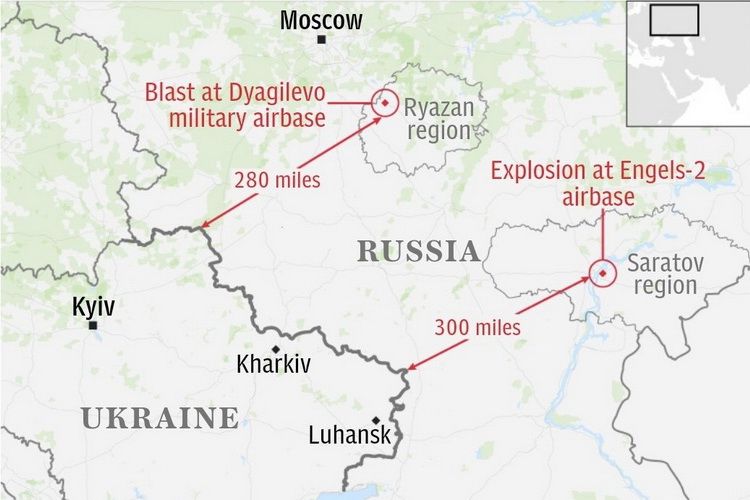
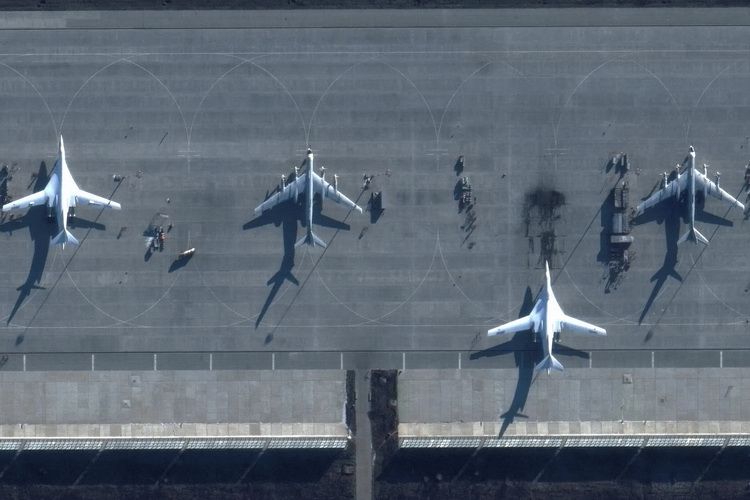
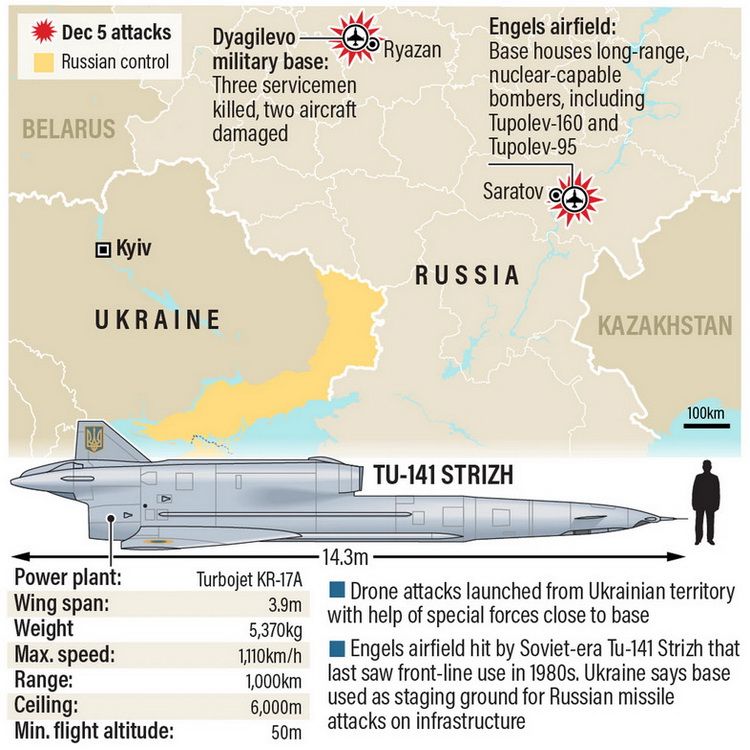
The next such strike, on December 5, 2022, was larger in scale and came already at the Engels airbase in Saratov region, where the main forces of the 22nd Heavy Bomber Aviation Division are stationed and Dyagilevo airbase in Ryazan region where 43rd Center for Combat Use and Retraining of Personnel of Long-Range (Strategic) Aviation is located. In the first case, two Tu-95MS aircrafts were damaged, and in the second — a Tu-22M3 aircraft. Some of the surviving aircrafts immediately were redeployed to other airfields.
Of course, such losses did not significantly damage the long-range (strategic) aviation of Russia, which once again attacked Ukraine already on December 7, 2022, however, as mentioned above, they had important political and military significance and became a symbol of Ukraine’s another victory over Russia. Based on the analysis of the situation around this issue, it is possible to assess and draw several conclusions regarding the national interests of Ukraine. The conclusions characterize the real state of the Russian army.
|
…The image of the Russian Federation as a “great world power” capable of defending itself with its political authority and military power was finally undermined… |
Firstly, Ukraine has demonstrated that it is capable of striking the enemy’s rear, including its military facilities in the depths of Russian territory, which nullified the enemy’s hopes that he would avoid fair retaliation from the Armed Forces of Ukraine by deploying his strike means and critical military infrastructure at distances beyond Ukrainian reach.
However, this is only the “tip of the iceberg”. The image of the Russian Federation as a “great world power” capable of defending itself with its political authority and military power was finally undermined. No threats from Moscow regarding a “crushing response” to the strikes on its territory have stopped or will stop Ukrainian retaliation. Thus, Russia suffered another defeat, now in the geopolitical sphere in terms of undermining its ability to intimidate other countries. This is evidenced by the position of Ukraine’s Western partners, who are no longer actually trying to avoid confrontation with Russia and are increasing military and technical aid to our country.
Secondly, for the first time, airbases and aircrafts of Russia’s long-range (strategic) aviation, which are considered one of the components of its nuclear triad, came under attack.
This fact showed the inability of the Russian Federation to ensure the stability and reliability of the functioning of its strategic nuclear forces, at least in terms of their aviation component. Ukraine’s relatively light drones could not significantly damage Russia’s airbases, but demonstrated this possibility if more powerful weapons available to the United States and NATO are used. This means that in the event of a war between them, the infrastructure of Russia’s strategic nuclear forces would be quickly destroyed, as a result of which it would not be able to fulfill the tasks assigned to it.
The situation with Russian long-range (strategic) aircrafts is even more complicated. Now Russia formally has more than 100 Tu-22M3 aircrafts, 60 — Tu-95MS, 15 — Tu-160M. In working condition there are no more than 30 aircrafts of the first group, 20 — of the second and 3–4 — of the third. At this, Russia has long lost its industrial base not only for production, but also for the overhaul of these aircrafts. Therefore, their destruction or damage cannot be compensated in any way. So, even the decommissioning of one or two Russian strategic bombers as a result of strikes on their airbases causes irreparable damage to the air component of the strategic nuclear forces and Russia’s strike potential.
Thirdly, Russia is forced to change the basing system and tactics of combat use of its long-range (strategic) aviation, which impairs its capabilities.
Strikes on airbases forced Russia to deploy strategic bombers at auxiliary airfields far inland or in remote northern regions, which are intended only for temporary such basing and do not have all the necessary infrastructure to ensure their proper functioning. The logistics system of aviation units is also violated.
In addition, the range of strategic bombers’ coming to the positions of missile launches has increased. And this includes additional fuel consumption, overstrain of personnel and equipment, complication of the procedure for forming combat orders and control of the actions of strategic bombers.
|
…Even with Ukraine’s limited use of air attack weapons, this system has shown its inability to reliably protect Russia… |
Fourthly, the unimpeded flight of UAVs to the interior of the Russian Federation at a distance of about 600 km indicates the low efficiency of the Russian air defense, which the Kremlin declared “the best in the world”.
In fact, the war against Ukraine unleashed by Russia was the first test of the effectiveness of the Russian air defense system in the conditions of real hostilities. At this, even with Ukraine’s limited use of air attack weapons, this system has shown its inability to reliably protect the Russian Federation.
Of course, the means of the Russian air defense neutralize some of the Ukrainian missiles and UAVs used to destroy the enemy’s positions, his equipment and troops, as well as his military facilities both at the front and in the rear. However, they still achieve certain goals. And not only in the occupied territories of Ukraine, but also in the border areas of Russia. This is evidenced by systematic explosions at oil depots, ammunition depots, military bases and airfields in Bryansk, Kursk, Belgorod and Rostov regions of Russia.
And all this — with the fully deployed Russian air defense system, built in several echelons and including all the necessary components. Namely, radio technical means of detecting and tracking air targets and suppressing UAV control systems, as well as various anti-aircraft missile systems, including Strela-10, Osa, Buk-M1 and Buk-M2, Pantsir and S-300, and in depth — S-400. And fighter aircrafts.
At the same time, all this military might could not “close the Russian sky”, which should have been expected from the experience of Russia’s actions in Syria. Thus, despite Russia’s creation of a powerful air defense around the Khmeimim airbase, Syrian rebels several times hit Russian planes at that airfield with homemade UAVs. But the Russian military command ignored the Syrian experience, relying on the fact that Ukraine does not dare and does not have the opportunity to strike at the territory of Russia (especially in the depths of the country).
|
…The situation with Ukrainian strikes on Russian airbases was another failure of the Putin regime in the war against Ukraine and once again had a negative impact on its authority… |
Fifthly, the situation with Ukrainian strikes on Russian airbases was another failure of the Putin regime in the war against Ukraine and once again had a negative impact on its authority.
Indeed, as noted above, Russian air defense could not protect the country, strategically important objects included. In fact, the Armed Forces of the Russian Federation suffered another defeat, which can be equated with the failures of Russian troops directly on the front line. In turn, this caused a new wave of criticism against V. Putin from various political forces that accuse the country’s leadership of unacceptable miscalculations in creating an air defense system and misleading society about its capabilities. There are also demands to punish the guilty. As you would expect, these problems have become an additional factor of negative impact on the ratings of V. Putin and the Russian ruling elite, which are already sliding down due to the consequences of the war that the entire Russian society has already suffered.
|
…The experience of Ukrainian strikes on airfields and airbases of the Russian Armed Forces will be studied by the United States and NATO… |
Sixthly, the experience of Ukrainian strikes on airfields and airbases of the Russian Armed Forces will be studied by the United States and NATO in their operational plans in case of a possible military clash with Russia.
Threats to use nuclear weapons have been and remain one of the main tools of Putin’s regime, which is used by V. Putin to intimidate and blackmail his opponents. With this in mind, the capabilities of Russia’s strategic nuclear forces are considered by the United States and NATO as priority targets. Ukraine has already shown how to do this in practice, and therefore its experience is carefully studied by its Western partners.
According to NATO Secretary General Jens Stoltenberg, this experience has already been reflected in the Alliance’s defense concepts and plans being worked out during various exercises. The United States went even further by creating special sabotage units designed to destroy the objects of the strategic nuclear forces of the adversaries at the initial stage of the war. They are also studying the experience of the Armed Forces of Ukraine.
And finally, the self-confidence of the Russians and their trust in the Russian army as the “second in the world” was seriously undermined. Many no longer believe not only in Russia’s air defense system, but in the ability of the country’s leadership and military command to turn the tide of the war in their favor either.
It is clear that Moscow will not leave it like that, it will try to do its best to correct the consequences of what happened to its airbases. Thus, we should expect an increase in their air defense by deploying additional air defense systems from reserves and other regions of the country. Besides, Russia will take revenge on Ukraine by carrying out new missile attacks on Ukrainian critical infrastructure and peaceful settlements. As always, such Moscow’s actions will be accompanied by an active information campaign with concealment of its losses and problems, as well as exaggeration of its own successes.
|
…In general, these circumstances confirm the deep crisis of the entire military system of Russia, which has already affected its strategic nuclear component… |
At the same time, Moscow is unlikely to be able to change anything for the better. In general, these circumstances confirm the deep crisis of the entire military system of Russia, which has already affected its strategic nuclear component. It is quite obvious that this applies not only to aviation, but also to other components of the Russian nuclear triad. On the one hand, this reduces Moscow’s ability to nuclearly deter its adversaries, but on the other hand, it may push Russia to use nuclear weapons against them.


