
Bohdan Sokolovskyi
After an unlucky for us referendum in the Netherlands April 6, 2016, time has come to draw the right conclusions regarding our future. In principle, the results (of the referendum) are quite logical. However, I believe that for Ukraine, it is not a tragedy, but it should not be underestimated. Whatever it was, the Dutch referendum showed serious enough drawbacks of our international activity. If something like that happened in Germany, France, the Czech Republic or Poland, it would be a real disaster.
The worst thing that can still be for us in the so-called Dutch story is traditional “appointment of the guilty”. Democratic countries are already in anticipation of such a “reaction”, from which they will draw their conclusions about how far we have moved away from the Kremlin, and whether we have moved away from it at all.
We must pay tribute to those who have tried to encourage the Dutch to support the EU-Ukraine Association Agreement. I mean people’s deputies, volunteers, Ukrainian diaspora, etc. — Honor and praise to them!
However, their work would have been by times more efficient if had fit into the framework of the system and continuous activity of the official representatives of our state in the Netherlands. Perhaps we would not then have to analyze our failure, but to enjoy the results of a victory in the referendum.
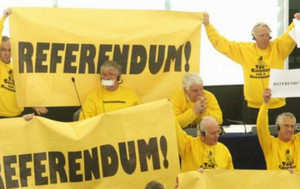 By the way, our official representatives (diplomats) had the opportunity to work with the population, but are they enough for the job, and do they feel responsible for all this? Apparently, the answer is negative.
Who is more to blame for the Dutch non-success and who — less, how effective the external action was and that we opposed to it, and so on — all this, of course, must be analyzed professionally. At least in order to avoid such annoying flaws in the future. In this context, following the example of other democratic countries, it is worth pointing out that the official representations of Ukraine abroad (FDI— foreign diplomatic institutions) should have performed the following four main functions:
– Information-explanation work;
– Economic (business) (including scientific and technological) cooperation;
– Political (including multilateral) cooperation;
– Consular (legal services to individuals and organizations) work.
In a word, it is necessary to move away from Soviet stereotypes of activity, which in the first place were promoting the Soviet way of life in the world. Or, in current terms, we need to thoroughly reform the Ukrainian diplomatic service.
Of course, diplomatic activity is effective with appropriate internal support. In our case – if we do really fight corruption and carry out real reforms.
To a large extent, our missions abroad and overseas activities in the Center have preserved the longstanding imperial principles, because they have been practically ignored by the leadership of the independent Ukraine. A key role in their activities have often played persons who directly and indirectly, even despite their patriotic ideas, often not consciously, have been formed under conditions not of Ukrainian stereotypes but of colonial principles. Clearly, not without the help of our native “friends”. Besides, a certain role was played by the fact that the central and peripheral bodies of our government in this sphere have never controlled the impressive financial flows.
For example: an educated European citizen (Professor!) often does not know where Ukraine is situated; and an average ordinary citizen of any EU country has never heard of, for example, which lands had belonged to Ukrainians before the Soviet occupation; he knows nothing about the Holodomor of 1932-1933, of the essence of the Ukrainians in Kholodnyi Yar or about the background of the UPA’s struggle, about the state building work of many generations of Ukrainian leaders or about Russia’s aggression in the Crimea and in the East of the Donbas, about the real aspirations of the Ukrainians in the context of European integration and so on. Most often about Ukraine Europeans get information from our detractors, who spread it through their central authorities and central media, paying them tens or even hundreds of millions of dollars annually. Of course, we do not have (and won’t have in the nearest future) enough resources to neutralize the anti-Ukrainian propaganda.
According to the Ukrainian Foreign Ministry’s website, we have more than 80 embassies around the world, not as many as we should have in accordance with our financial capabilities. At the same time all our diplomatic institutions abroad and, accordingly, our diplomats are limited in their activities, first of all because of lack of funds. In particular: they are limited in their mobility in the host country, they cannot pay for organizational arrangements and so on. Besides, our FDI are extremely modest. For comparison: in key EU countries, Ukrainian diplomats are fewer than Polish or Belarusian ones. Willy-nilly, Europeans ask themselves a question: who needs cooperation with the EU more — Kyiv or Minsk?
Obviously, taking into consideration the poor funding, it would be logical to extend the state of Ukrainian FDIs in each EU country due to their reduction in Russia, Asia, Africa and South America (in other words — to transfer positions). We are going to European integration and, therefore, should focus on this direction. The world diplomatic practice knows many such examples. Over time, when our country gets rich, we can expand our presence throughout the world. But not today, when there are no funds for the effective work of Ukrainian diplomats.
When we optimally expand staffing and create appropriate working conditions, in the EU and other democratic states, it is advisable to make each diplomat responsible for some (to cover by one diplomat) region and to oblige him (under the clear reporting into the Centre to the interdepartmental group, evaluating the effectiveness by means of secret ballot) to cooperate with the local exponents of public opinion, with a local business, with local universities, just with the public and with the local media and so on. Working with these media is particularly important, because every free European prefers local media to the central. It is clear that such a diplomat, apart from patriotic beliefs, professional skills, and other Ukrainian virtues, should have an excellent command of the language of the country of residence, even the local dialect, and peculiarities of local business, science, etc.
Obviously, this is one of the few most effective methods of learning and introducing in Ukraine European standards of life of ordinary citizens that are the basis of the current Ukrainian life. Systemic work with such an approach to FDI will provide a positive result not earlier than in a year.
Increasing the responsibility of ordinary diplomats and making weaker some traditionally high persons in the diplomatic service (in the central office, in FDI), we can quickly minimize the impact on our diplomacy of inefficient workers and anti-Ukrainian elements (“fifth column”). All this would take a lot less money than today is allocated by our opponents for the mainstream media.
It is an undeniable fact that in democratic countries the population forms the authorities’ opinion, and not vice versa, as it was, in particular, during the Soviet era. The referendum in the Netherlands has once again confirmed: immediately after the survey, the Prime Minister said, “the public opinion must be taken into consideration”.
We also should pay attention to the fact that there are fewer diplomats (both, in the Central office and in FDI) per capita in Ukraine than in Europe. And in the content of the work, its effectiveness, motivation and so on, Ukrainian diplomacy needs to be updated, in the first place — in the context of the European integration.
It must be said that the result of the work on the diplomatic front is observed after a certain time. And diplomacy, like science, for example, cannot be evaluated with the help of money. On the other hand, we must admit that Ukrainian diplomacy is funded poorly, and often works in the old way, for itself. Consequently, this issue needs to be reformed too. We should not, for example, reduce funding for other sectors, increasing working costs on diplomacy. But to increase funding the diplomatic activity abroad by, for example, bringing the Ukrainian economy out of the shadow — would be only fitting.

