
LAST WEEK’S KEY FACTORS AND MAIN TRENDS
IN THE DEVELOPMENT OF THE SITUATION AROUND UKRAINE
(April 03–09, 2017)
I. Major-Profile Events in the Development of the Situation around Ukraine
April 6, the European Parliament took a decision on simplifying the EU visa regime with Ukraine. The final point in this process should be the implementation of a number of formal procedures, in particular, voting in the Committee of Representatives and the Council of Ministers of the European Union.
|
|
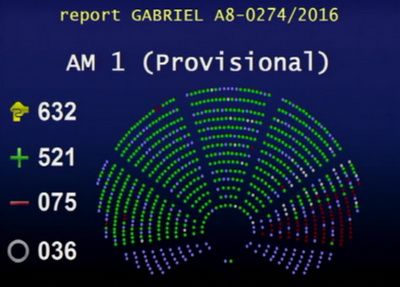 April 6, European Parliament voted for visa liberalization for Ukraine
This decision of the European Parliament is of fundamental importance from the point of view of confirming the EU’s strategic course on supporting Ukraine, as well as recognizing its entering the Western world, and not the Russian zone of influence. At the same time, it became a clear demonstration of the greater attractiveness of life in Ukraine than in Russia, let alone in the Ukrainian territories it occupied. In a word, all these circumstances once again confirmed the tendency of the insidious policy of V. Putin’s regime to fail on all directions.
This trend is evidenced by the act of terrorism in the metro in St. Petersburg on 3 April 2017, which shows that the Kremlin is not able to ensure security in the country (which until recently, in fact, was one of the “cornerstones” of Putin’s authority). We may assess the reasons and aims of the terrorist attack differently — from considering it in the context of the spread of protest actions in the Russian Federation (as one of the measures of the organizers of social unrest to destabilize the situation in the country) — to the actions of Islamic extremists in response to Russia’s military operation in Syria.
We should not rule out the version of the terrorist attack having been organized by the current regime of the Russian Federation “with a view to consolidate the Russian population on the ideas of fighting terrorism”, to persuade a need to unite the efforts of the West and Russia to counter extremism, and to create a resonant cause for suppressing anti-government protests in the country. In particular, the State Duma of the Russian Federation, in connection with the terrorist attack in St. Petersburg, has already initiated banning any meetings and demonstrations in Russia.
Moreover, Moscow is actively using the terrorist act to counterbalance the protests of the Putin regime’s opponents. Thus, on the Kremlin’s initiative, on 7–9 April 2017, in different cities of Russia were held so-called “Days of Unity” of the Russian Federation against terrorism. According to the order of local authorities, meetings had to be in invitum attended by students and employees of the budgetary sphere.
Apart from this, whatever the real reasons and aims of the terrorist attack, it clearly shows that Russia is plunged into the situation of the 1990s — early 2000s, when there were processes of disintegration and armed conflicts in its territories. In order to understand how real is such a threat, just look at the activization of the Islamic extremists in the South of Russia — the attack on the base of Rosgvardia (Russian Guard) in Chechnya on 24 March 2017, in order to get weapon, and on the police patrols in Astrakhan on 4 and 6 April and in Ingushetia on 7 April, 2017.
Besides, the act of terrorism in St. Petersburg on 3 April was a direct challenge personally to President Putin and all his politics in post-Soviet territories. It was at that time that he was meeting in the “northern capital” of Russia with the President of the Republic of Belarus A. Lukashenko on the occasion of the Day of Unity of the Russian Federation and Belarus.
At the same time, despite the Russian authorities’ repressions, mass protests of truckers in the form of peaceful strikes continue in the country. According to the Association of Carriers of Russia, more than 10 thousand drivers are taking part in them. Most actively — in Dagestan, Buryatia, Chelyabinsk, Vladivostok, in the South of Russia, as well as in Moscow and St. Petersburg. For example, in Dagestan the work of 100 % trucks has stopped, heavy and small ones included. Participants of the action have blocked the road Rostov-on-Don — Baku. In total, the work of 40 % of trucks with a carrying capacity of 5 to 12 tons has been suspended on the territory of Russia. In the overwhelming majority of cases, drivers are supported by owners of firms and enterprises working in the field of cargo transportation, and this has already caused interruptions in cargo deliveries in Russia.
Against this background, relations between Russia and the West have become even more acute because of the Assad regime’s use of chemical weapons against insurgents in Syria. Western countries and international organizations accused Moscow of conniving at war crimes in Syria, and also raised the question of tightening up sanctions against the Russian Federation. In addition, in response to the chemical attack, the US military conducted a missile strike at the Shayrat Air Force base of Syrian government forces, which effectively put an end to the Kremlin’s hopes of establishing cooperation with the West in countering terrorism. In turn, Russia suspended the memorandum with the US on the prevention of incidents in Syria.
|
|
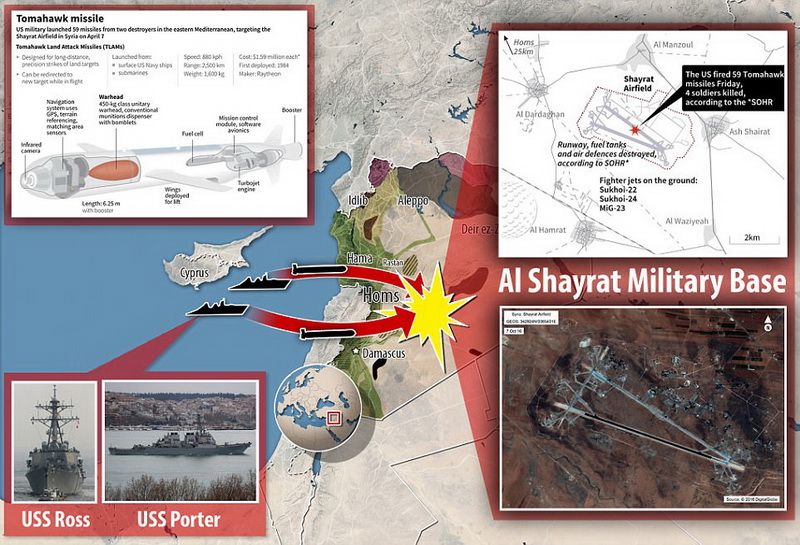
By the way, the power of the US attack, where 59 Tomahawk cruise missiles were used against the Shayrat air base alone, clearly shows the USA’s absolute military superiority over Russia. At the same time, this once again demonstrated the United States’ real attitude to Russia as a secondary country that does not have authority in Washington’s eyes and which cannot prevent its actions. With this in mind, it can be stated that the agreement between the USA and Russia in terms of “bargaining” Ukraine over Syria is impossible.
Principal disagreements between the United States and Russia were confirmed during the UN Security Council’s meeting on April 7, 2017 over the Syrian issue. The parties quite harshly accused each other of leading a destructive policy that could exacerbate the situation around Syria.
Independent experts are trying to predict how Putin will respond to the US missile attack and where to expect that response: in the Middle East, Mediterranean, Balkans, Baltic countries and Poland, or against Ukraine in the Donbas?
Despite the worsening of the situation in Russia and the intensification of its confrontation with the West, Moscow is still trying to achieve its goals in Ukraine. Thus, on 4 April 2017, during his telephone conversation with German Chancellor A. Merkel and French President F. Hollande, V. Putin again accused Ukraine of “failure to comply with the Minsk Agreements”. As a proof, he mentioned Ukraine’s refusal to use the so-called Steinmeier’s formula (provides for the implementation of the political part of the peace plan prior to guaranteeing security in the conflict zone), as well as the ongoing “blockade” of the Donbas. A similar position was demonstrated by the Russian side at the meeting of the diplomatic advisers to the leaders of the “Normandy Four” countries of April 6, 2017 in Minsk. But representatives of Ukraine, Germany and France condemned Russia’s actions to provoke tension in the Donbas, urging it to abandon such steps. A special emphasis was placed on the safe working conditions of the OSCE Special Monitoring Mission in the Donbas and letting it to all territories of Ukraine occupied by Russia. As always, Moscow ignored this.
ІІ. Russia’s Armed Aggression against Ukraine
1.1.The East of Ukraine (the ATO zone)
The Putin regime’s real policy towards Ukraine is evidenced by Russia’s violation of the terms of the truce in the Donbas during the celebration of Easter. Thus, the Russian-terrorist forces continued shelling of the ATO forces’ positions and civilian settlements with a peak intensity of 50–80 within a day. As a result, the preliminary agreement on the withdrawal of troops from the front line near Stanytsya Luhanska and on the Mariupol direction was also derailed. In this regard, very indicative was the participation in the fighting in the Donbas of units of the so-called “Orthodox Troops of Russia”, created under the auspices of the Russian Orthodox Church.
2.2. The Crimean Peninsula
Despite the leadership of the Russian Federation’s paying “special attention to the problems of the Crimea”, and intensifying repressions against opponents of the Putin regime, protest moods are observed in the Crimean Peninsula too. For example, a group of activists of the initiative movement “Navalny 2018. Crimea” intends to take part in the “Sick and Tired of you!” protest scheduled for April 29 this year by the public organization “Open Russia” (leader — former oligarch M. Khodorkovsky). So, the situation in the Crimea acquires a qualitatively new character, when apart the Crimean Tatars and supporters of Ukraine, a part of the so-called Russian-speaking population protests against the Kremlin, too.
Under these circumstances, the government of the Russian Federation continues the large-scale militarization of the Crimean Peninsula. Thus, on 1 April 2017, at the headquarters of the Black Sea Fleet in Sevastopol, a meeting of the Military Council of the Russian Navy was held, where plans were discussed to build up the Black Sea Fleet’s forces in the Crimea, as well as to strengthen Russia’s presence in near and far sea zones. At this the Commander-in-Chief of the Russian Navy, Admiral V. Korolev, confirmed the plans to introduce three new submarines of the project 636.3 “Krasnodar”, “Kolpino” and “Veliky Novgorod” into the Black Sea Fleet in 2017.
2.3. Other Aspects of the Russian Federation’s Actions against Ukraine and the West
|
|
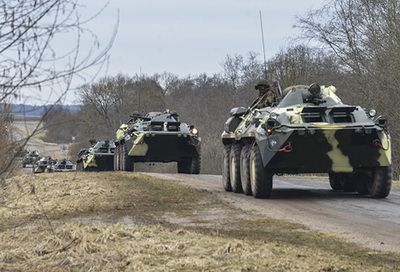 In the Vitebsk region, was held a joint tactical exercise
While the internal situation in Russia is becoming more complicated and the USA, NATO and the EU are increasing their pressure on it, the Russian leadership is trying to demonstrate its force to Ukraine and its Western partners. Thus, last week, as part of the preparation of the “West-2017” SCPE, a joint tactical exercise was held in the Vitebsk region of the Republic of Belarus with the participation of battalion tactical groups of the 98th Guards Airborne Division of the Armed Forces of the Russian Federation (Ivanovo region) and the 103rd Guards Airborne Brigade of the Special Operations Forces of the Armed Forces of Belarus.
Intelligence and search operations were developed on an unfamiliar terrain where the routes of the main forces of the combined airborne detachment of Russian and Belarusian troops were determined. The march range was more than 150 km, which actually corresponds to the depth of the army offensive operation.
At the same time, the battalion tactical trainings of the 336th Brigade of the Marine Corps (Baltiisk) of the Russian Baltic Fleet were held at the Khmelevka training ground in Kaliningrad Region of the RF. They mastered disembarking the sea assault, followed by the Marine Corps forces’ moving deep into the enemy’s coast.
The nature of these trainings does not exclude the possibility of conducting them on a single operational background within the framework of developing a scenario for a full-scale military operation against the Baltic states. All this was regarded by the military intelligence of Lithuania as a direct threat to the countries of the region and in general to NATO.
Besides, on 4–5 April 2017, in the Crimea and Volgograd region of Russia, there was tactical flight training of the aviation units of the 4th Air Force and Air Defense Army which is affiliated to the Southern Military District of the Russian Armed Forces.
In addition to providing military assistance to the “DPR” and “LPR”, Russia is deepening military cooperation with other self-proclaimed republics in the countries of the former USSR. Thus, following the results of the meeting of Russian Defense Minister S. Shoigu and the head of the military forces of South Ossetia I. Gasseev on 31 March in Moscow, an “intergovernmental” agreement was signed on the procedure for the entry of separate units of the self-proclaimed republic into the Russian Armed Forces. So, like in the Donbas, a common grouping of Russian troops and separatist armed units is being formed. Due to this, Russia is expanding the possibilities of conducting a “hybrid war” against Georgia, including by increasing the scale of the military invasion of Georgian territory.
III. Ukraine, International Organizations and Leading Western Countries
3.1. International Organizations
The European Union. Against the background of the increasing aggressiveness of Russia’s policy, the problem of international terrorism remains a significant threat to the security of Europe. April 7, 2017 in Sweden’s capital Stockholm, there was a terrorist attack where a truck hit a crowd of people. The latest similar attack was on 22 March, 2017 in London.
Because of this, the European Commission has introduced increased control at the external borders of the Schengen zone. From now on, citizens of the EU member states will also be subjected to a thorough check. In particular, their passports will be checked with databases of security services in order to prevent the European Union ‘s being entered by persons posing a threat to the public security.
NATO. NATO’s policy to restrain Russia is actively supported by the member countries of the Alliance from Central and Eastern Europe. April 3, 2017 President of Romania, Klaus Johannis, initiated the opening of the NATO Counter Intelligence Centre in Bucharest. According to him, creation of such a body would improve the security of the Alliance’s forces in the region and strengthen counteracting Russia’s methods of “hybrid wars”. Along with this, the implementation of such an initiative would strengthen Romania’s positions in NATO.
At the same time, last week, was completed a deployment to Estonia of the NATO’s Multinational Battalion Battle Group, which includes 1,200 military servicemen from the Armed Forces of Great Britain, France, Denmark and Estonia. This Battle Group is deployed and located on the Tapa military base — 150 km from the border with Russia.
3.2. Leading Western Countries
|
|
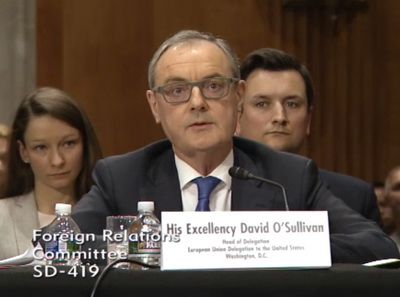 Head of the EU Delegation to the USA David O’Sullivan, testifies before the U.S. Senate Committee on Foreign Relations, April 4
The USA–European Union. The USA and the EU’s leaders are strengthening the coordination of their actions to contain Russia. A special meeting of the US Senate Committee on Foreign Relations of April 4, 2017 was devoted to this special issue. At the hearing, the Head of the European Union Delegation to the United States, D. O’Sullivan, pointed out the need to maintain sanctions against Russia until its full implementation of the Minsk Agreements and returning the Crimea to Ukraine. He expressed the EU’s firm intention to continue to provide all-round support to Ukraine, as well as to take other measures to counteract Moscow’s aggressive policy. Such measures, in particular, will include: deepening relations with the EU’s Eastern Partners; intensification of the struggle against Russian propaganda, as well as supporting the development of democratic processes in Russia. Similar positions with respect to Russia and Ukraine were also expressed by US Senators.
The participants of the hearing paid special attention to the plans to expand the range of sanctions against Russia, including by imposing an embargo on the export of Russian energy carriers. The parties reached an agreement to study in detail the possibility of such a step and consider its possible consequences for the energy security of Europe. In particular, among the priority ways to solve this problem, were mentioned the increase in the volume of supplies of liquefied gas from the USA to the EU countries, as well as the expansion of the EU’s access to other sources of energy. In this regard, they stressed Lithuania and Croatia’s positive experience in constructing terminals for receiving liquefied gas on their territory.
Poland. As part of a general confrontation between the West and Russia, the Polish leadership has resorted to a more tough policy towards the Russian Federation. April 3, 2017 Poland’s Prosecutor General’s Office accused the air traffic control service of the Russian Federation of having deliberately provoked the crash of the Tu-154 plane with Polish President L. Kaczynski on board in April 2010 near Smolensk. The evidence is the materials of air traffic control talks of Russians, based on which it is planned to send a suit to the International Court of Justice.
ІV. Other Important Trends and Developments that Will Have an Impact on Ukraine’s National Interests
|
|
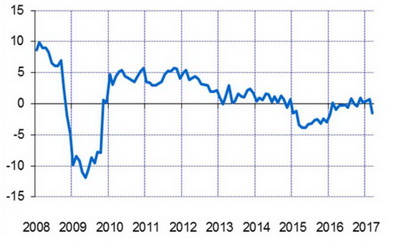 Russian GDP estimate by VneshEconomBank:
Russia. The development of the Russian economy does not confirm the optimism of the leadership of the Russian Federation about “Russia’s adaptation to Western sanctions” and “the country’s getting out of the crisis”. Thus, according to the VneshEconomBank (Foreign Economic Bank) of Russia, in February 2017 Russia’s GDP decreased by 1.5 % compared to the same period last year. All in all, in January–February this year, the volume of GDP fell by 0.4 %. According to the VEB’s assessment, since the beginning of the year, negative trends have been prevailing in the industry and most other sectors of the Russian economy. This applies in particular to metallurgy, manufacturing, automotive, shipbuilding and aircraft construction, as well as to the rocket and space industry. The orders for pipes for oil and gas pipelines have decreased. Besides, the volume of retail trade has also declined.
Worsening of the socio-economic situation in Russia causes changes in the society’s moods in terms of undermining the “Crimean consensus” between the population and the authorities. Thus, according to sociological surveys, the level of distrust of Russian citizens to the country’s leadership has increased from 25 % in March 2016 to 31 % in March this year. In general, to date, the rating of the government of the Russian Federation has decreased by 20 % compared to the end of 2014. All this will provoke growth of protests in the Russian Federation.
|
|
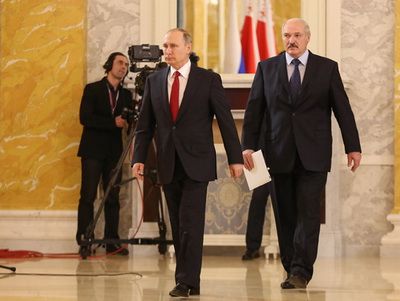 Meeting of Russian and Belarusian Presidents V. Putin and A. Lukashenko, April 3, St. Petersburg
Russia–Belarus. April 3, 2017, in St. Petersburg, there was the Russian President V. Putin and Belarus’ President A. Lukashenko’s meeting on the occasion of the Day of Russian-Belarusian Unity. The heads of both countries expressed their intentions to deepen the strategic partnership, including in the military sphere. For example, in the near future they plan to sign a number of new military-political, military and military-technical agreements.
In particular, in joint exercises on the territory of Belarus are expected to participate not only the units of the RF Armed Forces, but also other law enforcement agencies of Russia. In this regard, the Russian media have pointed out that the leadership of Belarus is interested in Russia’s military assistance, including specialists with experience in combating sabotage and reconnaissance groups and illegal armed formations. The relevance of this issue was related to the so-called “detection and detention on the territory of Belarus in March of groups of militants trained in Ukraine”. Taking into account such circumstances, the plans to conduct joint military exercises “Slavonic Brotherhood-2017” in July (with the participation of Russian, Belarusian and Serbian paratroopers) and “West-2017” in August–September of this year were confirmed.
V. Major Trends in the Development of the Situation around Ukraine in the Future
5.1. Key Events and Trends that Will Be Most Important for Ukraine
In the near future, the situation around Ukraine will be influenced by events related to mass protests in Russia. In this regard, the most noticeable will be the consequences of the truckers strike. Thus, according to the management of the Russian transport company “WAY-GROUP” (this company has representative offices in all regions of the country), if the strike continues, in 3–4 weeks Russia will suffer a shortage of food and essential goods. In turn, this will cause an increase in their prices and, as a consequence, protest moods will grow.
|
|
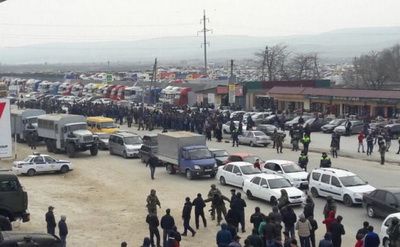 Protests of truckers in Russia
With this in mind, the leadership of the Russian Federation is already considering the possibility of reducing taxes on the use of highways, which is the main requirement of the truckers. At the same time, such a decision would in fact mean a political defeat of the Russian government, which would be used by opponents of V. Putin’s regime. In particular, a more active political demands to dismiss the government of the Russian Federation should not be ruled out.
Against this background, anti-government actions of Islamic extremists in the North Caucasus of the Russian Federation are becoming more active. First of all, in Dagestan, which is now considered the most problematic region of the country. Thus, the local situation has largely escaped the control of the central government, which shows Moscow’s failure to eliminate Islamic centers in Dagestan that openly operate on its territory. The high level of tension in Dagestan is also evidenced by the sharp nature of the actions of local truckers (blocking roads and attacking truckers who refuse to participate in the strike).
Another factor in undermining stability in Russia is the growing level of threats of terrorism. After the terrorist act in the metro of St. Petersburg, another manifestation of such a threat was the explosion of an improvised explosive device in Rostov-on-Don on 6 April 2017. At this, a new feature of terrorists’ actions is the disguise of explosive devices for various items that attract people’s, especially children’s attention.
All these problems demand from the leadership of the Russian Federation more and more attention and resources to solve internal problems, which will reduce its ability to implement the neo-imperial policy, including towards Ukraine. At the same time, in order to consolidate the Russian population on the ideas of fighting against an external enemy, V. Putin’s regime may decide to further strengthen the confrontation with Ukraine and its Western partners.
5.2. Prospects for the Development of Events in the Conflict Zones in Ukraine
On the above-mentioned circumstances will also depend the development of events in the Donbas and Crimea. Thus, Russia will continue to “demonstrate commitment to the peaceful resolution of the conflict in the East of Ukraine”, but will never ever implement the Minsk Agreements, continuing to put pressure on Ukraine. As the internal situation in the Russian Federation worsens, the intensity of such pressure will increase up to offensive operations in certain areas by Russian-terrorist forces. At the same time, Russia could launch a large-scale offensive in the Donbas in case of a political crisis in Ukraine. It is also possible that Russia may become more active in the Donbas in an “asymmetric response” to the US missile strike at the Sharyat Air Force Base of Syrian government troops.
At the same time, further intensification of protests in the Russian Federation, let alone the resumption of the armed confrontation in the Caucasus, may make Moscow divert part of its forces from Ukraine to resolve its internal problems. At this, additional difficulties for Russia’s actions in the Donbas will be created by destabilization of the situation in the South of the Russian Federation — in fact, in the operational rear of Russian-terrorist forces.
In turn, given the active protest movements in the Crimea, the Russian leadership will strengthen the police regime in the Peninsula, increase the scale of repressions against V. Putin’s opponents. The manifestations of such a policy of Moscow were last week’s mass detentions of persons of “non-Slavic appearance” at the market in Simferopol. At the same time, measures will continue to militarize the Crimea in order to strengthen Russia’s positions in the matter of confronting the United States and NATO in the Black Sea and Mediterranean regions.
5.3. Other Important Events that Will Influence Ukraine’s Interests and Security
The heads of the states and governments of NATO member countries will meet in late May 2017 at a summit to discuss the adaptation of this military-political organization to new challenges.
According to NATO Secretary General J. Stoltenberg, “…We will hold a meeting at the level of heads of state and government at the end of May in Brussels. It will be tied to the G7 (“Big Seven”) summit in Italy. During the working session, we will discuss NATO’s adaptation to a changing security environment and fight against terrorism”. And he added that the leaders would pay special attention to the issue of increasing and effective use of defense budgets.
|
Summit G7-2017 (“Big Seven”) will be hosted by Italy. In 2017, this country presides over the Organization. According to the head of the government of Italy, Matteo Renzi, the organizers of the event have already decided on the time and place — the summit will be held on 25–27 May 2017 in Sicily, in the city of Taormina. The event in Taormina will be the 43rd G7 summit. The Prime Minister of Italy stressed that this event would take place at a “special moment”. After all, this will be the first meeting with the new US President. Besides, the summit will begin its work immediately after the elections in France and before the elections in Germany. |
 Note:
Note:

