
LAST WEEK’S KEY FACTORS AND MAIN TRENDS
IN THE DEVELOPMENT OF THE SITUATION AROUND UKRAINE
(March 27–April 02, 2017)
І. Major-Profile Events in the Development of the Situation around Ukraine
The beginning of mass protests in Russia, one way or another, affects its policy towards Ukraine. March 26, 2017, in Moscow and in about a hundred of other cities of Russia there were meetings and demonstrations under the slogans of Russian Prime Minister D. Medvedev’s resignation because of his involvement in corruption. About 20 thousand people took to the streets in Moscow.
The next day, March 27, there began protests of truckers, who are against increasing the transport tax, and of farmers who went on tractors to Moscow with the demand to stop local authorities’ infringing their rights. The truckers’ actions of protest are held in more than 20 cities and regions of Russia, including St. Petersburg, Dagestan, North Ossetia, Tatarstan, Astrakhan, Saratov, Yaroslavl, Chita, Amur, Orenburg and other regions. Farmers’ march started from Krasnodar and Stavropol. April 2, 2017, a new protest action was organized by the “New Opposition” party in the center of Moscow. The action was held in the form of the so-called “Sunday walk” around the city, including with the participation of representatives of nationalist movements and organizations.
|
|
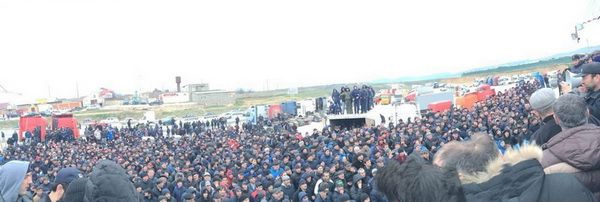 Truckers’ strike in Dagestan, March 31
The scale of citizens’ protests is the largest since 2011 (opposition meetings against the falsification of the results of the presidential elections in Russia). This time, the protests were attended by youth which is thought to be “the backbone of Putin’s regime”. By and large this indicates the failure of Moscow’s internal policy to consolidate the Russian population (in fact, its “zombifying”) on the ideas of building the “Russian world”. As well as the impossibility of complete suppressing all manifestations of discontent of the Russian population by the actions of the Kremlin.
At this, the nature of the demonstrations against the authorities confirms their well-prepared, pre-planned and well-organized character, which shows that there is a single coordinating center for the actions of protesters against V. Putin’s regime. In fact, such actions resonate with the policy of the West to contain Moscow through political and economic sanctions. We would like to draw your attention to the fact that due to the sanctions of 2014–2015, social and economic problems in the Russian Federation have worsened, which has provoked protest moods among Russian citizens. In 2015–2016, similar moods activated effective protest actions by representatives of Russia’s workers and middle class. At the same time, “new life has been breathed into” the democratic opposition to the Kremlin. As a result, in 2016–2017, there actually began mass demonstrations of the united front of the opponents of V. Putin’s regime.
At the moment, within the framework of such protests, the opponents of the Russian authorities are being evaluated, the methods and ways of their actions are being mastered, and at the same time the reaction of the Russian leadership is being tested. The results will determine the further strategy and tactics of measures to undermine the positions of V. Putin’s regime presumably reaching a peak of activity in 2018, during preparations for the presidential elections.
The Russian Federation’s leadership, well aware of all this, is trying to take tough measures to keep control over the situation. Under various pretexts, the leader of anti-corruption actions A. Navalny and more than a thousand of the participants in different Russian cities have been arrested. The leader of the St. Petersburg branch of the Association of Carriers (truckers) A. Bazhutin, the leaders and organizers of the farmers’ movement A. Volchenko and N. Maslov have also been detained. Movement of vehicles of the participants of the actions has been blocked.
These events in Russia are hushed up or specially underestimated by the Russian media, while the problems in other countries, first of all in Ukraine, are actively covered for camouflage. However, it should be noted that the scale of protest actions and their organized character really horrify the leadership of the Russian Federation. President Putin even compared these anti-government protests with the Ukrainian “Maydan” or mass social unrests in the countries of the Middle East and North Africa (the so-called “Arab spring”). Moreover, with the beginning of these actions, V. Putin and Russian Prime Minister D. Medvedev, in fact, fled from Moscow under the pretext of a trip to the Arctic region of Russia. (By the way, according to the estimates of independent Russian experts, at the current prices for oil and gas, the development of Russian Arctic resources is a financially unprofitable business, and therefore is economically inexpedient).
Against this background, look miserable the Kremlin’s attempts to influence the West’s policy towards Russia through interference with the elections in the USA and EU countries, supporting all sorts of pro-Russian, leftist, Euro-skeptic and populist forces. An example is the victory of the party “Citizens for European Development of Bulgaria” (GERB) in the early parliamentary elections on March 26, 2017. This created preconditions for the restoration of the center-right (pro-European) government of the country, which resigned after the representative of the Bulgarian Socialist Party, R. Radev became President of Bulgaria in November 2016.
|
|
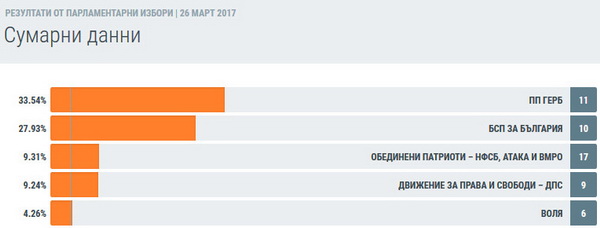 The results of early parliamentary elections held in Bulgaria on March 26
On the same day, following the regional elections in the Saarland in Germany, the Christian Democratic Union (CDU), led by the German Federal Chancellor A. Merkel, won with 40 % of the vote. In turn, the main opposition party — the pro-Russian and populist “Alternative for Germany” was supported by only 6 % of voters (the minimum passing barrier). In fact, the results of the elections in Saar can be seen as a certain test of public opinion of the German population before the parliamentary elections in September this year.
The invariability of the positions of the leading countries of the world regarding the policy of the Putin regime was confirmed by the representatives of the “Big Seven” and the EU during the meeting with President of Ukraine P. Poroshenko on March 27, 2017, in Kyiv. Thus, the members of the G7 and the European Union intend to maintain economic sanctions against Russia and increase pressure on it to contain its aggression against Ukraine. This is evidenced by the EU Court’s of Justice decision of 28 March 2017 on the recognition of the validity of EU sanctions against the Russian company “Rosneft”. By this it was again confirmed that the EU recognizes the fact of Russia’s armed aggression against Ukraine.
|
|
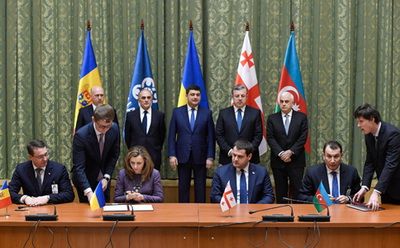 Signing of protocols on the establishment of the Free Trade Area within the framework of GUAM, March 27
By the way, Moscow is consistently losing its positions in post-Soviet territories, which it considers to be “a zone of Russia’s exceptional influence”. Just look at the activation of the work of the GUAM group (Organization for Democracy and Economic Development; unites Georgia, Ukraine, Azerbaijan and Moldova) as an alternative integration association of the countries of the former USSR. Following the meeting of the heads of governments of the member countries of the Organization on March 27, 2017, an agreement was reached to intensify the creation of a free trade area within the framework of GUAM.
With this state of affairs, Putin’s regime continues to pursue the cynical and double policy to justify its actions and accuse Ukraine. March 28, 2017, Minister of Foreign Affairs of the Russian Federation S. Lavrov voiced a statement on “Russia’s non-involvement in the conflict in the Donbas”, as well as “Moscow’s being interested in a stable and friendly Ukraine”. But again he accused Ukraine of “organizing the blockade of the Donbas” and promised that the Kremlin “will take all sorts of measures to stop such actions on the part of Kyiv”. By the way, Russia refused to participate in the work of the “Normandy” group of the negotiation process and continues to actively provoke an armed conflict in the East of Ukraine.
II. Russia’s Armed Aggression against Ukraine
2.1. The East of Ukraine (the ATO zone)
The current situation in the Donbas is fully in line with Russia’s policy towards Ukraine. Thus, last week Russian-terrorist forces continued to shell the ATO Forces’ positions and civilian settlements, including with heavy artillery and multiple artillery rocket systems. Besides, according to the decision of the Russian Military Command, the areas of combat operations of units of the 1st and 2nd Army Corps of the RF Armed Forces in the occupied territories of Donetsk and Luhansk regions are being additionally equipped.
March 29, 2017, in Minsk, there was a regular meeting of the representatives of the Tripartite Contact Group for the settlement of the conflict in the Donbas, which agreed on an armistice from April 1, (on the eve of Easter), which was broken by the Russian-separatist forces on the same day. The Ukrainian side initiated questions about “nationalization” of Ukrainian enterprises in the territory of the so-called “DPR” and “LPR”, as well as about exchanging of prisoners, but it did not receive a constructive response.
2.2. The Crimean Peninsula
Despite the growth in the number of protests in Russia, its leadership keeps “tightening the screws” in the Crimea. Last week, Russia’s security forces conducted another series of arrests of activists of the Crimean Tatar people. According to their now traditional practice, all were accused of “involvement in extremist activities”.
Counteracting the invaders, March 30, 2017, the Mejlis of the Crimean Tatar people appealed to the European Court of Human Rights against Russia’s decision to ban the activity of the Mejlis and cited facts of systematic illegal persecution of the Crimean Tatars by the occupation authorities of the Peninsula.
2.3. Other Aspects in the Russian Federation’s Actions against Ukraine and the West
|
|
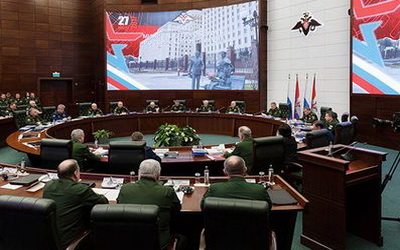 The Collegium of the RF Defense Ministry, March 27
In response to pressure from the USA, NATO and the EU, the Russian leadership keeps building up its military capabilities and demonstrating military force. According to the speech of Russian Defense Minister S. Shoigu at the Collegium of the Defense Ministry on March 27, 2017, the military power of the Military Districts of the Russian Federation’s Armed Forces has almost doubled within the last 3 years. In particular, within the specified period, 3.1 thousand modern weapons and special equipment were supplied to the Central Military District (MD) of the RF Armed Forces (the rear base for the Western MD and Southern MD) alone. Thus, seven groupings have been re-equipped. All in all, as of today, the level of equipping troops with modern weapons and military equipment is 58.3 %. By 2020, this figure is planned to increase to 70 %.
At the same time, the strength of the Russian Armed Forces is increasing. On 28 March 2017, Russian President V. Putin signed a decree on increasing the number of Russian Armed Forces to 1,903,051 servicemen. Due to this, it is planned to staff new command units, as well as units and groups of the Russian Army and Navy. Taking into account the personnel of the Russian Guard — up to 340,000 servicemen and of military formations of the FSB — about 250,000 servicemen, plus paramilitary structures of the Ministry of Emergency Situations and other departments, the general staff of the Russian law enforcement agencies (without the Ministry of Internal Affairs) is approaching 3 million people. For comparison — the strength of the Armed Forces of the USSR was about 4 million people. At this, the population of the Soviet Union at that time was almost 300 million, whereas the population of the Russian Federation today is about 150 million.
All this is accompanied by active measures for operational and combat training of the Russian Armed Forces, including the Strategic Missile Forces.
March 29, 2017, the regular command and staff exercises of the Strategic Missile Forces began with the combat patrolling the mobile missile systems “Topol-M” and “Yars”. Units of the 54th Missile Division (headquarters — in Teikovo, Ivanovo region) of the 27th Missile Army (headquarters — in Vladimir) are participating in the exercises. In total — more than 3 thousand military servicemen and more than 200 units of combat and special equipment.
Besides, last week there were tactical exercises of: the 2nd Guards Motorized Rifle Taman Division (Moscow region) of the 1st Guards Tank Army of the Western MD; a number of aviation formations of the 4th and 6th Armies of the Air Force and Air Defense (operationally subordinated to the Southern MD and Western MD); artillery units and special task units of the Southern MD (at the training fields in Rostov region and Ingushetia).
The exercises of the Russian occupation forces continued also in the Crimea. In particular, the air-cushion missile ship “Samum”, the small missile ship “Mirage” and the missile boat “R-239” conducted simultaneous missile firing at various ranges in the Black Sea.
At the same time, Russia is stepping up its policy of state terrorism against Ukraine and its Western partners. Thus, the logical continuation of Moscow’s actions to provoke tension in relations between Ukraine and Poland was the attack on the Consulate of the Republic of Poland in Lutsk on 29 March, 2017. An evidence of the high probability of Russia’s involvement in the incident is the attack occurred immediately after the Inter-Parliamentary Assembly of the Verkhovna Rada of Ukraine, the Seim of the Republic of Lithuania, the Seim and the Senate of the Republic of Poland on 27–28 March, 2017 in Warsaw. The participants of the Assembly condemned the Putin regime’s actions for the annexation of the Crimea and provocation of the conflict in the Donbas, and also appealed to the United States and the EU with a proposal to continue the sanctions against Russia until it has fully fulfilled the Minsk Agreements and has returned the Crimea to Ukraine.
III. Ukraine, International Organizations and Leading Western Countries
Supporting Ukraine, international organizations and Western countries are increasing pressure on Moscow, among other things, in the issues of human rights violations in Russia. Thus, the United States and EU countries condemned the actions of the leadership of the Russian Federation to disperse protest actions on 26 March 2017 and called on the Russian authorities to release all the detainees. At this, a number of German politicians made a proposal to boycott the FIFA World Cup in Russia in 2018. Such circumstances create additional grounds for both the continuation of the US and EU sanctions against Russia in June this year, and for using new means of pressure on the Russian Federation.
3.1. International Organizations
The European Union. According to the decision of the European Union, since March 28, 2017, a visa-free regime has been introduced between the EU and Georgia. This applies to all European countries except Britain and Ireland. The European Union’s decision on Georgia shows that there are positive prospects for completing the process of simplifying the visa regime between the EU and Ukraine.
NATO. The NATO’s leadership clarifies the main tasks and activities of the Alliance taking into account the changes in the world and Europe. These issues were considered by the NATO’s Foreign Ministers on 31 March, 2017, in Brussels. The participants of the meeting came to a common opinion that it is necessary to increase the Alliance’s efforts to counteract the threats from the Russian Federation. At this, US Secretary of State R. Tillerson confirmed Washington’s position on all-round support of NATO, and also spoke for continued pressure on Russia with a view to stop its armed aggression against Ukraine. He also spoke for the expansion of the Alliance’s participation in the struggle against terrorism and called on all members of the Alliance to fulfill their obligations to finance the defense sphere unconditionally.
|
|
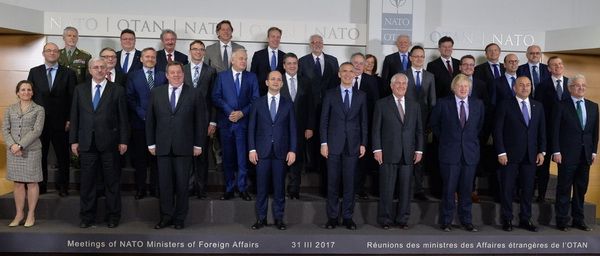 Meetings of NATO Ministers of Foreign Affairs, March 31
In the context of the Alliance’s summit, Russia-NATO Council ‘s meetings were held at the level of Ambassadors (March 30) and the Ukraine-NATO Commission at the level of Foreign Ministers (March 31).
At the meeting of the Russia-NATO Council, NATO’s officials called on the Russians to force the armed forces under their control in the Donbas to comply with the Minsk Agreements. Moscow’s actions to recognize the legitimacy of the documents of the “DPR” and “LPR” were also condemned. NATO’s Ambassadors reaffirmed the Alliance’s position regarding the illegality of Russia’s annexation of the Ukrainian Crimea.
During the meeting of the Ukraine-NATO Commission, the Foreign Ministers of the Alliance expressed their concern over the worsening situation in the Donbas and confirmed NATO’s intention not to stop providing assistance to Ukraine. US Secretary of State R. Tillerson openly acknowledged Russia’s armed aggression against Ukraine, and also expressed the intention of the United States of America to maintain sanctions against Russia until its fulfillment of the Minsk Agreements and returning the Crimea to Ukraine. NATO Secretary General J. Stoltenberg and R. Tillerson called on Ukraine to maintain its policy of reform and to strengthen its struggle against corruption.
Against this background, NATO’s military presence in the countries of Central and Eastern Europe and the Baltic States continues to grow. Last week, the last batch of armor of the NATO’s Multinational Battalion Battle Group arrived at the military base of Tapa in Estonia. The equipment belongs to the French unit and includes VBCI infantry fighting vehicles, VAB armored vehicles and Leclerc tanks.
The European People’s Party. At the Congress of the European People’s Party were adopted a resolution calling on the countries of the European Union to develop a long-term plan of assistance to Ukraine — the so-called “Marshall’s Plan for Ukraine”.
”The European Union and its member states should develop bilateral and multilateral programs, including immediate military, humanitarian and economic support, promotion of democratic reforms and support for Ukraine’s long-term foreign policy towards European and Euro-Atlantic integration”, — reads the resolution, which condemned the Russian aggression against Ukraine, that threatens stability on the continent. Also, the EPP recognized the existence of significant progress in the reforms in Ukraine since the Revolution of Dignity, despite Russia’s aggression.
3.2. Leading Western Countries
|
|
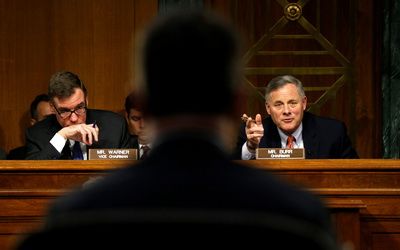 Open hearing in the US Senate Select Committee on Intelligence, March 30
The USA. The US Congress continues to investigate Russia’s interference with the presidential elections. March 30, 2017, the US Senate held an open hearing on this issue during which the Chairman of the US Senate Select Committee on Intelligence, R. Burr, and several other US Senators accused Russia of providing information support to D. Trump’s election campaign and purposeful discrediting H. Clinton. The facts of hacker attacks by Russian special services on American information (cybernetic) systems were cited. Based on these and other charges, to the House of Representatives of the US Congress on 28 March 2017 was proposed the draft law to introduce new sanctions against the Russian Federation (”Counteracting Russian Hostilities Act of 2017”). Note that on 27 March 2017, the draft resolution on “Condemning illegal Russian aggression in Ukraine on the three year anniversary of the annexation of Crimea” was introduced to the US Senate, co-authors of which are Senators from the Republican and Democratic parties.
France. With the approach of the presidential elections in France, the pressure of the French authorities on pro-Russian candidates, claiming to be the head of state, is increasing. March 28, 2017, the French law enforcement agencies opened a criminal case against the wife of the Republican Party’s leader F. Fillon — Penelope Fillon on her fictitious employment in the French Parliament. Earlier, a criminal case was started against F. Fillon himself — for embezzling several hundreds of thousands of Euros paid to his relatives for allegedly working in state bodies.
ІV. Other Important Trends and Developments that Will Have an Impact on Ukraine’s National Interests
Moldova. The political situation in Moldova keeps getting complicated, due to the growing contradictions between local pro-Russian and pro-Western forces. For example, last week, President of Moldova, I. Dodon, initiated a constitutional referendum on the following issues: expanding the powers of the head of state (including granting him the right to dissolve the parliament and appoint early elections); reduction of the number of deputies in the highest legislative body from 101 to 71; abolition of the law on transferring the EU’s credits (1 billion US dollars), which had been appropriated by the previous government, into the category of public debt; replacement of the school subject “History of Romanians” with “The History of Moldova”. The constitutional referendum is tentatively scheduled for September 24, 2017.
In turn, according to the statement of the Speaker of the Moldovan Parliament A. Kandu, the ruling pro-European coalition will raise the question of Moldova’s leaving the CIS if I. Dodon signs a memorandum on the country’s cooperation with the Eurasian Economic Union (tentatively scheduled for April 3–4, 2017).
Taking into consideration the approximate equality of the number of supporters of the European and Eurasian models of Moldova’s development, these contradictions can cause a political crisis and an active civil confrontation in the country.
V. Major Trends in the Development of the Situation around Ukraine in the Future
5.1. Key Events and Trends that Will Be Most Important for Ukraine
The spread of protest activity in Russia in the context of the West’s unchanged position towards it, creates a critical situation for the Russian leadership. Thus, on the one hand, the Kremlin’s further confrontation with Ukraine and the West will retain the grounds for the development of crisis processes in Russia, and on the other hand, giving up such a course would actually mean the Putin regime’s political death. This issue is especially acute due to the opposition’s plans to continue protest actions, including other political forces’ joining them. Thus, on the initiative of the “Open Russia” Party, on 29 April 2017, a new protest action is planned in Moscow under the slogan “We Are Sick and Tired of You!” Other opposition parties and movements are also invited to participate in the action.
|
|
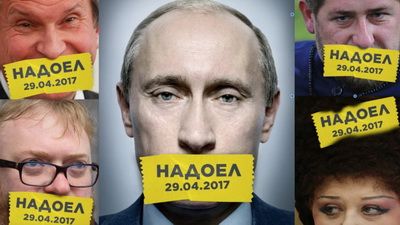 A new protest action “We Are Sick and Tired of You!”
Under such circumstances, the only opportunity for the leadership of the Russian Federation to retain its positions in Russia is to further strengthen the state power system in the country with tougher repressions against the opposition. This is precisely what explains the Kremlin’s power crackdown on protest actions on 26 March 2017, blocking the marches of truckers and farmers, mass detentions of their leaders and participants.
The intention to stick to this line of behavior was demonstrated by V. Putin in his speech on the occasion of the Day of the Russian Guard on 27 March, 2017. He demanded from the power structures of the country “…to react toughly to any attempts to destabilize public order in Russia”. In support of this demand, the Russian government decided to equip Rosgvardia with new special technical means to counteract protests.
By the way, in order to reduce the level of protests, the leadership of the Russian Federation will demonstrate its readiness to fight corruption, which is one of the main demands of the protesters. In particular, on 28 March 2017, head of the Russian government D. Medvedev signed an order to submit to the State Duma a draft law “On the Improvement of Legal Regulation in the Sphere of Counteracting the Legalization of Illegally Gained Income”.
At the same time, Russia will take all possible measures to achieve its goals in Ukraine as soon as possible. Moscow will mainly try to focus on destabilizing the internal situation in Ukraine and undermining its relations with partner countries. Most likely Russia will act both through certain political forces in the Ukrainian society, and by further intensifying the policy of state terrorism against our state. Thus, after the shelling of the Consulate of Poland in Lutsk, attacks on foreign citizens, including diplomats, from Poland, Lithuania, the USA, Germany, France, Canada and other partner countries of Ukraine, can’t be ruled out.
5.2. Prospects for the Development of Events in the Conflict Zones in Ukraine
Trying to put pressure on Ukraine, Russia will continue provoking an armed confrontation in the Donbas. At this, despite the regular arrangements for an armistice from April 1, 2017, V. Putin’s regime can go to a sharp aggravation of the conflict in order to create an excuse for recognizing the self-proclaimed republics (or, at least, for demonstrating a possibility of it), as it was in Georgia in 2008.
Besides, the goal of the Kremlin’s provocations in the East of Ukraine is to divert the attention of the Russian population from protest actions, and, despite all the problems, to demonstrate the firmness of Moscow’s course. These issues are especially relevant for the leadership of the Russian Federation in the situation of the highest-level protest activity in Russia exactly in the southern regions of the country — near the conflict zone in the Donbas.
In addition, in terms of the confrontation with NATO, Moscow will strengthen military activity in the Crimea and in the Black Sea region, as well as on the Central European and Baltic directions. Therefore, the “West-2017” SCPE will continue, accompanied by various maneuvers and exercises of operational-tactical level, including the missile-nuclear component of the Armed Forces of the Russian Federation.
5.3. Other Important Events that Will Influence Ukraine’s Interests and Security
In the near future, one of the key events that will significantly affect the situation in the EU and the European Union’s future policy towards Russia and Ukraine will be the results of the first round of the presidential elections in France in April 2017. In view of the dynamic development of pre-election processes in this country, it is difficult to predict the possibility of coming to power of specific political forces. At the same time, the most undesirable for Ukraine may be the election of the leader of the National Front movement, M. Le Pen, who is for lifting the EU sanctions against Russia. At the same time, the experience (including D. Trump’s becoming US President) shows that the candidates’ pre-election statements in no way guarantee their unconditional fulfillment.
At the same time, a visit to Ukraine by a delegation of the North Atlantic Council, scheduled for 2017, will be important for Ukraine in terms of its developing relations with NATO. The visit will be timed to coincide with the 20th anniversary of the signing of the Charter on a Distinctive Partnership between Ukraine and NATO and has to demonstrate the unchanged position of the Alliance for the support of our state.

