
LAST WEEK’S KEY FACTORS AND MAIN TRENDS
IN THE DEVELOPMENT OF THE SITUATION AROUND UKRAINE
(March 06–12, 2017)
I. Major-Profile Events in the Development of the Situation around Ukraine
March 6, 2017, the International Court of Justice in the Hague began hearing in the case brought by Ukraine v. Russian Federation over Russia’s violation of the Convention for the Suppression of Financing of Terrorism and the Convention on the Elimination of All Forms of Racial Discrimination. During the first round of hearings, held from 6 to 9 March 2017, Ukraine and Russia submitted their arguments on the raised question.
|
|
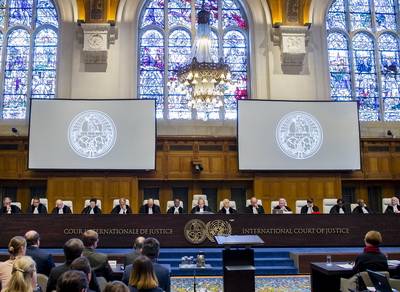 On March 6, International Court of Justice in the Hague starts hearings in the case Ukraine v. Russian Federation
The tactical aim of Ukraine’s claim is to prevent the Putin regime’s expansion of military aggression against our country and violations of human rights in the occupied Ukrainian territories. Such a deterrent must become the Court’s conditional measures towards Russia, in particular a ban on assistance to illegal armed formations in the Donbas and stopping the persecution of the Crimean Tatars.
At the strategic level, Ukraine’s appeal to the UN International Court should create preconditions for official recognizing Russia an aggressor and occupier. In the future this will allow to transfer sanctions against V. Putin’s regime from the category of actually proactive actions of the US, EU and their allies and partners into the category of the UN’s binding acts.
However, more specific should become also objectives of the international pressure on Russia, which will include implementation of possible decisions of the UN International Court of Justice on withdrawal of Russian troops from the territory of the Donbas and stopping all forms of support to the self-proclaimed republics on the territory of Ukraine, restoration of the Mejlis in the Crimea and compensation for Ukraine’s losses.
Besides, Ukraine will be able to appeal to the UN with demands to introduce international control over the execution of the decisions of the UN International Court of Justice and to bring UN peacekeepers to the Donbas without Russia’s participation.
Of course, the court procedures will take quite a lot of time, and the Court’s decisions will be ignored by Moscow. However, the very fact of the Court’s hearings the case of Ukraine’s suing Russia will yet again draw the world’s attention to the Ukrainian issue, and will be a powerful factor in undermining the international prestige of Putin’s regime.
In this context, Russia’s cynical and treacherous policy is being openly demonstrated by the speeches of the Russian representatives in the Court, who are trying to justify Moscow’s policy towards Ukraine and to prove the Kremlin’s “having nothing to do with” the events in the Donbas.
Such actions of the Putin regime have already caused protests of relatives of the killed passengers of the Malaysian airlines’ Boing-777, flight MH17, which was shot down by Russian SAM “Buk” in the airspace over the zone of conflict in the Donbas in July 2014.
II. The Situation in the Conflict Zones in Ukraine
Moscow’s cynical and cunning policy is also confirmed by Russia’s intensifying the armed conflict in the Donbas against the background of the beginning of hearings in the UN International Court of Justice of Ukraine’s claim against Putin’s regime. In this way the Kremlin once again demonstrates open contempt for any actions and decisions of the international community.
2.1. The East of Ukraine (the ATO Zone)
Last week the Russian-terrorist forces continued active shelling of the ATO forces’ positions and peaceful settlements almost along the entire front line, with peak intensity up to 100–120 per day. At this, according to the OSCE, the Russian side is making concerted efforts to destroy the infrastructure of life support of the civilian population in the area of the conflict zone, including in Avdiivka. One third of all attacks made last week by Russian-occupation troops in the Donbas, were conducted with the use of the forbidden by Minsk Agreements heavy weapons.
However, a quite expected consequence of the “DPR” and “LPR”’s leadership’s actions to “nationalize” Ukrainian enterprises in the occupied territories of the Donbas has become sharp worsening of the economic situation in the breakaway republics. Thus, most of the seized companies stopped work due to the loss of opportunities for selling their products. In turn, this puts Russia before the need to increase the financial support to the “DPR” and “LPR” to prevent their complete collapse. Addressing this issue requires additional money from the state budget, and this makes Russia’s financial problems even worse.
This situation begins to cause Moscow’s hysterical reaction. Thus, on March 9, 2017, Russian Foreign Minister S. Lavrov demanded from Ukraine to “immediately stop the blockade of the Donbas” and blamed “Ukrainian nationalist battalions” for it.
2.2. The Crimean Peninsula
In terms of the continued the USA and EU’s pressure on Russia over the Crimean issues, V. Putin’s regime is taking further steps to strengthen its positions in the Crimea. On March 6, 2017, the RF State Duma started considering a draft law that prohibits publication of any maps where the Crimea is not marked as a “part” of the Russian Federation. After the adoption of the law such publications will be regarded to as “anti-Russian propaganda”. “Guilty” for this will bear both administrative and criminal liability. According to human rights defenders, implementation of these requirements by Russian companies could lead to their falling under Western sanctions. So, the political ambitions of the Kremlin once again contradict Russia’s economic interests.
Meanwhile, the occupation authorities of the Crimea have banned celebration of the anniversary of the birth of Ukrainian poet Taras Shevchenko on March 9, 2017. Warnings were directed by the Ministry of Internal Affairs of the Russian Federation to Ukrainian activists in the Peninsula.
2.3. Other Aspects of the Russian Federation’s Actions Against Ukraine and the West
Since the UN International Court of Justice began hearings over Ukraine’s case against Russia, a separate direction of Moscow’s information policy has become supporting the Putin regime’s positions in the Hague. In this regard the main lines of the Kremlin’s efforts are justification of its being “not involved in the events of Ukraine” and “Ukraine has no convincing evidence for its claim”. At the same time Russians state that “Ukraine’s appeal to the Court is not prepared properly”, “Ukraine will inevitably lose”, “Russia’s position in the Court is stronger”. In support of the said they give the fact of the negative for Georgia decision of the UN International Court of Justice (in 2011) in respect of Tbilisi’s similar claim to Russia over Abkhazia and South Ossetia.
|
|
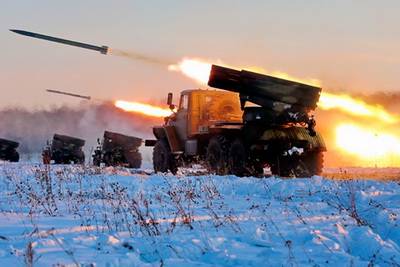 The Russian multiple-launch rocket system (MLRS) “Tornado-G”
Meanwhile, Russia continues active military activities near the Ukrainian border. In particular, last week were conducted regimental tactical trainings of the 752nd Motorized Infantry Regiment (Valuyki, Belgorod region), part of the 3rd Motorized Infantry Division of the 20th Combined Arms Army of the Western Military District of the RF Armed Forces.
At the same time, Russia continues measures to strengthen the combat potential of the grouping of the RF Armed Forces on the Ukrainian direction. In March this year, the 856th Self-Propelled Artillery Regiment (Pochep, Bryansk region) of the 144th Motorized Infantry Division (headquarters — Yelnia, Smolensk region) of the 20th Combined Arms Army received two Battalions of “Tornado-G” multiple launch rocket systems. The first firing of the new Battalions is scheduled for the end of this month as part of the field training. As you know, MLRS “Tornado-G” has 2.5–3 times higher combat effectiveness than BM-21 “Grad”.
The Russian Federations military activity is growing in the Black Sea region as well. In particular, from 10 March, 2017, aviation of the Russian Black Sea Fleet has expanded the area of its combat patrolling over the whole Black Sea zone.
III. Ukraine, International Organizations and Leading Western Countries
In contrast to Russia’s actions, leading international organizations and Western countries maintain firm positions to support Ukraine. At this, Moscow’s attempts to influence the USA and the EU’s policy over the Ukrainian issue in fact have led to the opposite effect — increasing their negative attitude to the Russian Federation.
3.1. International Organizations
The European Union. The EU pursues a consistent policy of pressure on Russia. Thus, representatives of the EU Member States have agreed to continue for 6 months sanctions against Russia, which were introduced over its annexation of the Crimea. The formal decision on the matter will be adopted at the meeting of EU Ambassadors on March 15, 2017.
At the same time, measures are being taken to strengthen the military component of the EU. On March 6, 2017, the Foreign Affairs Council of the European Union decided to establishment of a Military Planning and Conduct Capability (MPCC) for the planning and conduct of the EU non-executive military missions. According to the EU High Representative for Foreign and Security Policy F. Mogherini, the main task of this body is to empower the EU’s capability to establish monitoring missions in areas of crises and conflicts, and to assist in preparation of government forces recognized by the UN. However, F. Mogherini confirmed that there is no intention to create a separate European army.
NATO. Russia’s armed aggression against Ukraine remains in the focus of the Alliance’s attention. Developments in the Donbas and Crimea were the main themes of the meeting of the NATO-Ukraine Commission on March 8, 2017 in Brussels. During the consideration of these issues, NATO officials stressed another intensification of the armed confrontation in the conflict zone in the East of Ukraine, and stated Russia’s not implementing the Minsk Agreements. In particular, the meeting pointed out Moscow’s continuing political, military, military-technical and logistic support to illegal armed groups in the occupied territories of Donetsk and Luhansk regions. Taking into consideration these circumstances, Ukraine’s partners in NATO condemned Russia’s actions and reaffirmed their unrecognizing the legality of Russia’s annexation of the Ukrainian Crimea.
The process of building up NATO forces in Central and Eastern Europe and the Baltic States continues. By the end of March this year, it is planned to complete the deployment of the Battalion Battle Group of the Alliance in Estonia. The battle group led by Great Britain is comprised of nearly 1.2 thousand Allied soldiers with military equipment. In particular, it will consist of a British unit numbering 800 military, equipped with tanks Challenger 2 and Warrior infantry fighting vehicles, and a French military unit numbering 300 military, equipped with Leclerc tanks and armoured vehicles. The battle group will interact with the 1st Infantry Brigade of Estonia’s Land Forces and will be deployed in Tapa. Already in May 2017, the battle group will participate in the NATO’s Joint Forces’ training exercise “Spring Storm”.
|
Note: It is worth recalling that in 2016 a similar NATO exercise began in Estonia May 2, with the participation of 6 thousand military servicemen. The exercise under the name of “Spring Storm” lasted for three weeks — to May 19. In them participated the military from ten NATO countries, including the USA, Canada, UK, Germany, France, Poland, the Netherlands and the Baltic countries. |
3.2. Leading Western Countries
|
|
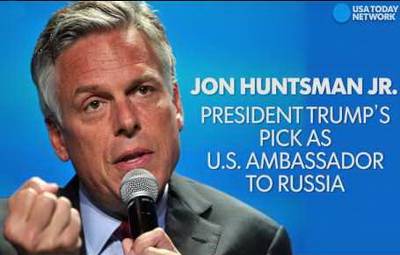 Presidential candidate for the post of US Ambassador to Russia Jon Huntsman
The USA. The US Congress continues steps to get evidence of Russia’s interference with the presidential elections in the United States. Thus, for 20 March 2017, in the Intelligence Committee of the House of Representatives is scheduled the first public hearing on the matter. As witnesses have been invited FBI Director J. Comey and National Security Agency’s Director, Admiral M. Rogers, as well as former heads of US intelligence and law enforcement agencies.
In turn, new appointments to the US administration confirm the trend for strengthening the positions of Russia’s opponents in the new US leadership. In particular, for the post of the US Ambassador to the Russian Federation has been proposed former Governor of Utah, the head of the Atlantic Council J. Huntsman, consistent critic of V. Putin’s regime.
The plans for appointing J. Huntsman US Ambassador to Russia have caused a negative reaction in political circles of Russia. According to the member of Russia’s Federation Council Committee on Defense and Security A. Pushkov, “…D. Trump mostly surrounds himself with people who are not willing to improve relations with Russia, and this complicates the search for common ground between the USA and Russia”.
Canada. Canada’s leadership confirms its role as a major partner of Ukraine. On March 6, 2017, the Government of Canada made a decision on the extension of the Canadian training mission in Ukraine UNIFIER for another two years — to the end of March 2019. The mission of 200 military personnel will continue its activities in Yavoriv training ground in Lviv region. The training includes mastering the skills in the explosive ordnance disposal, first aid, mission control and logistics.
At the same time, the Upper House of the Federal Parliament of Canada has supported the ratification of the free trade area (FTA) between Ukraine and Canada. According to experts, the implementation of the Agreement will allow Ukraine to get additional 600 million US dollars a year from exporting its goods to the Canadian market.
The United Kingdom. During the visit to Kyiv in early March 2017, UK Secretary of State for Foreign Affairs Boris Johnson confirmed London’s recognition of the fact of Russia’s interference with internal affairs of Ukraine, the EU and the Western Balkans. According to B. Johnson, Moscow’s giving up such actions is the only way to restore relations between Russia and the European Union.
France. With the approach of the presidential elections in France, the campaign of political pressure on the main pro-Russian presidential candidates is getting intensified in the country. Thus, March 7, 2017, The Local France published information about new facts of corruption of the Republican candidate F. Fillon. In particular, it regards to his alleged hiding 50 thousand Euros (taken as a loan) from the tax authorities.
|
|
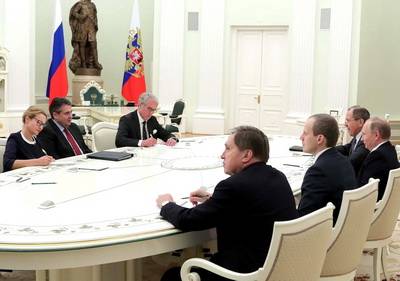 A meeting of Minister for Foreign Affairs of Germany S. Gabriel with V. Putin and S. Lavrov, March 9
Germany. Against this background, special attention should be paid to the meeting of Russian President V. Putin and RF Foreign Minister S. Lavrov with the new German Foreign Minister S. Gabriel on March 9, 2017. They discussed preparations for the visit to Moscow of the Federal German Chancellor A. Merkel. At that, Putin assured Germany’s Foreign Minister of Moscow’s wiliness to solve all the problems that have currently arisen between Russia and Germany.
Besides, the parties expressed Russia and Germany’s being interested in inviting the USA to the “Normandy” format of talks to resolve the situation in the Donbas. According to Russian representatives statements, this will enhance the credibility and effectiveness of the negotiation process. S. Gabriel said that Germany and Russia were seeking fruitful contacts with the new US administration. “We are interested in the USA’s not just being informed, but in its using its abilities to influence all, whom it can influence. We would like to support our American colleagues to use their role, their influence”, — said S. Gabriel.
Russian Foreign Minister S. Lavrov supported the idea of the USA’s participation in the negotiations to resolve the conflict in the Donbas. However, in this regard the leadership of the Russian Federation is caring about its own political goals, which include launching direct dialogue with the USA over the Ukrainian issue, and getting more opportunities to influence the USA to support Russia’s position on Ukraine.
Given these circumstances, the United States and Germany are deepening coordination of their actions regarding Russia and Ukraine. Consideration of these issues is planned at the meeting of US President D. Trump and German Federal Chancellor A. Merkel on 14 March 2017, in Washington (prior to A. Merkel’s visit to Moscow).
IV. Other Important Trends and Developments that Will Have an Impact on Ukraine’s National Interests
Russia. According to experts of the Center for Macroeconomic Analysis and Short-Term Forecasting and the Institute of Strategic Analysis, each year of Western sanctions costs the Russian Federation a loss of about 900 billion rubles. All in all, since the introduction of sanctions in 2014 it has lost 2.5 trillion rubles.
However, real, strategically important effects of USA and EU’s sanctions against Russia were considered forcing the Russian government to use (spend) reserve funds to support the Russian economy, as well as cuts from the state budget for development of the country, military needs and social sphere. It is these cuts and costs that were explained the slowdown in the fall of GDP from 3.7 % in 2015 to 0.6 % — in 2016.
At this, the Russian government’s ability to support the Russian economy depends on the volume of the reserve funds, which are largely exhausted. In turn, the reduction of public spending undermines the Kremlin’s ability to implement its geopolitical plans, and leads to increased tension in the country. Based on the above-mentioned, the Russian leadership’s statements about “the adaptation of the Russian economy to Western sanctions” are criticized as Moscow’s bluff.
Experts of these organizations point out that “…the statement of the Russian government and population surveys give the impression of two different economies: one — with increased production and accelerated growth in wages; the other — with falling consumption and continued stagnation of major industries”.
Romania. Despite the cancellation by the Romanian government and Parliament of decisions on easing the anti-corruption legislation, last week at the country began a new series of mass rallies and demonstrations. Members of the protests demand de-politicization of the Constitutional Court and intensifying the fight against corruption. In addition, the demands to dismiss the government continue. Actually, all this shows the continuing political struggle between the National Liberal Party led by President K. Iohannis and the Social Democratic Party, which controls the Romanian government.
V. Major Trends in the Development of the Situation around Ukraine in the Future
5.1. Key Events and Trends that Will Be Most Important for Ukraine
|
|
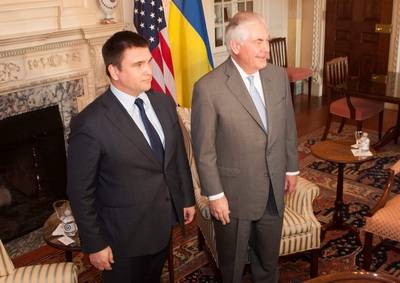 Minister of Foreign Affairs of Ukraine Pavlo Klimkin held a meeting with the US Secretary of State Rex Tillerson on March 7
The most important for Ukraine is the USA’s position regarding our country in the context of Washington’s foreign policy interests. This issue was clearly and finally determined during the meeting of Minister of Foreign Affairs of Ukraine Mr. Klimkin and US Secretary of State Mr. Tillerson on March 7, 2017. According to the head of the Foreign Ministry of the United States, Washington will never “exchange” Ukraine, which is of fundamental importance for the United States. Besides, R. Tillerson expressed the USA’s intention to extend sanctions against Russia until it has implemented the Minsk Agreements and returns the Crimea to Ukraine.
In turn, on March 8, under the Department of Defense Appropriations Act for 2017, the US House of Representatives decided to allocate 150 million US dollars to Ukraine to purchase lethal weapons of a defensive nature and affirmed the ban on Pentagon’s cooperation with the Russian company “Rosoboronexport”. In addition, the US House of Representatives is considering the bill on Stability and Democracy for Ukraine Act (“STAND for Ukraine Act”). The document prohibits the USA to recognize the legality of Russia’s annexation of the Crimea, establishes the legislative status of the sanctions imposed by the US President against Russia over its destabilizing the situation in Ukraine and annexation of the Crimea, and also gives the President the right to impose new sanctions against Russia.
This completely eliminates speculations about the possibility of compromises between the USA and Russia over Ukraine in exchange for expansion of cooperation between the parties in the fight against international terrorism and other issues. In view of this, the USA will continue to provide assistance to Ukraine in political, economic and military spheres, including the transfer of lethal weapons of a defensive nature — if necessary. However, the USA will continue political and economic pressure on Russia. Expectedly similar will be the positions of other Western countries.
In general, the above-mentioned circumstances increase the likelihood of the USA and EU’s continuing sanctions against Russia in June–July of the current year. This will be another blow to the Russian economy, which remains in a state of deep depression, despite Moscow’s statements about “adaptation to Western sanctions”. Besides, this raises the chances of Ukraine’s winning the lawsuit in the UN International Court of Justice in the Hague. Thus, Russia will face the full range of negative consequences for its military aggression against Ukraine.
According to Forbes, Trump has got out of Putin’s control and turned from his man “into a nightmare”. …the relations between the two countries are back in the era of the Cold War, “but under less favorable conditions for the Russian side”, and this time Russia has no chance to equal confrontation with the United States.
5.2. Prospects for the Development of Events in the Conflict Zones in Ukraine
The USA and EU’s refusal to compromise with Russia over the Ukrainian issue actually deprives Moscow of a chance to implement its interests regarding Ukraine by political and diplomatic methods. In this situation, we should expect the Putin regime’s continuing actions to maintain tension in the conflict zone in the Donbas, which will be coordinated with the Kremlin’s attempts to provoke a political crisis in Ukraine. Thus, another outbreak of hostilities in the Donbas is possible in April 2017 against the background of the completion of the “parliamentary immunity” of the Ukrainian government, which would allow Russia to increase pressure on it through some political forces in Ukraine.
However, according to German Bild, citing sources in the NATO, the experts of the Alliance point out a threat of full-scale military attack on Ukraine. Evidence of this is called the building up of the strike grouping of Russian troops on the border with Ukraine, its being re-arming with new kinds of weapons and military equipment, and conducting active operational and combat training of offensive nature.
5.3. Other Important Events that Will Have an Impact on Ukraine’s Interests and Security
The United Kingdom. Brexit can start as early as this Monday. According to British sources, the document on the launch of the procedure of Great Britain’s leaving the European Union will be voted in the House of Commons and House of Lords on 13 March, 2017.
Then the bill has to be ratified by the Queen Elizabeth II, and March 14, 2017 the government of Prime Minister Theresa May will start the procedure of Brexit. If this happens, the 27 countries that stay in the European Union will gather for an emergency summit already on 6 April, 2017.
The Netherlands. Scheduled for March 15, 2017, parliamentary elections in the Netherlands keep risks for both Ukraine and the European Union.
February 23, 2017, the Lower House of the Parliament — the House of Representatives — supported the bill on the ratification of the EU-Ukraine Association. Now it’s the Upper House of the Parliament — the Senate’s turn, where a vote will be held only after the elections (March 15) to the House of Representatives.
|
|
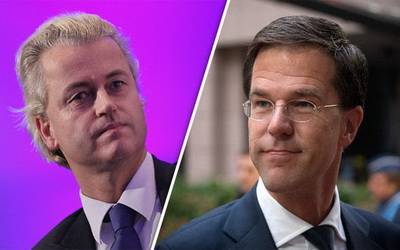 Geert Wilders against Mark Rutte in the Dutch general election
Dutch experts do not rule out that a vote in the Senate on this Agreement (tentatively in April 2017), despite there enough votes for adoption of a positive for Ukraine decision, can be not in favor of Ukraine.
Regarding the risks to Europe, the greatest support of Dutch voters have Euro-Skeptics of the radical rightwing populist “Freedom Party” led by Geert Wilders, on the victory of whom the Kremlin counts. It is this political force that in the last (2016) year actively promoted the referendum, which blocked the ratification of the European Union-Ukraine Association Agreement. Today the “Freedom Party” is aimed against Mark Rutte’s government and promotes the idea of the Netherlands’ possible exit from the EU — Nexit.
If the economy played the main role in the elections that will be held on March 15, the center-right party of Prime Minister M. Rutte would win a landslide victory. But today in the Netherlands, as in general in Europe the first positions are being captured by populist, Euro-Skeptic and anti-Islamic political forces which last minute may influence the Senate’s decision on ratification of the EU-Ukraine Association Agreement.
Besides, as previously reported, during the elections in the Netherlands on March 15, the votes will be counted by hand — to prevent hackers’ interference. The Netherlands’ Minister of the Interior R. Plasterk does not rule out the influence of external forces on public opinion in the country, as well as their interference with the policymaking process.
In general, lately the EU has significantly intensified efforts to protect itself from Russian interference with the elections. Thus, before the elections in the Netherlands, France and Germany a special European group — East StratCom, which is engaged in debunking myths of Russian propaganda, and studies the mechanisms of influence on the election results by means of disinformation, etc., has received additional funding.
France. According to French Foreign Minister Jean-Marc Herault, in the coming days in Paris, the heads of Foreign Ministries of Ukraine, France, Germany and Russia will hold another meeting within the framework of the “Normandy” format.
The latest fruitless meeting of Foreign Ministers of the countries-participants of the “Normandy Four” was February 18, 2017, in Munich (Germany).

