
LAST WEEK’S KEY FACTORS AND MAIN TRENDS IN THE DEVELOPMENT OF THE SITUATION AROUND UKRAINE
(August 22-28, 2016)
I. The Highest-Profile Events in the Development of the Situation around Ukraine
Last week’s main event in Ukraine was the 25th anniversary of our State’s independence. This jubilee was really crucial for the whole Ukrainian nation. Ukraine has become a state and could defend its independence and sovereignty from Muscovy’s attacks. Despite the heavy losses, Ukraine has withstood in the armed confrontation with Russia, and this, on the one hand, united us as a people, and on the other — deterred Russia’s neo-imperial ambitions.
The role and importance of Ukraine as a key factor in ensuring security and stability of Europe, and in fact — as “the shield of the European Union” against Russia’s armed aggression — was recognized in greetings from all civilized countries of the world addressed to our State on the occasion of the main celebration in its history. As part of Ukraine expressed support congratulations United States, Germany, France, Great Britain, Poland, Lithuania, Latvia, Estonia, Georgia, Moldova, as well as other allies and partners of our State. In this regard, a special place was occupied by China and Turkey, which are also in their congratulations spoke for the preservation of Ukraine’s independence, sovereignty and territorial integrity within the internationally recognized borders, despite all Moscow’s attempts to “pull” Beijing and Ankara to its side.
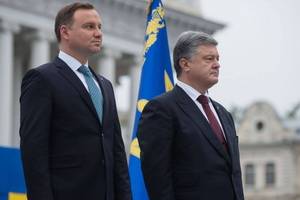 Of special importance for Ukraine was President of Poland Andrzej Duda’s visit to our Country (He was the only president of foreign countries, who took part in the celebration of Ukraine’s Independence Day; President of the Republic of Lithuania Dalia Grybauskaitė could not take part in the celebrations because US Vice-President Joseph Biden was visiting Lithuania at that time). By his visit to Ukraine, A. Duda showed preservation of Poland’s positions as the main ally of Ukraine and conductor of its interests in the EU and NATO, despite all the efforts of pro-Russian and nationalist forces to split the Ukrainian-Polish relations on the basis of some aspects of the history of the Second World War.
In contrast, all the Kremlin’s attempts to discredit Ukraine in front of the western world looked like an agony of V. Putin’s regime. Thus, instead of congratulations to Ukraine, the Russian Foreign Ministry issued an official article in the Russian media, which condemned “the growth of nationalism in the world”, mentioning our State as the main example. By this Moscow yet again confirmed the unacceptability for Russia of Ukraine’s independence, which is a major challenge to the Kremlin’s geopolitical plans.
II. Russia’s Armed Aggression against Ukraine
2.1. The East of Ukraine (The ATO zone)
On the day of 25th anniversary of Ukraine’s Independence, the Russian-terrorist forces in the East of our State exceeded all their “records” in the intensity of shelling the positions of the ATO forces and civilian settlements. The shelling was the most active since the times of the enemy’s storming the Donetsk airport and Debaltsevo in early 2015.
The greatest cynicism and meanness of the Russian-terrorist forces have become firing from heavy artillery of the Ukrainian Armed Forces’ depots of military equipment, which was withdrawn from the front line in accordance with the Minsk Agreements. In fact, in such a way the enemy is deliberately destroying the military equipment of the Armed Forces of Ukraine in the operational and tactical depth, depriving the Ukrainian side of a possibility to quickly build up its own fire power in case of critical danger.
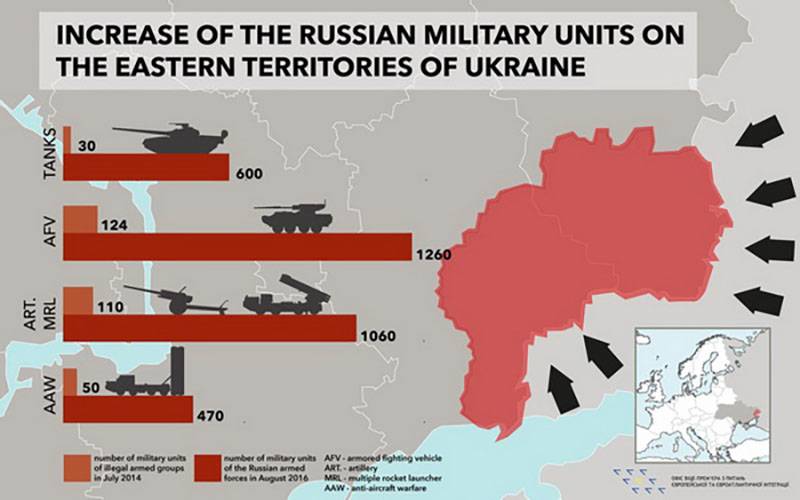 At the same time, under the guise of such actions, the Russian side has several times increased the number of heavy equipment and weapons as part of its troops in the East of Ukraine, compared with “the hottest period of the large-scale invasion of the Russian Armed Forces on the territory of Donetsk and Luhansk regions,” — August 24, 2014.
Due to this Russia’s position, the regular meeting of the Trilateral Contact Group in Minsk on August 26, 2016 ended actually without a result. In fact, it was stated only about the “need for a complete and permanent ceasefire at the Donbas from September 1, 2016” (“Day of Knowledge” and the beginning of the new school year). What these statements end in has been known since 2014 and 2015.
2.2. The Crimean Peninsula
A separate “gift” was made by Russia to Ukraine’s Independence Day in the Crimea. Thus, in response to Ukraine’s lawsuit in the International Court on the sovereign waters around the Peninsula, the occupying authorities of the Crimea expressed their intention to submit their own counter-claim — “…for the damage caused to the republic as a result of two decades of plunder by the Ukrainian authorities”. At this, they completely silence the subsidized nature of the Crimea, which had actually been funded from Ukraine’s state budget, as well as the worsening of the economic situation in the Peninsula after Russia’s occupation and annexation of it.
2.3. Other Aspects of the Russia’s Actions against Ukraine and the West
Russia’s provocations against Ukraine and its Western partners and allies were not limited to Moscow’s political declarations and another intensification of hostilities in the conflict zone in the Donbas. The Kremlin’s true reaction to the 25th anniversary of Independence of Ukraine has become a large-scale demonstration of military force within the framework of the “unannounced inspection” of units and forces of the Western, Southern and Central Military District of Russian Federation, as well as of the Northern Fleet, Air and Space Forces (VKS) and Airborne Troops of the RF Armed Forces.
According to the Ministry of Defense of Russia, the inspection is being carried out in preparation for the Strategic Command Post Exercise (SCPE) “Caucasus-2016”, the active phase of which is scheduled for September 5–10, 2016. However, Moscow’s goals and intentions to provoke tension around Ukraine are quite obvious. The “unannounced inspection” was paying special attention exactly to the South-Western strategic direction, first of all — to the Black Sea region.
Thus, the Black Sea Fleet composed a ship strike group of more than 15 warships, including a new frigate “Admiral Grigorovich”, missile ships “Samum” and “Mirazh”, patrol ship “Smetlivyi”, small antisubmarine ships “Aleksandrovets” and “Kisimov”, large amphibious ships “Nikolai PFilchenkov”, “Azov”, “Yamal”, “Tsezar Kunrikov”, and “Saratov”, as well as missile boats and mine-sweeping ships. At the same time, Russia was “not shy” to get involved in the exercises the ships and boats, which were captured in Ukraine during the occupation of the Crimea in 2014.
At the same time there were trainings of the Coastal Defense Troops and Marines of the Black Sea Fleet of the Russian Federation with the participation of 4 thousand military servicemen and more than 300 pieces of military equipment. They were mastering the tasks of “rejecting an attack on the Crimea”, as well as amphibious landings, which once again confirms Russia’s aggressive intentions against Ukraine.
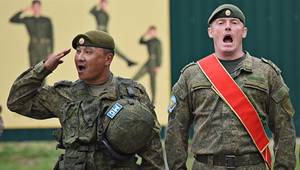 Apart from these, there continued Russia’s other military events near the Ukrainian border. In particular, August 23-27, 2016, in Belarus were held multinational exercises within the CSTO — “Enduring Brotherhood-2016” with the participation of the armed forces of Russia, Belarus, Armenia, Kazakhstan, Kyrgyzstan and Tajikistan. The official theme of the exercises is “Separation of warring parties in the conflict zone, disarmament of illegal armed groups, as well as establishment of demilitarized zones and corridors for the safe movement of refugees and humanitarian supplies”.
At the same time, the scope of the exercises and the types of weapons and military equipment that were involved in them, allow to draw a conclusion about the possibility of Russia’s practicing a broader range of tasks, including an open intervention in the situation in the East of Ukraine under the guise of “peacekeeping “or” stabilization “operations. In particular, during the exercise, were used BTR-82, the latest means of fire destruction, attack helicopters and Mi-24 transport and assault Mi-8AMTSh “Terminator” and intelligence, control and communication systems “Strelets”. Besides, they tested modern sets of equipment of the military servicemen on the battlefield, “Ratnik”.
Against this background, Russia, in its usual manner, is trying to avoid international problems associated with its use of the Iranian air base Hamadan, by fooling the international community on this issue. For example, it states that all Russian military aircrafts from Iran are returning to Russia.
However, referring to the space reconnaissance data, the USA refute such Russia’s statements. But, despite this, the USA continues to cooperate with Russia in solving the Syrian problem. In particular, as a result of the meeting of US Secretary of State J. Kerry and Russian Foreign Minister S. Lavrov in Geneva, agreements were reached on taking agreed measures for gradual resumption of the truce and ceasefire in Syria.
III. Ukraine, International Organizations and Leading Western Countries
3.1. International Organizations
The European Union. Against the background of the EU’s stable position on supporting Ukraine, the European Union’s significant problem in Europe remains a “migration crisis” in Europe. This problem undermines the unity of the European Union, increases the tension in the member countries of the Organization, and makes them spend significant funds for the resettlement of refugees.
In particular, the European Commission has started reconsidering the introduction of financial sanctions against countries that refuse to accept migrants. According to representatives of the leadership of the European Commission, the existing mechanism should be complemented with the mechanism of distribution of refugees and to make adjustments for situations where the individual EU Member States occupy selfish positions in relation to the European Union’s other Member States.
These processes weaken the EU’s ability to support Ukraine and are used by Russia to weaken the European Union and to influence it. They are one of the goals of Moscow’s intensifying air strikes on Syrian territory, which causes an increase in flows of refugees to Europe.
3.2. Leading Western Countries
 The USA — the Countries of the North-Eastern Europe. Intensification of Russia’s military activity on the Western direction worries the USA and European countries, especially the North-Eastern Europe.
August 25, 2016, the increasing concern about Moscow’s military activity was expressed by the leadership of the US Defense Department. At this, the Pentagon associated this activity with the exacerbation of the armed confrontation in the conflict zone in the Donbas, as well as with the strengthening of Russian troops in the occupied territories of Ukraine by sending them additional heavy weapons.
The situation around the “unannounced inspections” of the RF Armed Forces was discussed during an emergency meeting at the Ministry of Defence of Poland with the participation of the Chiefs of the Military Intelligence Service and the Military Counterintelligence Service. In order to respond adequately to Russia’s actions, it was decided to bring the Polish Armed Forces to the increased level of combat readiness.
Concerns about Russia’s aggressive policy is demonstrated by the countries of Northern Europe bordering on the Russian Federation. Thus, the negotiations between Finland and the United States ended in signing an agreement on deepening cooperation between the two countries in the military sphere. In its turn, Norway (after the Baltic states and Poland) has started constructing a system of engineering barriers on the border with the Russian Federation.
The USA. As part of the development of the electoral process in the United States, a positive trend in favor of Ukraine is further advance of the rating of the candidate from the Democratic Party of the United States H. Clinton over the Republican candidate D. Trump. Today, the gap between the two contenders is already more than 10 % (a month ago it was 5-8 %). The above-mentioned fact actually shows the failure of Russia’s “stake” on D. Trump as “apologist” of Russian interests in the United States. H. Clinton being elected a new US President will ensure the continuity of US policy towards Russia and Ukraine. Despite Moscow’s expectations, the United States will remain the main unifying factor in the strategic deterring Russia and putting pressure on it.
IV. Other Important Trends and Events Relating to Ukraine’s National Interests
The difficult economic situation in Russia is exacerbating social problems in the country, which leads to increased protest moods in the Russian society. In particular, the evidence of this was the attempt of another “march on Moscow”, now of the farmers from Krasnodar Territory of the Russian Federation, protesting against the raids of their property. The protest was supported by the movement of “truckers” of Russia, who continue demanding to cancel the raising of taxes on the use of roads by heavy vehicles in the Russian Federation.
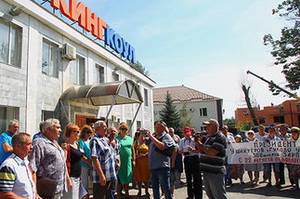 Besides, in the Russian Donbas mine workers of “KingCoall” company have started a hunger strike demanding payment of salaries for more than a year and a half. The hunger strike is accompanied by rallies and pickets in Russian cities of Gukovo, Zverevo and Krasny Sulin — in close proximity to the conflict zone in the East of Ukraine. Together with the sources of tension in the “DPR” and “LPR”, the above-mentioned can lead to the spread of instability in south-western regions of Russia, as well as to create a real threat of the explosive situation in the region.
Taking into consideration the critical level of such threats to Putin’s regime, protests in Russia are being harshly suppressed by the Russian authorities. For example, “the march on Moscow” of farmers of Krasnodar and attempts of Russian “truckers” to join it, as well as protests of miners in the Russian Donbas were blocked by force, including with using the RF’s Special Task forces.
V. Main Trends in the Development of the Situation around Ukraine in the Future
5.1. Key Events and Trends that Will Be Most Important for Ukraine
As expected, in the nearest future one of the key factors influencing the development of the situation around Ukraine may become the summit of “Big Twenty” (G20) in China (September 4-5, 2016) as well as political events, which will take place on the sidelines of the summit. After the exclusion of Russia from the G8 in 2014, Moscow is trying to actively use the G20 format to strengthen the Russian Federation’s international positions and to implement its interests regarding Ukraine.
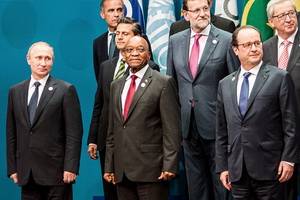 Thus, August 23, 2016 Russian President V. Putin offered the Federal Chancellor of Germany A. Merkel and French President F. Hollande to hold on the sidelines of G20 summit a separate meeting to discuss the “Ukrainian issue” without the participation of the Ukrainian side. At this, V. Putin made another attempt to discredit our State, again using as an odd justification of his own provocations in the Crimea, accusing Ukraine of “state terrorism”. Thus, Russia has once again confirmed its giving up the existing “Normandy Format” of negotiations and proceeded to attempts to reach an agreement with the Federal Republic of Germany and France on resolving the situation around Ukraine without the latter’s participation, in fact artificially putting Ukraine beyond the negotiations in the “Normandy Four” format.
A. Merkel and F. Hollande gave preliminary consent to a meeting with V. Putin, however, they reminded him of the illegality of Russia’s annexation of the Crimea that will never be recognized by the world. Besides, emphasis was placed on the need for Moscow’s full implementation of the Minsk Agreements.
In order to ensure Europe’s single position on the eve of the G20 and to prevent possible Russia’s actions to enhance the fighting against Ukraine this autumn, Germany (as Presidency of the OSCE) has initiated considering the “Ukrainian qissue” at a special extraordinary meeting of representatives of the Organization’s member states on September 1, 2016, in the German Potsdam.
5.2. Prospects for the Development of Events in the Conflict Zones of Ukraine
It is possible that in order to demonstrate its “peaceful” plans, Russia and its puppets in the Donbas can reduce the intensity of the fighting in the East of Ukraine on the “Day of Knowledge” and at the beginning of the new school year from September 1, 2016. At the same time, the armed confrontation in the region will inevitably be activated by Russia after a possible lull.
 Although, taking into consideration the Putin regime’s anti-human nature, Russia’s bloody provocations, including mass killing of children in the war zone in the Donbas are possible in this period. Russia does have an experience of such actions. Schools of Tiraspol and Dubasary in Moldova were shelled during school leaving celebrations by units of the 14th Army of the RF Armed Forces at the end of May 1992.
That is exactly what provoked the armed conflict in 1992 in the Trans-Dniester region of Moldova. Now the remains of the former 14th Army are performing “peacekeeping functions” in the zone of the created by Moscow conflict in Moldova, “frozen” as of today.
Independent experts believe that Russia and its puppets are trying to “freeze” the conflict in the Donbastoo, with preserving in the territory of individual districts of Donetsk and Luhansk regions (ORDLO) of the Russian military presence in the status of “peacekeepers”.
5.3. Other Important Events that Will Influence Ukraine’s Interests and Security
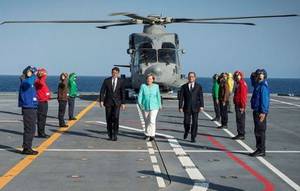 September 16, 2016, Slovakia (Bratislava) is scheduled to host the European Union’s next summit. The main theme of the event was determined on the 23d of August, 2016, during a meeting of the Federal Chancellor of Germany A. Merkel, French President F. Hollande and Italian Prime Minister M. Renzi on the aircraft carrier “Giuseppe Garibaldi” near the Italian island of Ventotene. In particular, the intention was announced to discuss counteraction to growing threats to collective security in Europe in the context of the worsening “migration crisis” in Europe.
This is not good for Ukraine — as a factor of distraction of Europe’s attention from the situation around our Country. Thus, a number of EU countries, especially in southern Europe, consider the “migration crisis” a much greater threat for the European Union than the Russian Federation’s aggressive policy in the East of Ukraine and towards the EU. At this, they “shyly forget” or “do not want to see” that the “migration crisis” in a united Europe, was caused by Putin’s Russia’s “hybrid policy” against it in Syria, Iraq, Yemen, and in general in the Middle East, as well as in the region of North Africa.
At the same time, a positive aspect for our Country is Slovakia’s proposal to conduct a meeting of the EU’s “Eastern Partnership” program’s member states in the sidelines of the Organization’s summit in Bratislava. So, Ukraine, as one of the most active participants in the EU’s “Eastern Partnership” program, will have a real opportunity to position both its achievements and challenges, as well as proposals and initiatives regarding the prospects of cooperation within the framework of this program.

