
Bohdan Sokolovskyi
July 7 and 8, 2015, in Kyiv, on the initiative of the Agency for Modernization of Ukraine, there was a meeting of the “round table” with participation of and chaired by the former European Commissioner for Energy G. Verheugen and former Austrian Foreign Minister M. Spindelegger. Its five functioning panels were as follows: political aspects of the Association Agreement; economic aspects of the Association Agreement; energy; transport; telecommunications. Obviously, those are the main aspects by which the EU will assess Ukraine’s achievements on the way of European integration.
Perhaps the most successful is our progress to the European Union in the energy sector. Be it as it may, but Ukraine, apart from the Association Agreement with the EU, is a full member of the Energy Community, which facilitates the introduction of the EU’s legislation into the energy sector. And no matter how difficult it sometimes was, we should point out that our state has been consistently moving forward. Maybe sometimes not so fast, as we would like it to, but still there are unconditional achievements. In a word, on the energy panel we did have something to show and tell Europeans and Ukrainians — participants about the achievements in terms of European integration.
Of course, there should have been presentations from the executive branch (the Ministry of Energy and Mines) and the Ukrainian Parliament. But, unfortunately, this did not happen: all the speeches were by the “former” and experts, representatives of business and the “European” G. Verheugen. And not a single one — from the Ukrainian executive power and the Parliament… Of course, the speeches could not do without ideological colouring. But it should be noted that the current “opposition” was first of all civic-minded. Obviously, they preferred to keep quiet about their recent sad role in the government.
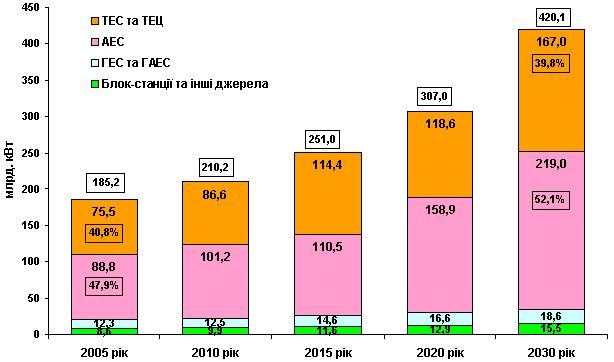
The main indicators of development of electric power in Ukraine until 2030
But most surprising was the absence of an actual strategy for the development of the Ukrainian energy sector. In fact, it is unknown what and why Ukraine (and consequently, its citizens) is planning to do in a certain period of time — in a year, in a month, in a week, or tomorrow, and so on.
You should have seen the genuinely surprised faces of “Europeans” about it! “Where are you trying to go if there is no energy plan” — one of them said frankly, going for a break.
I’d like to hope that the energy panel was the only such a failure for Ukraine. And I do want to believe that the rest of the panels were adequately represented by the current executive power of Ukraine and the Ukrainian Parliament.
The main conclusions from the above-mentioned “round table” are as follows:
– in no way the current Ukrainian power should ignore these events because participation in them of the experienced “former” European officials may be used in the EU, mildly speaking, to find out what, apart from declarations, Ukraine does in terms of its European integration;
– it is necessary to immediately, with the participation of qualified specialists, experts and politicians-statesmen, to develop and adopt (preferably by the Verkhovna Rada of Ukraine) a Development Strategy of the Energy Sector of Ukraine in the context of its development as a state that is going to integrate into the EU.
Well, these and other similar events are perceived by Europeans, unfortunately, rather, as a proof of declarativity of intentions against the background of a lack of actions.

