
 Fuel shortages have already led to a number of extremely negative consequences for Russia
Ivan Sichen
One of the consequences of the Putin regime’s war against Ukraine is a decrease in exports of Russian oil and petroleum products due to the complete or partial abandonment of them by EU countries. Moreover, Moscow has not been able to fully compensate for the loss of its supplies to the European energy market by reorienting them to the East.
It would seem that this should have led to an excess of liquid fuel in the domestic market of Russia and a drop in prices for it. However, as is always the case with Russia, the situation has become completely opposite. Thus, since the end of the summer of 2023, there has been an acute shortage of diesel fuel in the Russian Federation, and its prices have risen sharply. This has already created a number of serious problems for Russia, the main of which are the increase in the cost of goods and services, as well as the emergence of additional difficulties in the work of transport companies and farmers. And most importantly, it has caused a shortage of fuel for the Russian army.
|
…Russian experts forget the main factor that creates fuel shortages — the redistribution of fuel from civilian to military purposes… |
The problem of the shortage of diesel fuel in Russian Federation causes a significant resonance in Russian society, as it affects the majority of its population and, in general, the country’s economy. At this, a quite reasonable question arises: why did this problem appear in the Russian Federation, which is a “major energy power”? Currently, there is a fairly wide range of experts’ assessments on the said topic. In particular, the reasons for this trend are explained by:
- depreciation of the ruble. Despite the Kremlin’s statements about refusing to pay in US dollars, domestic fuel prices in Russia are still tied to it;
- an increase in demand for fuel during field works and the end of vacations, when people return home en masse;
- lack of transport for the transportation of petroleum products from suppliers to consumers, which does not allow to quickly meet the growth in demand for diesel fuel;
- a decrease in fuel production by oil companies due to the government’s refusal to pay financial compensation for maintaining stable and relatively low prices in the Russian energy market.
All this really affects the supply of Russian consumers with diesel fuel. At the same time, Russian experts, as a rule, forget or do not want to name another factor that creates fuel shortages — the redistribution of fuel from civilian to military purposes.
As you know, Russia’s war against Ukraine has been going on for more than a year and a half with the participation of thousands of pieces of military equipment. Most of it runs on diesel fuel, including armored and special vehicles, self-propelled artillery, MLRS and air defense systems, tractors and heavy trucks, etc. All of them need diesel fuel, and need it every day.
One tank consumes up to 500 liters of fuel per 100 km, an armored personnel carrier — 40–60 liters, an infantry fighting vehicle — up to 100 liters, a heavy vehicle and a tractor — 30–40 liters. Currently, in Ukraine, there are about 2 thousand tanks, up to 8 thousand armored personnel carriers and infantry fighting vehicles, as well as at least up to 20 thousand heavy vehicles and tractors of the Russian invaders.
Before the start of the war, no one in the leadership of the Russian Federation expected that it would have such a scale and last that long, and therefore they did not make appropriate stocks, of fuel included. In fact, Russians created only operative stocks, designed for a relatively short time. Currently, they are almost exhausted, as a result of which fuel is being withdrawn from the civilian sector.
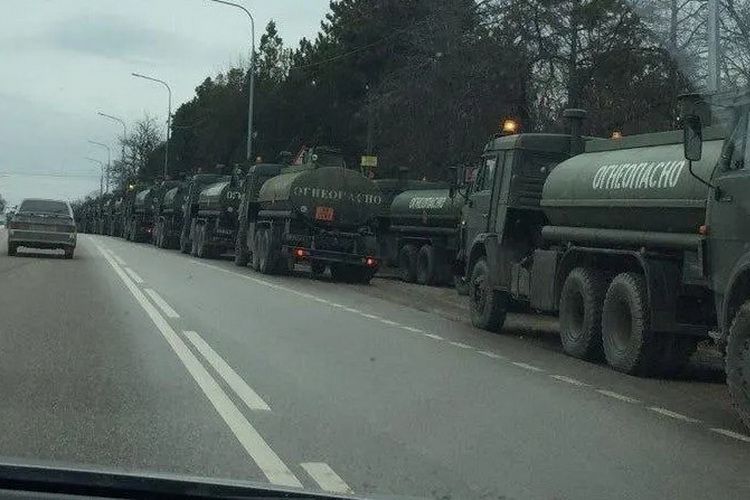 The Russian army doesn’t have enough trucks to defeat Ukraine.
Source: Forbes
And there are no strategic reserves at all. The USSR had enough of them in case of war with the United States and NATO. However, after the collapse of the Soviet Union, such stocks were liquidated by oil companies as unprofitable and unnecessary. Fuel was sold out, and its storage infrastructure was destroyed. The fuel tanks were cut and scrapped.
Oil refineries are operating at full capacity, but cannot compensate for the lack of fuel. Moreover, refineries are systematically attacked by Ukrainian UAVs, saboteurs and partisans. Let’s recall just a few examples. In particular, since the beginning of 2023, UAVs have struck several times at the Tuapse, Ilsky and Afipsky refineries in the Krasnodar Territory, as well as the Novoshakhtinsky refinery in Rostov region. In all the cases, equipment was damaged and fires broke out. At this, the true scale of the destruction would be concealed by the Russian authorities. In reality, they are much larger destructions than reported in the media.
A significant problem was also the strikes of the Armed Forces of Ukraine on fuel storage facilities in the occupied territories of our country and in Russia itself, including in Luhansk and Donetsk regions, Crimea and Sevastopol, as well as in Belgorod, Bryansk and Oryol regions of the Russian Federation. Among them, the most illustrative was the explosion of the oil depot of the Black Sea Fleet of the Russian Federation on April 29, 2023, in the Cossack Bay of Sevastopol, where 40 thousand tons of fuel were stored. A column of smoke from the fire was visible as far away as Turkey. A railway tank is 60 tons. A standard cargo echelon includes 50 to 70 tanks. That is, in Sevastopol alone, at least a hundred echelons with fuel were destroyed. Huge losses of fuel need to be replenished and therefore it is again being withdrawn from the civilian sector.
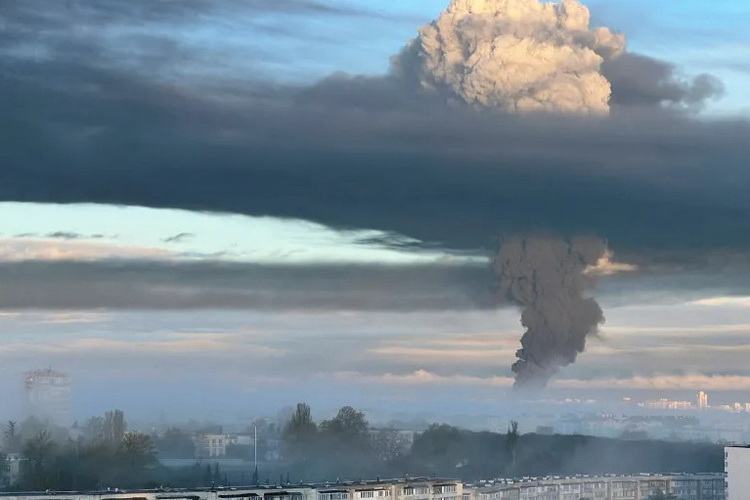 Russia blames drone attack for Crimea fuel depot blaze.
Source: Al Jazeera/ Reuters
Earlier it was said about the lack of transport vehicles for the delivery of fuel from producers to consumers. Why did this happen if there used to be plenty of them? Again, because of Russia’s war against Ukraine. To supply the Russian troops, both drivers and road and rail tanks are used. They also suffer losses. Because not only are they removed from the country’s economy, but they also do not come back. It is difficult to tell how many of them were lost by Russia. But in the spring of 2022 alone, hundreds of them were destroyed in the north of Ukraine. Videos of how this was done were shown in the media online.
Now the Russian orcs’s life is not easier. Especially after the Defense Forces of Ukraine’s systematic attacks on the Crimean bridge. Unfortunately, trains still run on it. However, very slowly and with great limitations. We all saw how fuel tanks burned on that bridge in October 2022. But then, after the Defense Forces of Ukraine destroyed more than twenty war ships and boats of the Black Sea Fleet, the latter probably doesn’t really need fuel anymore…
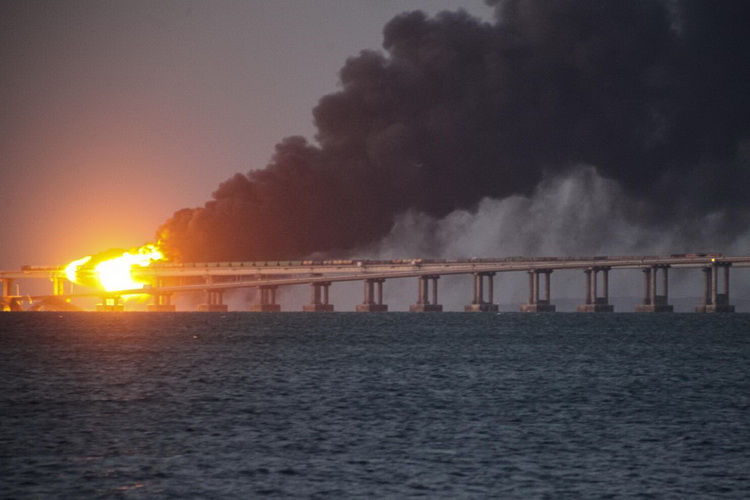 Blast on bridge to Crimea hurts Russian supply lines.
Source: Associated Press
Fuel shortages are also caused by mass theft. Those stocks that were in the Russian Armed Forces were largely stolen even before the war. Now, under the guise of war, Russian military logistics officers are plundering and selling it in even larger volumes. It is mainly bought by various transport companies and farmers. Fuel stolen from the army attracts them by its availability compared to civilian gas stations, where it is not available, plus the prices are lower than the market ones. Part of the fuel is used by consumers immediately, the rest is stored for the future. But fuel is still being withdrawn from the market.
The military write off the stolen fuel as combat losses and demand new supplies. Of course, they are given fuel, because the war in Russia is a priority. They have never minded the price there, especially when it’s done at the expense of ordinary citizens. The fuel does have its price as a commodity, but it is covered by the civilian market, because there are simply no other sources for the Russian army.
In this situation, the directors of refineries and oil depots, as well as commanders of military units where fuel is stored, are “vitally interested” in their facilities being attacked. This allows them to cover up abuses, write off shortages, and also receive illegal profit. Therefore, in many cases, they themselves imitate sabotage at refineries and oil depots, but in fact they carry it out themselves. No one pays attention to the damage it causes to the Russian troops themselves.
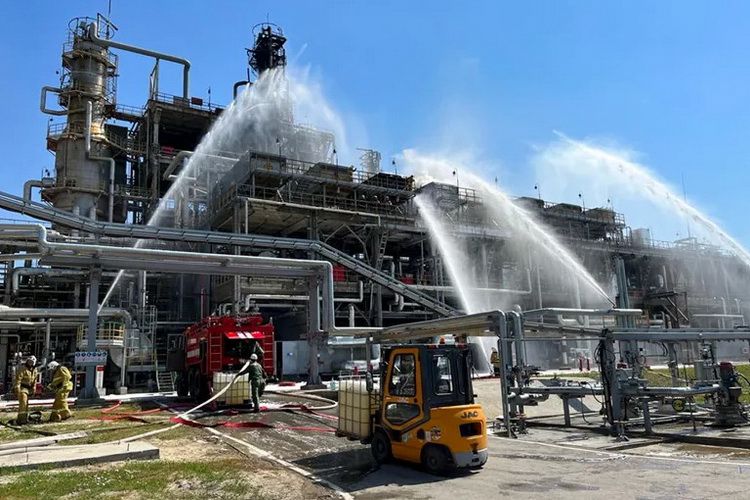 Russian Emergency Situation ministry’s firefighters work at the scene of a fire at the Novoshakhtinsk oil processing plant in the Rostov region.
Source: Al Jazeera/Russian Emergency Ministry/AP Photo
Russia is somehow trying to resolve these problems. The export of diesel fuel has been closed. While not long ago, it was one of the main sources of foreign exchange earnings of the Russian budget. Strange as it might seem, but now Russia is already importing fuel. Diesel fuel is supplied to Russia from Belarus, where there are still temporarily intact refineries. Oil is delivered there from the Russian Federation and returned back in the form of diesel fuel.
One way or another, the shortage of diesel fuel has already led to a number of extremely negative consequences for the Russian Federation. First of all, this concerns the lack of fuel throughout Russia, as well as the increase in prices for all goods and services. Significant difficulties arose in the work of transport companies. They cannot operate normally, and transportation stops throughout the country. There were difficulties with the delivery of military supplies to Crimea and other occupied territories of Ukraine. And this is one of the most significant results of the actions of the Defense Forces of Ukraine.


