
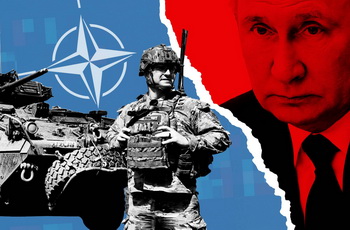
 Provocations As an Instrument of War
Ivan Sichen
The main feature of the current stage of the Russian-Ukrainian war is Ukraine’s interception of the operational-tactical initiative in most active sections of the front line where the Ukrainian counteroffensive is taking place. At the same time, Ukraine manages to deter Russians’ offensive actions in certain sectors of the front. One of the determining factors in Ukraine’s achievement of such success is political, economic and military assistance from the West. Each time it acquires new forms and scale. In turn, due to the long duration of the war and its negative consequences for Russia, it seeks to change the situation in its favor, increasing pressure on the West. Mainly moving to open military provocations in the north and southeast of Europe. At this, Russia demonstrates that it is ready for a direct armed clash with the United States and NATO. Thus, it raises the stakes in confrontation with Ukraine and the West, trying to force them to make concessions. Of course, this increases the threat of the war against Ukraine escalating into regional and larger-scale conflicts between Russia and the United States/NATO. At the same time, the use of a significant part of its military resources in the war against Ukraine does not allow Russia to effectively confront its Western adversaries.
|
…Russia raises the stakes in confrontation with Ukraine and the West, trying to force them to make concessions… |
Based on Russia’s political and historical experience, playing to raise the stakes instead of reaching compromises with opponents is a common practice for it. This is exactly the approach Moscow has been using since 2007 in its confrontation with the West. This is confirmed by Russia’s attacks on Georgia and Ukraine — countries that are at the center of contradictions between Russia and the United States/Europe.
However, while in the case of Georgia, Moscow did manage to achieve strategically important successes for itself (first of all, in terms of NATO’s refusal to offer the Membership Action Plan to Georgia and Ukraine), in the case of our country, Russia loses in all directions. And so it raises the stakes again, using traditional military-provocative methods.
As part of this practice, Russia has recently taken a number of dangerous demonstration steps. First of all, sending militants of the private military company “Wagner” to Belarus together with military equipment, as well as Moscow’s withdrawal from the Grain Deal, accompanied by threats to use military force against civilian ships that will go to Ukrainian ports without Russia’s consent.
|
…Russia has recently taken a number of dangerous demonstration steps. First of all, sending militants of the PMC “Wagner” to Belarus… |
Currently, there are about five thousand “Wagnerians” in Belarus, some of them are located on the border with Poland and Lithuania, including in the area of the so-called Suwalki Corridor. As you know, this corridor is the shortest route from the Grodno region of Belarus to Kaliningrad region of the Russian Federation, and runs along the border between Poland and Lithuania. It can become one of the main directions of attack of the Russian troops in case of a war between Russia and the United States/NATO.
In the border zone, PMC “Wagner” militants are actively involved in Russian-Belarusian provocations against Poland and Lithuania. So far, they are mainly limited to accumulating illegal migrants from Central and Southeast Asia in camps in Belarus and pushing them (with appropriate assistance) to forcefully break through the Polish and Lithuanian borders. Thus, attempts are being made to destabilize the situation in the adjacent areas of Poland and Lithuania, as well as to discredit them before the EU as those that “cannot stop the flow of illegal migrants to Europe”.
It is possible that more large-scale provocations may be committed, in particular, breakthroughs into Polish and Lithuanian territory of sabotage and reconnaissance groups (DRGs) consisting of mercenaries of PMC “Wagner” with the support of special services of Russia/Belarus and their border guard and military units. The aim of such provocations is to sharply aggravate the tension of the societies in Poland and Lithuania in order to increase pressure on their authorities for supporting Ukraine, as well as to divert the attention and resources of the two countries from the tasks of ensuring their own security.
At the same time, such a course of events will increase the threat of border conflicts between Belarus and Poland/Lithuania. The causes may be armed clashes on the border during breakthroughs of DRGs, as well as mutual accusations of shelling adjacent territories, aggressive intentions and plans or accumulation of troops to carry out aggression. Moreover, the self-proclaimed President of Belarus A. Lukashenko has repeatedly made provocative statements that the militants of PMC “Wagner” are able to “reach Warsaw and Vilnius in half a day”.
If the parties fail to resolve the problems politically, regional clashes may escalate and reach the level of the entire Baltic region with the use of not only forward units, but also the main troops of the countries participating in the armed confrontation. At this, it will involve both, Russia and Belarus, as well as the entire NATO bloc, which will help Poland and Lithuania under Article 5 of the North Atlantic Treaty.
|
…If Russia does not give up creating obstacles to freedom of navigation, a local conflict may reach the level of the entire Black Sea region… |
No less complicated is the situation in the Black Sea region. It is also the scene of hostilities between Russia and Ukraine. Thus, Moscow has deployed and maintains in full combat readiness the Black Sea Fleet, which performs tasks to conduct missile strikes on the territory of Ukraine and blockade its seaports.
The first of these tasks is partially implemented, although Ukraine is doing everything possible to counter the enemy. After its withdrawal from the Grain Deal, Russia began to actively attack port infrastructure and grain stocks in Ukraine. To a certain extent, Russia managed to achieve what it wanted. The infrastructure of our ports was significantly destroyed, more than 200 thousand tons of Ukrainian grain were destroyed. In response, Ukraine accelerated measures to build up air and missile defense in the region, and began active use of naval drones against the ships of the Black Sea Fleet. That is, the war between Russia and Ukraine in the Black Sea region is gaining new momentum, which leads to further tensions throughout the Black Sea region.
The situation regarding the Russian Black Sea Fleet’s implementation of the second of these tasks is somewhat different in nature. For example, the fleet’s commanders and warship’s captains do threaten to use weapons against civilian ships if they try to enter Ukrainian ports without prior permission from Russia. However, in reality, this is not being implemented, since the world would regard such actions as an act of international aggression, which would entail new sanctions. Besides, the circle of direct enemies of the Russian Federation will expand, which is not good for it.
However, Russia’s demonstration of these intentions can be considered another factor in complicating the situation in the Black Sea region. One way or another, however, the threat of the Russian Black Sea Fleet to attack civilian ships is quite serious. Shelling of civilian ships can be accidental, or deliberate — in order to demonstrate Moscow’s determination to achieve the desired.
In both of these options, the possibility of a local conflict between Russia and the United States/NATO, which already protects civilian ships, is not excluded. In particular, three civilian cargo ships of Greek, Israeli and Turkish-Georgian companies recently sailed to the Ukrainian port of Izmail. The passage of ships was monitored by the United States/NATO reconnaissance aircrafts and UAVs (NATO E-3A AWACS aircraft, US Navy P-8 patrol aircraft and US Air Force RQ-4 UAV). And in high readiness in Romania were NATO fighters, in particular, Italian Eurofighters and Romanian F-16s.
Accidental strikes by the Russian Black Sea Fleet on US/NATO ships and aircrafts are also quite possible, especially given the poor quality of Russian missiles, which can sometimes change the flight path without instruction. Finally, as Russia continues its war against Ukraine, Russian missiles and UAVs (or their fragments) periodically fall on the territory of NATO’s Black Sea countries. These countries may perceive such cases as an act of aggression, which will give another reason for a local conflict between Russia and the United States/NATO. At this, if the Russian Federation does not give up creating obstacles to freedom of navigation in the region and attracts additional forces to counteract the United States/NATO, the Alliance will have to take adequate measures in response, and a local conflict may reach the level of the entire Black Sea region. However, unlike the Baltic region, it will mostly involve the naval, air and missile forces of the parties, since they do not have direct land contact.
|
…Russia’s provocations in the Baltic and Black Sea regions can lead to local armed conflicts with the United States/NATO with their further reaching the regional levels… |
Thus, Russia’s provocations in the North-and South-East of Europe, and in fact — in the Baltic and Black Sea regions, can lead to local armed conflicts between it and the United States/NATO with their further reaching the regional levels. And this, again, will create the basis for a full-scale war, including with the use of missile and nuclear weapons. However, this option will not be considered yet, as Russia and the United States/NATO will try to avoid it, as it would threaten their existence. Therefore, let’s analyze the likely outcome of local and regional conflicts between Russia and the United States/NATO, taking into account the balance of forces of both sides.
Thus, in case of local armed conflicts on the Belarusian-Polish and Belarusian-Lithuanian borders, the parties may use in hostilities the following forces (not counting in border guards):
- Russia and Belarus, in each of the conflicts — two or three battalion tactical groups from PMC “Wagner” with the support of regular troops, including a divisional tactical group of barrel and rocket artillery, a helicopter squadron and a squadron (two or three flights) of tactical aircrafts, some special forces units. The use of PMC “Wagner” units as the main component of the troops participating in the conflict will allow Moscow and Minsk to absolve themselves of responsibility for its organization and shift it to alleged “gangs” that “act on their own initiative”;
- Poland and Lithuania, each in a conflict on its border — up to two brigade tactical groups from the national armed forces with the support of battalion tactical groups of barrel and rocket artillery, helicopter squadrons and tactical aviation squadrons (in the case of Lithuania — from the NATO Air Force), some special forces units. In addition, units of the NATO Response Force can be used.
These troops will allow Poland and Lithuania to localize border conflicts and prevent enemy breakthroughs into their territory. At the same time, Russia and Belarus may not stop there and send additional forces to conflict zones, which will cause further escalation. At the same time, border conflicts will develop into one single conflict of the regional level. During such a conflict, the armed forces of Russia and Belarus will act under a single command within the framework of the Regional Group of Forces of the Union State of the two countries. In turn, the armed forces of Poland and Lithuania will act as part of the NATO Allied Forces.
|
…In the North-East of Europe, NATO will outnumber Russia and Belarus almost threefold, and in terms of aviation — twice, which will actually guarantee the victory of the Alliance… |
The balance of forces between the parties (ground forces and aviation) can be roughly determined, taking into account the following considerations:
- according to different estimates, currently about 70 % of the Ground Forces and aviation of the Russian Aerospace Forces are involved in the war against Ukraine. Of the remaining 30 %, no more than a quarter may be used in the Baltic region, since the rest are supposed to protect Russian territory in the north, south and east. According to calculations, one division can be conditionally considered as three brigades;
- in the Western Military District of the Russian Armed Forces, there are five divisions and up to two separate brigades. In view of this, the Western Military District can allocate no more than five brigades to participate in a regional conflict with NATO;
- in the Central Military District, there were up to 10 brigades. At least 6 of them are fighting in Ukraine. Of the remaining, no more than one may be sent to the Baltic region;
- about 10 brigades were stationed in the Eastern Military District. That is, the District can also send no more than one brigade to the northwest of Russia;
- units of the coastal troops of the Northern Fleet (those that have not yet been sent to Ukraine) are fully involved to protect the Arctic zone of the Russian Federation, so they cannot actually allocate anything;
- the armed forces of Belarus consist of four brigades. All of them can be sent to participate in a regional conflict with NATO, which, in fact, is their main task. That is, the total potential of the Regional Group of Forces of Russia and Belarus, which can be used against the North Atlantic Alliance, is about 11 brigades;
- Currently, about ten tactical aviation regiments of the Russian Armed Forces have been destroyed in Ukraine. Of the remaining, no more than two or three can be used in the Baltic region. Taking into account the aviation of Belarus, this will be up to four or five regiments;
- NATO can counter Russia and Belarus with its full potential in northeastern Europe. Its main components are the Allied Multinational Corps Northeast, the V Corps of the United States Army, the multinational battlegroups of the Alliance, the national armed forces of Poland, Lithuania, Latvia and Estonia. In total, it is about 35 brigades;
- in the Baltic region, NATO tactical aviation from the armed forces of Poland, Germany, France, the United Kingdom, the Netherlands, the US Armed Forces in Europe and Allied Air Forces in the Baltic States can operate. In general, these forces can be conditionally counted as ten regiments.
Thus, within the framework of a possible conflict in the North-East of Europe, NATO will outnumber Russia and Belarus almost threefold, and in terms of aviation — twice, which will actually guarantee the victory of the Alliance. Especially taking into account the higher tactical and technical characteristics of Western weapons, as demonstrated by the Russian-Ukrainian war.
|
…NATO has a tangible advantage over Russia in the Black Sea region also, which guarantees it victory in the confrontation… |
As noted above, the local conflict in the Black Sea region will differ significantly both in form and in forces of the parties. In particular, both, Russia and the Black Sea member states of NATO can use in it one or two missile and patrol ships, two or three missile and patrol boats, a squadron of fighter-bombers.
Such a number of forces will allow the parties to conduct a series of naval and air battles of a small scale with small losses. However, Russia’s actual inability to replenish the Black Sea Fleet (due to Turkey’s closing the Bosphorus and Dardanelles Straits to Russian warships), as well as the need to preserve its potential for war against Ukraine, will force Moscow to completely or partially abandon creating obstacles to navigation.
In case of reaching the local conflict of a regional level (under the conditions that were considered earlier), the parties may use:
- Russia — three missile ships, up to 11 small missile ships and boats, four submarines, two or three units of anti-ship missile systems, up to four fighter and bomber regiments;
- NATO — a cruiser and two guided-missile destroyers (from the US Sixth Fleet), 5–6 frigates or patrol ships, 20–25 missile and patrol boats; 5–6 fighter and bomber regiments.
That is, the Alliance has a tangible advantage over Russia in the Black Sea region also, which guarantees it victory in the confrontation.
Calculations by nature are indicative and may differ slightly from the real balance of forces of the parties. Besides, they did not take into account the mobilization potentials of these countries and the USA’s ability to move troops from the continental part of the country to Europe. However, at least, the main indicators are determined.
Therefore, the above-mentioned circumstances allow us to draw the following conclusions.
|
…Russia is actually “bluffing” and in fact trying to avoid any direct armed clashes with its Western opponents… |
Leadership of the Russian Federation has finally realized the impossibility of overcoming Ukraine as long as the West provides it with political, economic and military assistance. In view of this, Moscow raises the stakes and tries to change the position of Western countries by organizing armed provocations in the Baltic and Black Sea regions, as well as demonstrating readiness for a direct military confrontation with the United States/NATO.
Moscow’s provocative activities increase the threat of local armed conflicts between Russia and the United States/NATO, which could escalate and reach the regional level. At the same time, today the West is noticeably superior to Russia in its military capabilities in these regions, since most of the Russian troops (except its nuclear component) are involved in the war against Ukraine. In this case, Moscow is actually “bluffing” and in fact trying to avoid any direct armed clashes with its Western opponents.
This situation once again demonstrates the role and importance of Ukraine as one of the main factors of Russia’s military deterrence, as well as influence on the balance and positioning of forces in Europe. Therefore, the West will never leave Ukraine without help, regardless of what provocations Moscow makes.


