
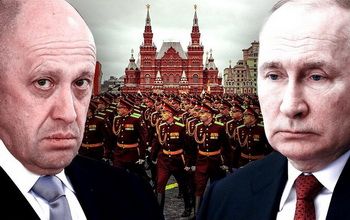
 What is happening in Russia and what should we expect next?
Ivan Sichen
In the context of Russia’s continuing full-scale war against Ukraine, the internal situation in the aggressor country is important for our state. It is on this situation that depends whether and in what forms Russia will be able to pursue its aggressive policy towards Ukraine in the future. Identifying such capabilities of Russia will allow Ukraine to make adequate decisions to counter the enemy.
So far, in this context, the most illustrative event was the demonstrative military-political action of the owner of the private military company (PMC) Wagner Yevgeny Prigozhin and the armed formations subordinate to him on June 23–24, 2023, which was called by the Russian leadership “an attempt of military coup and violent seizure of power” in the country.
The circumstances of the incident are well known. Therefore, we will not dwell on them. Instead, we will focus on the reasons for the open armed protest of Prigozhin and PMC Wagner against the ruling elite of the Russian Federation, along with determining the consequences of their actions for Russia and Ukraine. Assessments on these issues have also been repeatedly given by various politicians and experts. However, there are significant differences between them, and they themselves are rather ambiguous, which complicates the correct understanding of the situation.
So what is happening in Russia and what should we expect next?
First, let us analyze the main versions of the reasons for Prigozhin’s mutiny with the support of mercenaries of his PMC, which have already been cited in the information space of Russia, Ukraine and other countries. First of all, among them are mentioned:
- a sharp conflict between Prigozhin and the leadership of the Russian Ministry of Defense due to mutual accusations of failures at the front and attempts to attribute to themselves the achieved “successes”;
- intentions of the Russian state leadership and command of the RF Armed Forces to centralize the control and command of regular troops and armed formations of various private companies, which causes resistance of their owners;
- personal ambitions of Prigozhin, who sought and, obviously, continues to strive to raise his status in the Russian Federation to the level of its dictator or, at least, the head of the country’s power bloc, contrary to the interests of the current ruling elite;
- attempts of certain politico-oligarchic circles in the highest echelons of the Russian power to remove Putin, since his policy already directly contradicts their interests;
- Putin’s attempts to create a pretext for “purges” in his environment and ruling structures of Russia, as well as for strengthening the power vertical in the country.
All these versions may take place, testifying to modern Russian realities, no matter how bizarre they may seem to all normal people with common sense. Thus:
- there is indeed a sharp mutual hostility between Prigozhin and Russian Defense Minister Sergei Shoigu and Chief of the General Staff of the Russian Armed Forces Valery Gerasimov. Moreover, the contradictions of them concern not only their “successes” at the front and responsibility for failures in the course of hostilities, but also the struggle for financial and other resources allocated by the state for military purposes. The possibility of intersection of business interests of Prigozhin and the leadership of the Russian Ministry of Defense should not be excluded either. Moreover, on the eve of the Wagner revolt, they moved from mutual public brutal accusations to armed clashes between units subordinate to them;
|
…Prigozhin’s ambitions took the form of a “march of justice” to Moscow with all the signs of an armed insurrection… |
- Prigozhin’s ambitions really went beyond all reasonable limits, as shown by both his public speeches and ultimatum demands to the top state leadership of the Russian Federation regarding the change of command of the Russian Armed Forces and the extradition of Shoigu and Gerasimov to him. And those were still relatively moderate manifestations of Prigozhin’s character, although no one else could dare to do anything like that. Because no one had such a PMC that he had and with the military strength that it had. Thus, Prigozhin’s ambitions reached a qualitatively new level and eventually took the form of a “march of justice” to Moscow with all the signs of an armed insurrection. He no longer hid his goal to change power in the country. At this, Prigozhin and his militants not only resorted to seizing military facilities in the cities of Rostov-on-Don and Voronezh, where no one resisted them, but were not afraid to engage in armed clashes with Rosgvardia units that tried to impede their movement. They also shot down five helicopters and a plane of the Russian Armed Forces;
|
…Putin’s war against Ukraine really leads to more and more negative consequences for the Russian Federation… |
- Putin’s war against Ukraine really leads to more and more negative consequences for the Russian Federation and its political and oligarchic circles, which are losing their wealth due to Western sanctions. At the same time, this causes a deepening split in Putin’s environment and the ruling elite of Russia between those who demand the continuation of the “special military operation” in Ukraine to the “victorious end” and those who advocate the need to reach certain compromises with Ukraine and the West.
Both the former and the latter groups are dissatisfied with Putin and the leadership of the Russian Ministry of Defense, which can neither achieve decisive success in the war against Ukraine, nor move on to other — non-military methods of achieving Russia’s goals in relation to Ukraine. As a result, they are likely to look for ways to replace Putin with someone else who could take the situation out of the current impasse in one way or another. One of such ways could be to involve Prigozhin and his PMC in an attempt to carry out a military coup in the country and overthrow the Putin regime. Moreover, his actions were likely to be supported by a number of people from the top command of the Russian security forces, who are associated with Russian oligarchs and have armed units under their command. Close ties with a number of politicians and oligarchs were maintained by Prigozhin himself, which created favorable conditions for the implementation of such plans;
|
…The scale and high organization of the insurrection of Prigozhin and PMC Wagner exclude its spontaneousness… |
- Putin, as a former officer and head of state security service, as well as a person with a great experience in political intrigue and struggle, could not help knowing the facts of widespread dissatisfaction with his policy in the ruling elite of Russia and the possibility of a conspiracy against him. It was in order to fine out such conspirators and obtain grounds for their removal from power and big business that Putin could have organized a military coup controlled by him. In addition, it would have allowed him to accuse of inaction and change the leadership of the country’s security forces, which failed to implement his plans for a quick seizure of Ukraine without excessive negative consequences for the Russian Federation, personally for him and the oligarchs in his environment. At this, Putin could reach appropriate agreements with Prigozhin or use him in the dark through third parties. However, such an option is unlikely, since the situation could get out of Putin’s control, and the real development of events has already damaged his reputation;
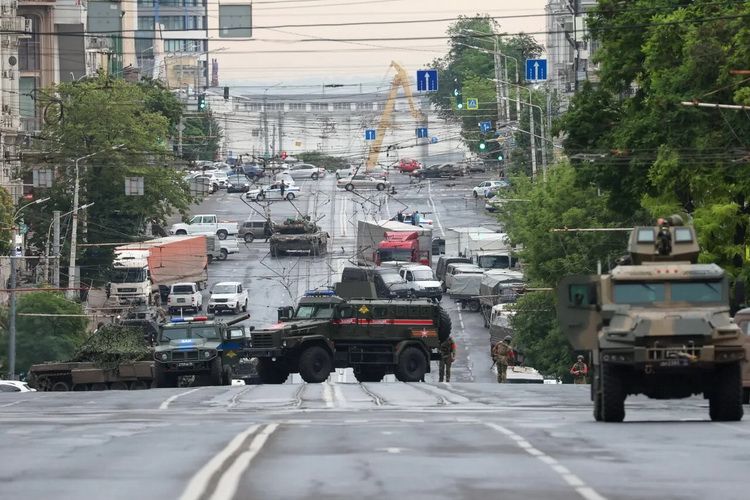
The leader of PMC Wagner Yevgeny Prigozhin on June 23 announced a demarche against the Russian military leadership, in particular against Russian Defense Minister Sergei Shoigu. According to him, Shoigu flew to Rostov-on-Don, where he personally conducted an operation to destroy the “Wagnerites”.
Source: Ukrinform
- the scale and high organization of the insurrection of Prigozhin and PMC Wagner exclude its spontaneousness. It was prepared by a certain group of people at the highest state level, and Prigozhin was only the executor of their plans.
Despite the different content of the aspects considered, they closely fit together, which allows us to make assumptions about the likely scenario of the situation around the coup attempt by Prigozhin and his PMC Wagner. Including:
|
…Most of the ruling elite and political-oligarchic circles in Russia have finally become convinced of Putin’s inability to ensure victory in the war with Ukraine… |
- after the actual failure of the offensive of the Russian Armed Forces, launched in early 2023, most of the ruling elite and political-oligarchic circles of Russia have finally become convinced of Putin’s inability to ensure victory in the war with Ukraine. Based on the understanding of this fact, a certain group of high-ranking officials and representatives of big business decided to remove Putin from power or create conditions for this by radically weakening his position. It is quite obvious that they also counted on the spread of anti-Putin moods in the Russian society due to the prolongation of the war and its negative consequences;
- as part of the practical implementation of the above-mentioned plan, there began preparations for a military coup, aimed at overthrowing the Putin regime or launching such a process. Prigozhin was chosen its main executor as a strong personality with big ambitions, who had a powerful military unit with combat experience and was not afraid to oppose the Russian Ministry of Defense, the Rosgvardia and even Putin himself. After achieving the goals of the military coup, Prigozhin could be brought to power or physically liquidated with his replacement by a more moderate politician. At the same time, work was carried out with representatives of the leadership of Russia’s security forces in the interests of persuading them to go over to the side of Prigozhin;
|
…Government troops began to build up resistance, which created the danger of a large-scale civil war in Russia… |
- upon completion of the preparatory measures, a number of resonant conflicts between Prigozhin and the high command of the Russian Armed Forces were provoked, which created a pretext for the start of a military coup on June 23. At the first stage, it was successful, showed support for the rebels by a significant part of the population, and also showed the inability of the Russian Armed Forces and the Rosgvardia to prevent the actions of the armed formations of PMC Wagner in the peripheral regions of the country. At the same time, as the “Wagnerites” were marching to Moscow, government troops began to build up resistance, which created a danger of a large-scale civil war in Russia with unpredictable consequences, including for the rebels themselves;
- given this threat, the leaders of the coup and representatives of Putin’s inner circle, who remained loyal to him, began negotiations with the mediation of the self-proclaimed President of Belarus Aleksandr Lukashenko. As a result, the well-known compromises were reached, which, on the one hand, provided for the return of PMC Wagner units to field camps, and on the other — the authorities’ promise not to prosecute them for participating in the coup. It was reported that the criminal case against Prigozhin was closed, and he himself was sent to Belarus.
Despite the alleged failure of the coup, it already has a number of significant consequences for Russia, Ukraine and the world, which may become even more acute. Thus:
|
…Despite the alleged failure of the coup, it already has a number of significant consequences for Russia, Ukraine and the world… |
- it clearly confirmed the lack of unity in Russian society, which not only did not rally around Putin’s regime, but began to reject it;
- a precedent has been created for the possibility of an armed coup against the current government of Russia without any consequences for its participants. It will certainly be repeated, since none of the problems that led to the PMC Wagner mutiny can be resolved without changing the ruling elite of the country;
- Putin’s regime is becoming weaker and losing leverage over the situation in Russia. This opens the way to the development of destructive processes in the country all the way up to its collapse. At the same time, the threat of civil war in Russia, disintegration of its economy, emergence of mass flows of refugees, as well as loss of arms control, including nuclear weapons by the Russian military command, are becoming quite real;
- the prospects of any negotiations with Putin’s authorities are completely crossed out, since they cannot guarantee their implementation. The same applies to hopes for the possibility of ending the war of the Russian Federation against Ukraine by political means;
- the personnel of Russia’s security forces are demoralized, which may affect their capability of fighting effectively on the front in Ukraine. Along with them, collaborators in the occupied Ukrainian territories are also demoralized. This facilitates the solution of the problem of restoring the territorial integrity of Ukraine.
In general, the processes taking place in Russia meet the interests of Ukraine. At the same time, we may face new problems associated with the likely collapse of the Russian Federation.
Author: Ivan Sichen, military expert, Colonel (retired).
|
On June 24, Prigozhin and a group of his supporters captured the headquarters of the Southern Military District in Rostov. When asked to withdraw the fighters from the territory of the headquarters, he refused, and then said that he was “going to Moscow”. On the evening of June 24, Prigozhin spoke with self-proclaimed President of Belarus Aleksandr Lukashenko. After that, he announced that he was turning the columns and going in the opposite direction, to the field camps. Russia will close the criminal case against him. He “will go to Belarus”, Russian presidential spokesman Dmitry Peskov said. What Prigozhin will do in Belarus, the Kremlin spokesman does not know.. |
Source: Gazeta.ua
The article is available in Russian


