
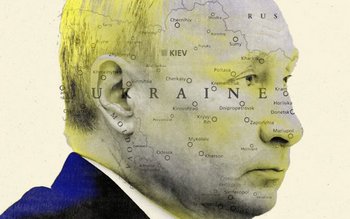
 Ivan Sichen
Achieving some progress in the negotiation process between Ukraine and Russia, as well as changes in the situation on the battlefront, raise an urgent question: what will happen next? First of all, it concerns the possibility of the war entering a new phase or its ending. It is difficult to answer this question due to the impossibility of unambiguously assessing the prospects for the development of the situation around our country. It depends on many factors of a political, economic and military nature. Therefore, we consider it expedient to analyze some options of further development of the situation.
In early April 2022, Ukraine defeated the troops of the invaders near Kyiv, Chernihiv and Sumy. Contrary to objective reality, Russia continues to call its defeat “the completion of the first stage of a special operation in Ukraine” and is trying to take revenge in the east and south of our country.
The intensification of the negative consequences of the war against Ukraine for the Russian Federation itself forces Moscow to look for ways out of the situation with minimal losses for its own interests. That is why the Kremlin agrees to negotiate with Ukraine on the terms of cessation of hostilities and reaching peace agreement.
At this, according to Ukrainian participants in the negotiation process, Moscow is gradually abandoning the tactics of ultimatums to Ukraine and is beginning to move to more pragmatic positions. Of course, this does not mean that Russia is giving up its strategic goals for Ukraine. Moscow is only changing the forms and methods of realizing its intentions, taking into account the failures of the first stage of the war against our state.
The aggressor’s plans and steps are significantly influenced by a number of circumstances, which include: Moscow’s lack of sufficient resources to replace the losses of Russian army and to capture all Ukrainian territory; the growing negative impact of Western sanctions on Russia’s economy; Ukraine’s maintaining sufficient potential to continue fierce resistance to the Russian fascist invaders.
Depending on the nature of the action of these factors and their consequences, it is possible to expect the following main scenarios (options) for further development of the situation around Russia’s war against Ukraine.
Scenario One – Russia will restore the combat capability of its troops withdrawn from Kyiv, Chernihiv, and Sumy regions, accumulate and replenish reserves, and launch a new offensive from the north and northeast directions. At this, Moscow will continue its offensive operations in other areas as well. All this will be accompanied by a tightening of Russia’s position in negotiations with Ukraine, including the issuance of all previous ultimatums, as well as additional demands for recognition of new self-proclaimed “republics” that Russia may establish in the temporarily occupied territories of Ukraine.
Such actions by Moscow will be aimed at “the final solution of the Ukrainian question” by the de facto destruction of Ukraine as an independent state. At the same time, the Kremlin will be able to demonstrate to its people a “victory over Ukraine”, which will boost Putin’s authority and his regime in Russia, and allow him to pursue a more aggressive policy in the post-Soviet space and toward the West.
However, resolving these issues will require significant military and economic resources from Russia to defeat the Ukrainian army, establish control over the occupied territories and counter Western sanctions.
Scenario Two – Russia will limit itself to continuing to establish full control over Luhansk and Donetsk regions, as well as seizing the southern territories of Ukraine, including Mariupol, Mykolaiv and Odesa regions, and parts of Kharkiv region. In addition, the Russian army will launch missile strikes on military and economic facilities and settlements throughout Ukraine. At the same time, the Russian leadership can agree to certain compromises during negotiations with Ukraine, in particular, limit itself to the requirements of our neutral status and non-deployment of strike weapons.
Russia’s main goals in this scenario will be: expanding Moscow-controlled Ukrainian territories, depriving our country of access to the Azov and Black Seas, as well as weakening our military potential and undermining our economy. Besides, as in the previous case, the Kremlin will be able to declare to its own population a “victory over Ukraine” and “achievement of the objectives of the special operation”.
Implementation of these plans will require less resources from Moscow than in the first scenario, however, – also quite significant. In addition, Russia will inevitably remain under pressure from US and EU sanctions.
Scenario Three – the Kremlin will agree to cease hostilities, liberate the occupied territories of Ukraine (except for Crimea, “DPR” and “LPR”) and return to the situation that existed before February 24, 2022. Demands to Ukraine will be similar to the second scenario.
Thus, Russia will try to achieve the lifting of Western sanctions and, at the same time, it will maintain control over Crimea and leverage over Ukraine through the self-proclaimed republics in the Donbas. As a result, Moscow will be able to get out of the war with Ukraine in some way, but will have to make much more efforts to explain to the Russian population the failure of the attack on Ukraine.
Today, Moscow’s intentions to implement the second of the considered scenario are quite obvious. In particular, evidence of this is Russia’s measures to restore the combat effectiveness of its troops who took part in hostilities in the north of Ukraine, and their concentration in the Donbas direction.
At this, the Russian leadership is counting on the ability of the Russian economy to withstand the sanctions of the United States, the European Union and their partners. Especially when they are not fully implemented by some European countries. Not to mention that Germany, Austria, Hungary and some other members of the European Union do not want to give up Russian energy at all.
However, according to financial and economic experts, Russia will completely lose the ability to counter Western sanctions in a few months – by the end of April 2022, to be exact. Approximately for this period – until May 9, 2022 – Moscow expects to win at least some victory in Ukraine. Although, it is unlikely to be able to do so, even with additional reserves from the RF’s Far East.
So, most likely Russia will be forced to move to the third scenario, or at least it will demonstrate such an opportunity. Besides, Moscow can promise Ukraine “guarantees of its security”. However, in any case, such “guarantees” will mean nothing. Experience shows that no agreement with Moscow is worth the paper on which it is signed.
Even in the case of concluding a peace treaty between Russia and Ukraine, after its military losses’ replacement, Moscow will again resort to aggression against our state. Russia’s goals towards Ukraine will remain unchanged, regardless of who is in power in the Kremlin. Therefore, the only guarantee of Ukraine’s security can only be its army and other security forces.


